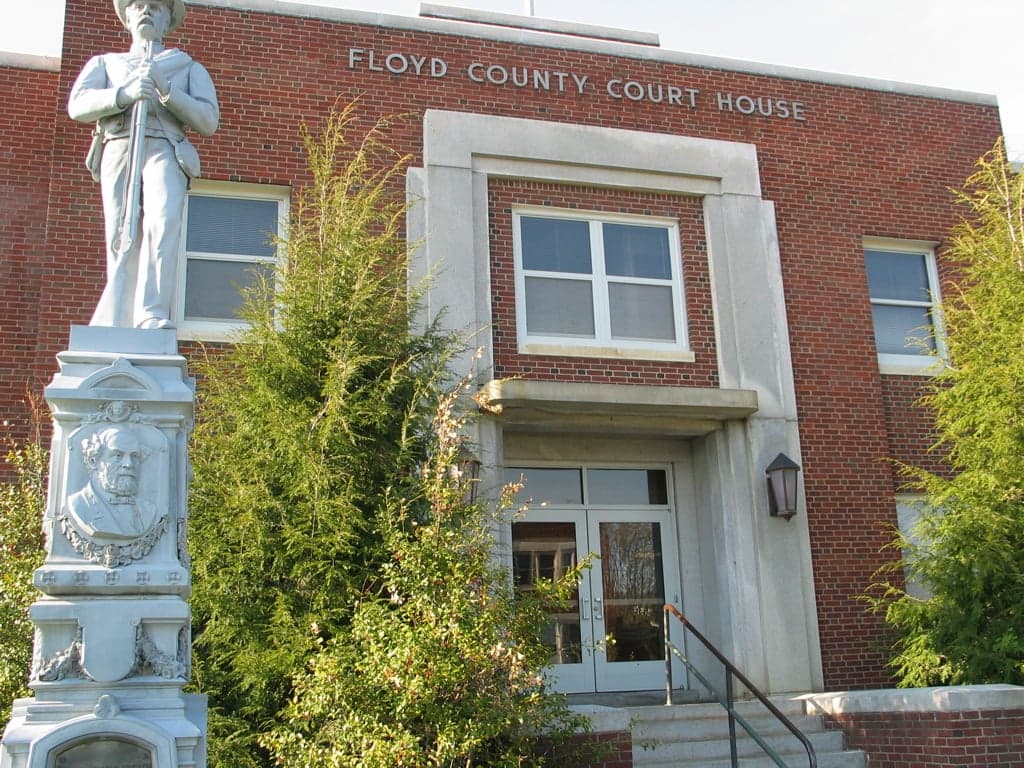

Photo: Wikipedia
Political ClimatePolitical Climate in Floyd County
Showing district-level results — no local-only data available.
Local Political AnalysisPolitical Analysis of Floyd County
Floyd County, Virginia, is a deep-red outlier in a state that has shifted blue in recent years. With a Cook Partisan Voting Index (PVI) of R+22, it stands in stark contrast to Virginia’s statewide PVI of D+4, making it one of the most reliably Republican counties in the commonwealth. This isn’t a recent development—the county has voted Republican in every presidential election since 2000, often by margins exceeding 60%. But the political reality here is more textured than a single number suggests, especially when you look at the difference between the county seat of Floyd and the surrounding rural areas.
How it compares
The gap between Floyd County and Virginia as a whole is enormous. While the state has trended Democratic—driven by growth in Northern Virginia, Richmond, and Hampton Roads—Floyd County has held steady or even moved slightly right. In the 2020 presidential election, Donald Trump won Floyd County with 72.8% of the vote, while Joe Biden took just 25.7%. That’s a 47-point spread, compared to Biden’s 10-point statewide win. The contrast is even sharper when you look at the town of Floyd itself, which is a small liberal island in a red sea. Precincts within the town limits often split closer to 50-50 or even lean Democratic, thanks to a mix of artists, retirees, and younger transplants drawn to the area’s music scene and mountain views. Drive just five miles out to the county’s rural precincts like Check or Willis, and you’ll see Republican margins of 80% or higher. The swing precincts are essentially nonexistent—most voters here are deeply entrenched in their party affiliation.
What this means for residents
For conservative residents, Floyd County feels like a stronghold in a state that’s slipping away. Local offices—from the Board of Supervisors to the School Board—are overwhelmingly held by Republicans, and policy debates tend to focus on property rights, gun access, and keeping taxes low. The county’s Republican committee is active and well-organized, and you’ll see Trump signs on lawns year-round, not just during election season. For liberal residents, the reality is more isolating but not hostile. The town of Floyd provides a social and cultural refuge, with its Friday Night Jamboree, the Floyd Country Store, and a growing community of organic farmers and artisans. But outside town, progressive views on issues like climate policy or social justice are rarely voiced in public. Most liberals here have learned to navigate conversations carefully, especially in more traditional settings like church or the local feed store. The county’s political lean means that statewide Democratic initiatives—like expanded voting access or environmental regulations—often face local resistance or outright noncompliance.
Culturally, Floyd County’s politics are wrapped up in a fierce independence that predates modern partisan labels. The area has a long tradition of self-reliance, rooted in its Appalachian heritage, and that translates into a deep skepticism of both Richmond and Washington. You’ll find libertarian streaks among both Republicans and Democrats here, especially on issues like land use and local control. The county’s decision to remain a “dry” county (no alcohol sales outside of restaurants) until 2016, and its ongoing debates about short-term rentals and solar farms, reflect a community that wants to decide its own future. For newcomers, the key is understanding that political labels matter less than relationships—your neighbor might vote differently, but they’ll still help you fix a fence or pull your truck out of a ditch. That’s the Floyd County way, and it’s unlikely to change anytime soon, even as the state around it keeps shifting.

State Political ClimatePolitical Climate in Virginia
State Political AnalysisPolitical Environment in the State
Virginia has shifted from a reliably competitive swing state to a solidly Democratic-leaning one over the past two decades, carrying a Cook PVI of D+4. The transformation is driven almost entirely by explosive growth in the Washington, D.C. suburbs, particularly in Northern Virginia, which now dominates statewide elections. While the state still elects a Republican governor (Glenn Youngkin in 2021) in off-year cycles, Democrats have won every presidential election here since 2008 and control both chambers of the General Assembly as of 2026. For a conservative relocator, the reality is a state where your vote matters most in local and primary races, but statewide outcomes are increasingly determined by the urban crescent from Alexandria to Richmond.
Urban vs. rural divide
The political map of Virginia is a study in stark contrasts. The Democratic stronghold is the "Urban Crescent" — Northern Virginia (Arlington, Alexandria, Fairfax, Loudoun, Prince William), the Richmond metro area, and the Hampton Roads cities (Norfolk, Virginia Beach, Newport News). Fairfax County alone, with over 1.1 million residents, delivers a Democratic margin larger than the entire Republican vote in many rural districts. Meanwhile, the rest of the state — Southside Virginia, the Shenandoah Valley, and Southwest Virginia — votes overwhelmingly Republican. Places like Roanoke and Lynchburg are conservative anchors, with Lynchburg home to Liberty University and a deeply evangelical base. The divide is so sharp that a candidate can win the governorship by sweeping the suburbs while losing 90+ of the state's 133 counties. The 2021 gubernatorial race saw Youngkin win by flipping Virginia Beach and Chesapeake back to the GOP column, but those gains were erased in the 2023 legislative elections as suburban voters returned to Democrats over abortion rights.
Policy environment
Virginia's policy landscape is a hybrid that reflects its purple-to-blue trajectory. The state income tax is a flat 5.75% (down from 5.75% in 2023 after a phased reduction), and the sales tax is 5.3% (higher in some localities). Property taxes are set locally and are generally moderate, though Northern Virginia rates are elevated. The regulatory posture is business-friendly in many respects — Virginia has a right-to-work law and consistently ranks in the top 10 for business climate by CNBC and Forbes. However, the state has moved left on social policy: it expanded Medicaid in 2019 under a bipartisan deal, and the 2020 General Assembly passed a sweeping package of gun control measures including universal background checks, a red flag law, and a one-handgun-per-month limit. Education policy is a flashpoint: Youngkin pushed for "parental rights" and banned critical race theory from K-12 curriculum, but local school boards in blue areas largely ignored the directives. Election laws are moderately accessible — no-excuse absentee voting and same-day registration are available, but voter ID is required. Virginia does not have a sanctuary state law, but several cities including Richmond and Alexandria have declared themselves sanctuary cities, creating tension with state law.
Recent policy direction
The last five years have seen Virginia lurch leftward on most fronts, with some conservative wins under Youngkin. On gun and self-defense law, the 2020 package was the most significant shift in decades: the red flag law allows police to seek temporary removal of firearms from individuals deemed a threat, and the one-handgun-per-month rule restricts bulk purchases. Virginia is a shall-issue state for concealed carry, but permitless carry was rejected by the Democratic legislature in 2024. On parental and education rights, Youngkin's executive orders on "inherent parental rights" and his model policies on transgender students (requiring parental notification and restricting bathroom access) have been tied up in court. The 2024 General Assembly passed a law requiring schools to adopt policies on cellphone-free classrooms, a bipartisan win. On medical and bodily autonomy, Virginia has become a regional abortion access hub: the 2020 Reproductive Health Protection Act removed many restrictions, and the 2023 constitutional amendment to protect abortion rights was proposed but not yet passed. On property rights, Virginia has strong eminent domain protections after the 2005 Kelo backlash, but localities in Northern Virginia have aggressively used zoning powers to mandate affordable housing. On taxation, the 2023 budget cut the corporate tax rate from 6% to 5% and increased the standard deduction, but the overall tax burden remains moderate. On voting and ballot access, the 2021 Voting Rights Act (state-level) expanded language assistance and early voting, but voter ID remains in place.
Civil unrest & political movements
Virginia has been a stage for some of the most visible political flashpoints in the country. The 2017 Unite the Right rally in Charlottesville — which turned violent and left one counter-protester dead — remains a scar on the state's psyche and a symbol of far-right organizing. Since then, the state has seen organized activist movements on both sides. On the left, Indivisible chapters in Northern Virginia and the Richmond chapter of the NAACP have been highly effective at mobilizing voters and lobbying the General Assembly. On the right, the Virginia Citizens Defense League (VCDL) organized massive pro-gun rallies at the state capitol in 2020, drawing tens of thousands of armed protesters. Immigration politics are less heated than in border states, but the sanctuary city declarations in Arlington and Richmond have drawn conservative backlash, and Youngkin's 2023 executive order requiring local cooperation with ICE was largely symbolic. Election integrity controversies flared after 2020, with Republican activists challenging ballot drop boxes and mail-in voting procedures, but no widespread fraud was ever documented. The 2024 presidential election saw Virginia's results certified without major incident, though the state's 13 electoral votes went to the Democratic candidate by a comfortable margin.
Projection
Over the next 5-10 years, Virginia's Democratic lean is likely to deepen, not reverse. The key driver is demographic: Northern Virginia continues to grow faster than the rest of the state, adding highly educated, diverse, and left-leaning residents. The Loudoun County school board battles of 2021-2023, which saw conservative parents win seats only to lose them in the next cycle, suggest that even suburban backlash is temporary. The rural population is aging and shrinking, meaning the GOP's base is eroding. However, the state's off-year election cycle (governor and legislature elected in non-presidential years) creates a persistent opportunity for Republicans if they can turn out their base and win over moderate suburbanites on economic issues. The 2025 gubernatorial race will be a key test: if a Democrat wins, the state's blue shift will be cemented; if a Republican wins, it will signal that Virginia remains competitive in state-level races. For a relocator, expect a state where the policy environment will continue to move left on social issues (abortion access, LGBTQ rights, gun control) but remain moderate on economics (low taxes, business-friendly). The wildcard is the federal workforce: if the next administration cuts D.C. jobs, Northern Virginia's growth could slow, potentially rebalancing the political map.
For a conservative relocator, Virginia offers a mixed bag. You'll find strong communities in Roanoke, Lynchburg, and the Shenandoah Valley where your values are the local norm, and you'll have a Republican governor who can veto the worst of the legislature's excesses. But you'll also live in a state where your vote for president or U.S. Senate is almost certainly going to be in the minority, and where the state-level policy direction is increasingly set by the D.C. suburbs. If you're looking for a state where your vote reliably moves the needle in statewide races, you'd be better off in North Carolina or Georgia. If you're willing to accept that reality and focus on local politics — school boards, city councils, and county supervisors — Virginia remains a place where conservatives can win and make a difference, especially outside the Urban Crescent. The bottom line: Virginia is a blue state with a red governor, and that tension is likely to persist for the foreseeable future.
* Values derived from national, state, county, city and local statistics and may differ in a specific area. Last updated: 2026-10-20T09:03:01.000Z
Narrative content on this page is AI-generated and may contain mistakes. Verify any details that matter before acting on them.
ReloMaps may earn a commission from affiliate links at no extra cost to you.

