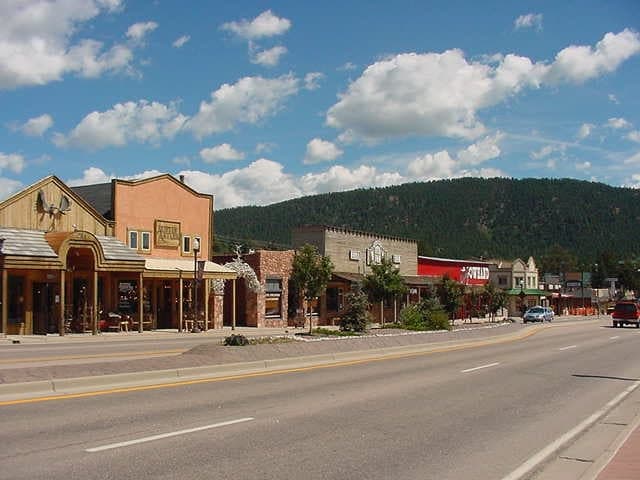
Photo: Wikipedia
Political ClimatePolitical Climate in Woodland Park, CO
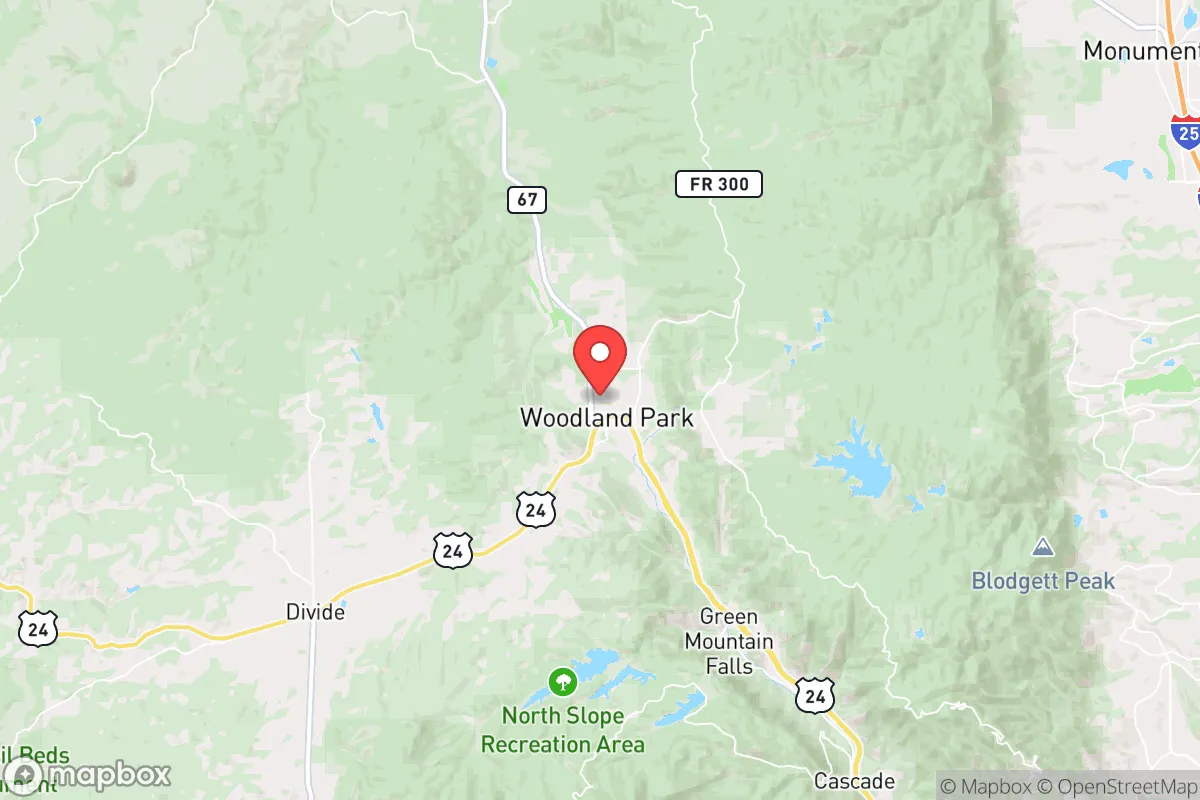
District shown is the primary district for this city’s centroid. Cities may span multiple districts.
Local Political AnalysisPolitical Analysis of Woodland Park, CO
Woodland Park has a Cook PVI of D+8, which means it leans significantly more Democratic than the national average. That’s a big shift from what this town used to be. I’ve been here long enough to remember when it was a solidly conservative mountain community, where folks minded their own business and the biggest political debates were about elk hunting seasons and school board budgets. Now, you’re seeing a steady influx of people from Colorado Springs and even Denver, and with them comes a different set of priorities. The trajectory is clearly toward progressive policies, and that’s something a lot of us who value personal freedoms are watching closely.
How it compares
To really understand Woodland Park’s politics, you have to look at the surrounding area. Drive 20 minutes east down Highway 24, and you hit Colorado Springs, which is a conservative stronghold with a Cook PVI of R+16. The contrast is stark. Up here in the mountains, we’re seeing more support for things like expanded government programs and stricter environmental regulations that can feel like overreach. Compare that to places like Divide or Florissant, which are still very much “live and let live” communities. Even within Teller County, Woodland Park is the outlier. The county as a whole voted for Trump in 2020, but the city itself is trending blue. It’s a real split personality for the area.
What this means for residents
For those of us who value limited government, the practical effects are already showing up. You’re seeing more local ordinances that feel like they’re creeping into daily life—things like stricter noise regulations, more permitting requirements for home businesses, and a general push toward “community standards” that can feel a lot like government overreach. Property taxes are also a concern, as the progressive push for more public spending often means higher levies. If you’re someone who likes to keep your own schedule, run a small shop out of your garage, or just not have the county telling you what you can do on your own land, these shifts are worth paying attention to. The long-term trend suggests more of the same, especially as the population grows.
One of the biggest cultural distinctions here is the tension between the old-timers and the newcomers. Woodland Park used to be a place where you could get a building permit with a handshake and a smile. Now, there’s a whole planning department. There’s also a noticeable push for more “green” initiatives, like electric vehicle charging stations and bike lanes, which sound nice but often come with mandates and fees that hit small businesses and homeowners hardest. If you’re moving here from a more progressive area, you might not notice it. But if you’re a long-time resident, you feel the squeeze. The near future looks like more of the same—more regulation, more taxes, and a slow erosion of the independent spirit that made this town special. Keep an eye on the city council elections; that’s where the real fight is happening.

State Political ClimatePolitical Climate in Colorado
State Political AnalysisPolitical Environment in the State
Colorado has shifted from a classic purple swing state to a reliably blue stronghold over the past two decades, with Democrats now controlling the governorship, both U.S. Senate seats, and both chambers of the state legislature. The state voted for Hillary Clinton by 5 points in 2016, Joe Biden by 13 points in 2020, and Kamala Harris by roughly 11 points in 2024, reflecting a durable leftward tilt driven overwhelmingly by the Denver-Boulder-Aurora metroplex. For a conservative considering relocation, the state’s political trajectory is a cautionary tale of how rapid in-migration and demographic change can flip a once-balanced state into a one-party progressive laboratory.
Urban vs. rural divide
The political map of Colorado is a stark story of two Colorados. The Front Range urban corridor—Denver, Boulder, Aurora, Fort Collins, and Colorado Springs—contains over 80% of the state’s population and votes overwhelmingly Democratic. Denver County itself gave Biden 80% of the vote in 2020, while Boulder County hit 78%. Colorado Springs, home to the Air Force Academy and a large military presence, is the only major city that leans Republican, but even it has been trending purple as younger tech workers move in. Meanwhile, the Eastern Plains, Western Slope, and San Luis Valley remain deeply red: counties like Elbert, Lincoln, and Kit Carson routinely vote 70-80% Republican. The rural-urban divide is so pronounced that the state’s 3rd Congressional District, which covers most of the Western Slope and southern Colorado, flipped from Republican to Democrat in 2022 after redistricting, then back to Republican in 2024—a microcosm of the constant tug-of-war. The key takeaway: if you live in or near Denver, your vote is effectively drowned out by the urban machine; if you’re in rural Colorado, you’re politically isolated but culturally aligned with the state’s conservative heritage.
Policy environment
Colorado’s policy environment has become a showcase of progressive governance, with consequences for personal freedom and economic liberty. The state income tax rate was cut from 4.63% to 4.4% in 2020 under Proposition 116, but property taxes have surged—especially in Denver and Boulder counties—due to rapid valuation increases and a 2023 law that capped assessment rate reductions, effectively raising tax bills for homeowners. The regulatory climate is hostile to energy development: the 2019 SB 19-181 law gave local governments veto power over oil and gas drilling, effectively banning new wells in many Front Range counties. Education policy is dominated by the teachers’ unions, with school choice limited compared to states like Arizona or Florida—Colorado’s charter school law is middling, and the state has resisted universal school choice expansion. Healthcare is heavily regulated, with a state-run reinsurance program that has stabilized premiums but done little to lower out-of-pocket costs. Election laws are among the most convenient in the nation: universal mail-in ballots, same-day registration, and automatic voter registration have made Colorado a top-5 state for voting access, but critics argue this undermines election integrity—especially after the 2020 election saw widespread use of ballot drop boxes with minimal chain-of-custody oversight. For a conservative, the policy environment feels like a slow-motion erosion of local control, fiscal restraint, and parental rights.
Trajectory & freedom
Colorado is becoming less free by nearly any measure of personal liberty. The most glaring example is gun rights: in 2013, the state passed universal background checks and a 15-round magazine limit (HB 13-1224), and in 2023, Democrats passed a red flag law (HB 23-1219) allowing courts to temporarily seize firearms from individuals deemed a risk—without a criminal conviction or due process hearing. Parental rights took a hit in 2023 with the passage of HB 23-1108, which requires school districts to adopt policies that allow students to use facilities and participate in activities consistent with their gender identity, overriding parental notification. Medical autonomy has been constrained by the state’s strict vaccine mandates for healthcare workers and schoolchildren, though COVID-era mandates have largely expired. Property rights are under assault from a 2021 law (SB 21-260) that allows local governments to impose rent control on mobile home parks, and from a 2023 law that requires landlords to accept Section 8 vouchers, effectively limiting a property owner’s right to choose tenants. On the positive side, Colorado voters passed Proposition 115 in 2020, which would have banned late-term abortions after 22 weeks—but it was struck down by the state supreme court, and the legislature has since codified abortion access into law. The trajectory is clear: the state legislature is on a multi-year binge of expanding government control over personal decisions, from what you can own to how you raise your kids.
Civil unrest & political movements
Colorado has seen its share of political flashpoints. The 2020 George Floyd protests in Denver turned violent, with looting and fires in the downtown area, and the city’s defund-the-police movement led to a 2021 budget cut of $8.4 million from the police department—though most was later restored. The state has become a battleground over immigration: Denver has a sanctuary city policy that limits cooperation with ICE, and in 2023, the city spent over $40 million on shelter and services for migrants bused from Texas, straining local resources and sparking backlash. The secession movement is alive and well in rural Colorado: in 2013, 11 counties on the Eastern Plains voted to secede and form the proposed state of “North Colorado,” though the effort fizzled without legislative approval. Election integrity remains a hot-button issue: in 2022, a Mesa County clerk was indicted for allegedly allowing unauthorized access to voting machines, and the state’s universal mail-in system continues to draw skepticism from conservatives who worry about ballot harvesting and signature verification. Organized activist groups on the right, such as the Colorado Republican Party and local Moms for Liberty chapters, are active but outspent and out-organized by left-leaning groups like Indivisible and the Colorado Democratic Party. A new resident will notice the political tension most acutely in suburban school board meetings, where fights over curriculum, library books, and transgender policies have become routine.
Projection
Over the next 5-10 years, Colorado will likely continue its leftward drift, but with potential for a partial correction. The state’s population growth is slowing—it grew just 1.8% from 2020 to 2024, down from 7.2% in the previous decade—and the in-migration is increasingly from blue states like California and Illinois, reinforcing the progressive tilt. However, there are signs of a ceiling: the 2024 election saw Republicans flip the 3rd Congressional District and hold the 5th and 8th, suggesting the GOP is not dead in Colorado. The state’s housing crisis, driven by restrictive zoning in Denver and Boulder, is pushing young families to exurbs like Castle Rock, Parker, and Windsor—areas that lean red and could become political counterweights. If the state legislature continues to overreach on issues like property taxes, energy bans, and parental rights, a backlash could materialize in the 2026 and 2028 elections, similar to what happened in Virginia after 2021. But for now, the structural advantage for Democrats—thanks to the Front Range population concentration and the state’s generous mail-in voting system—makes a full reversal unlikely. A conservative moving to Colorado today should expect to live in a state where their vote is marginalized, their values are legislated against, and their best bet is to settle in a red-leaning county like Elbert, Douglas, or Weld and engage in local politics to slow the damage.
For a new resident, the bottom line is this: Colorado offers stunning natural beauty, a strong economy, and a high quality of life, but it comes with a political price tag. If you’re a conservative, you’ll be a minority voice in a state that is increasingly hostile to your views on guns, education, and parental rights. Your best strategy is to choose your county wisely—Douglas County (Castle Rock) and Elbert County (Kiowa) are the most reliably red and have strong school choice options—and to get involved in local elections, where your vote still matters. Colorado is not lost, but it’s in a fight, and the outcome will depend on whether conservatives show up to the ballot box and the school board meetings. If you’re looking for a state where your political values are the norm, you might be happier in Texas or Florida. But if you’re willing to be a political minority in exchange for world-class skiing, hiking, and a booming job market, Colorado can still work—just know what you’re signing up for.
* Values derived from national, state, county, city and local statistics and may differ in a specific area. Last updated: 2026-04-29T00:34:54.000Z
Narrative content on this page is AI-generated and may contain mistakes. Verify any details that matter before acting on them.
ReloMaps may earn a commission from affiliate links at no extra cost to you.

