Photo: Wikipedia
Demographics of Maui County
Affluence Level in Maui County
A middle-class area roughly in line with national averages across income, home values, education, and employment.
People of Maui County
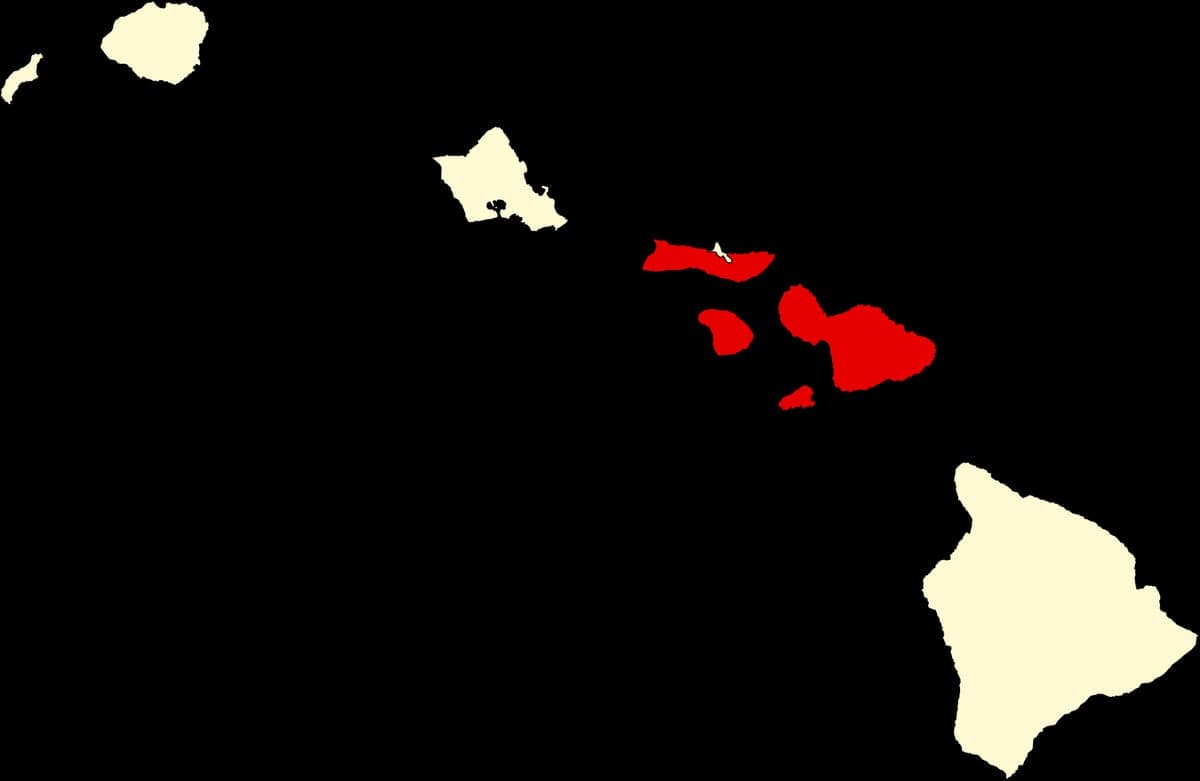
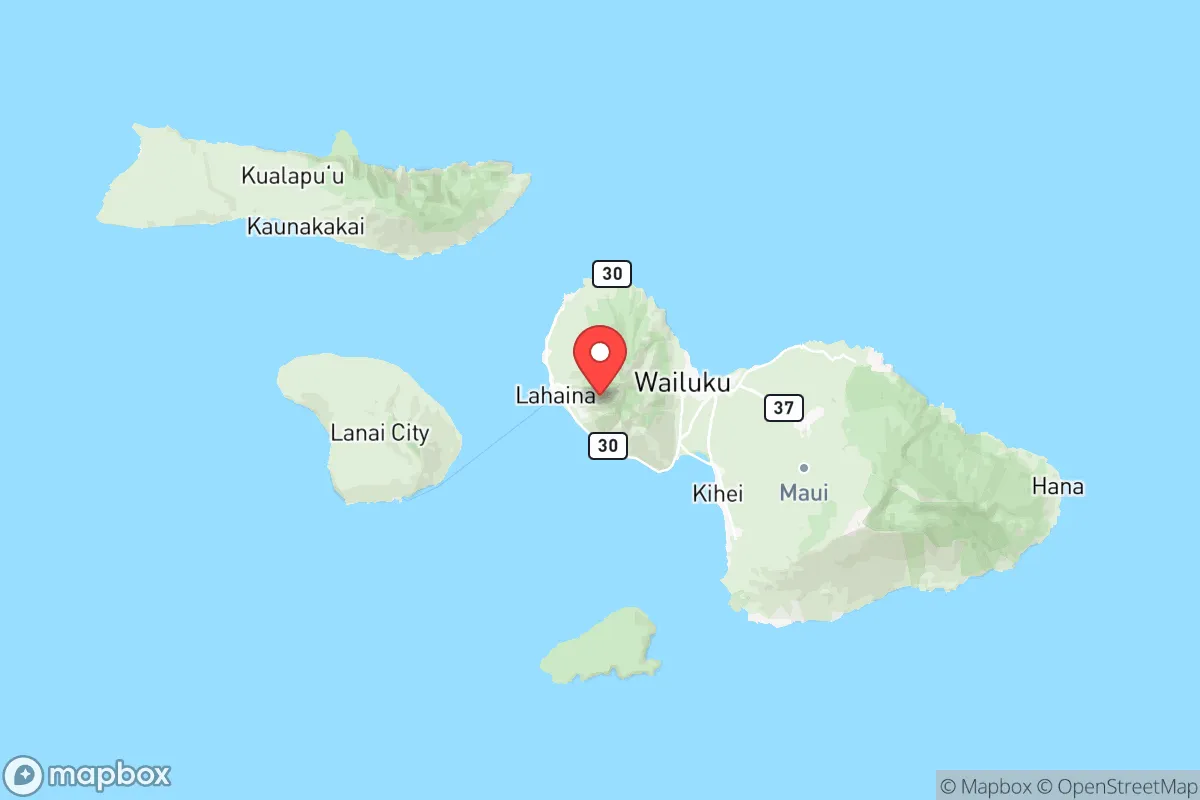
Maui County’s 164,632 residents form a uniquely multiethnic society where no single group holds a majority—29.4% White, 27.7% East and Southeast Asian, 10.5% Hispanic, and 0.7% Black, with a small Indian-subcontinent population of 0.1%. The county’s population is concentrated along the coastal corridor from Kahului to Kihei and in the historic whaling port of Lahaina, with a distinctive local identity rooted in plantation-era ethnic mixing and a modern economy driven by tourism and remote work. Only 7.6% of residents are foreign-born, a relatively low share for a Pacific island county, reflecting the deep generational roots of most families. The population is notably older and less transient than Hawaii’s urban core on Oahu, with a strong sense of place among Native Hawaiian, Asian, and haole (White) communities alike.
Settlement & growth (pre-1960)
The original inhabitants of Maui County were Polynesian voyagers who arrived from the Marquesas Islands around 500–800 AD, followed by a second wave from Tahiti around 1000–1200 AD. These settlers established a complex chiefdom society across the islands of Maui, Molokai, and Lanai, with major settlements at Lahaina (the royal capital of the Maui kingdom), Hana, and the sheltered bays of Kihei and Wailea. The population before Western contact is estimated at 30,000–50,000, but introduced diseases—smallpox, measles, and tuberculosis—reduced the Native Hawaiian population by over 80% within a century of Captain James Cook’s arrival in 1778.
The first permanent Western settlement began with Protestant missionaries from New England who arrived in Lahaina in 1823, establishing churches, schools, and a written Hawaiian language. Lahaina became the capital of the Hawaiian Kingdom under King Kamehameha III from 1820 to 1845, and the town grew as a whaling port—by the 1840s, it hosted 400 whaling ships per season, drawing American, British, and European sailors who often stayed and intermarried. The 1848 Mahele land reform allowed foreigners to purchase land, and by the 1850s, sugar plantations began transforming the landscape, particularly in the central Maui plains around Wailuku and Kahului.
The sugar industry drove Maui’s most consequential demographic shift: the importation of contract laborers from Asia. Between 1868 and 1900, Japanese workers arrived in large numbers, settling in plantation camps around Puunene, Paia, and Spreckelsville. Chinese laborers followed from the 1870s, many later opening stores and restaurants in Wailuku and Lahaina. Portuguese immigrants from Madeira and the Azores came between 1878 and 1913, establishing communities in Kula and Makawao on the cooler slopes of Haleakala. Filipino laborers arrived in waves after 1906, concentrating in the sugar and pineapple fields of Kahului, Kihei, and the Molokai plantations. By 1920, Maui’s population was roughly 40% Japanese, 20% Native Hawaiian, 15% Portuguese, 10% Chinese, 10% Filipino, and 5% White—a pattern of ethnic segmentation that persisted for decades.
The pineapple industry, dominated by the Baldwin and Cooke families, expanded on Lanai and Molokai after 1920. Lanai was essentially a company plantation town until 1961, with a workforce that was predominantly Filipino and Japanese. Molokai’s Kalaupapa peninsula became a forced settlement for Hansen’s disease (leprosy) patients from 1866 to 1969, housing up to 1,200 residents at its peak, including the famous Father Damien. The post-World War II period saw gradual suburbanization around Kahului, which was rebuilt after a devastating 1946 tsunami, and the first resort development at Kaanapali in the 1950s.
Modern era (post-1965)
The 1965 Hart-Cellar Act ended national-origin quotas and reshaped Maui’s immigration patterns, though the county’s foreign-born share remained modest compared to mainland metros. The most significant post-1965 immigrant group has been Filipinos, who now form the largest Asian subgroup on Maui, with strong communities in Kahului, Wailuku, and the Kihei area. Many arrived through family reunification after the 1965 act, working in hotels, construction, and healthcare. A smaller but notable wave of Chinese immigrants from Hong Kong and Taiwan arrived in the 1980s and 1990s, often as investors in hotels and retail, settling in Wailea and Kihei.
Domestic migration reshaped Maui more dramatically than foreign immigration. The jet age and the rise of mass tourism after 1960 transformed the economy: Kaanapali Resort opened in 1962, Wailea Resort in 1971, and Kapalua in 1975. This created a demand for service workers that drew mainlanders—particularly from California, the Pacific Northwest, and the Northeast—who came for lifestyle reasons and stayed. The White population grew from roughly 15% in 1960 to 29.4% today, concentrated in the resort communities of Kihei, Wailea, and Kapalua, and in the upcountry towns of Makawao and Kula. Many of these newcomers are retirees or remote workers, drawn by climate and outdoor recreation.
The Hispanic population, now 10.5%, grew primarily through domestic migration from the mainland U.S. rather than direct immigration. Many are of Mexican or Central American descent who moved from California or Texas for construction and hospitality jobs, settling in Kahului and Wailuku. The Black population remains tiny at 0.7%, mostly military-affiliated families at the small Coast Guard presence or professionals in tourism management. The Native Hawaiian population has stabilized at roughly 20–25% of the county, with strong communities in Hana, Molokai, and the rural parts of East Maui, though many have moved to Kahului and Kihei for jobs.
Suburbanization since 1990 has been concentrated in the central Maui corridor from Kahului to Kihei, which now holds over half the county’s population. Kihei has grown from a sleepy fishing village of 2,000 in 1970 to a sprawling resort-and-condo town of 25,000. The 2023 Lahaina wildfire, which destroyed over 2,200 structures and killed 102 people, has triggered a demographic disruption: many displaced residents have relocated to Kahului, Wailuku, and Kihei, while others have left the county entirely. The rebuilding process is expected to take years, and Lahaina’s population—once 12,000—may not fully return.
The future
Maui County’s population is projected to grow slowly, if at all, over the next decade. The state’s high cost of living—median home prices above $1 million—and strict land-use regulations limit new housing construction, pushing out younger families and service workers. The county is tribalizing into distinct enclaves: wealthy mainland transplants in Wailea and Kapalua, working-class multiethnic communities in Kahului and Kihei, and Native Hawaiian strongholds in Hana and Molokai. The Filipino community is growing through chain migration and higher birth rates, while the Japanese and Chinese populations are aging and shrinking as younger generations move to Oahu or the mainland for education and careers.
The Hispanic share is likely to rise slowly, driven by continued domestic migration from the mainland, but will remain below 15% due to housing costs. The White population may plateau or decline slightly as baby-boomer retirees age out and are not fully replaced by younger newcomers. The Native Hawaiian population faces the most uncertain future: while cultural revival movements are strong, economic pressures push many to leave for cheaper areas on the mainland or Oahu. The Lahaina rebuild may eventually bring some displaced families back, but the character of the town—once a working-class, multiethnic community—is likely to shift toward higher-end housing and tourism.
Maui County is becoming a place of stark economic stratification, where the old plantation-era ethnic mixing persists in central Maui but is increasingly separate from the affluent resort zones. For a conservative-leaning newcomer, the county offers a stable, family-oriented environment in towns like Makawao and Kula, with strong schools and low crime, but at a very high cost of entry. The population is not homogenizing—ethnic identities remain distinct and valued—but the shared experience of island life and the legacy of the plantation era continue to bind communities together in ways that are rare on the mainland. The next 20 years will likely see a slow, aging population with a growing Filipino plurality, a shrinking Native Hawaiian presence in the workforce, and a persistent tension between preservation and development.

* Values derived from national, state, county, city and local statistics and may differ in a specific area. Last updated: 2026-05-11T21:54:46.000Z
Narrative content on this page is AI-generated and may contain mistakes. Verify any details that matter before acting on them.
ReloMaps may earn a commission from affiliate links at no extra cost to you.

