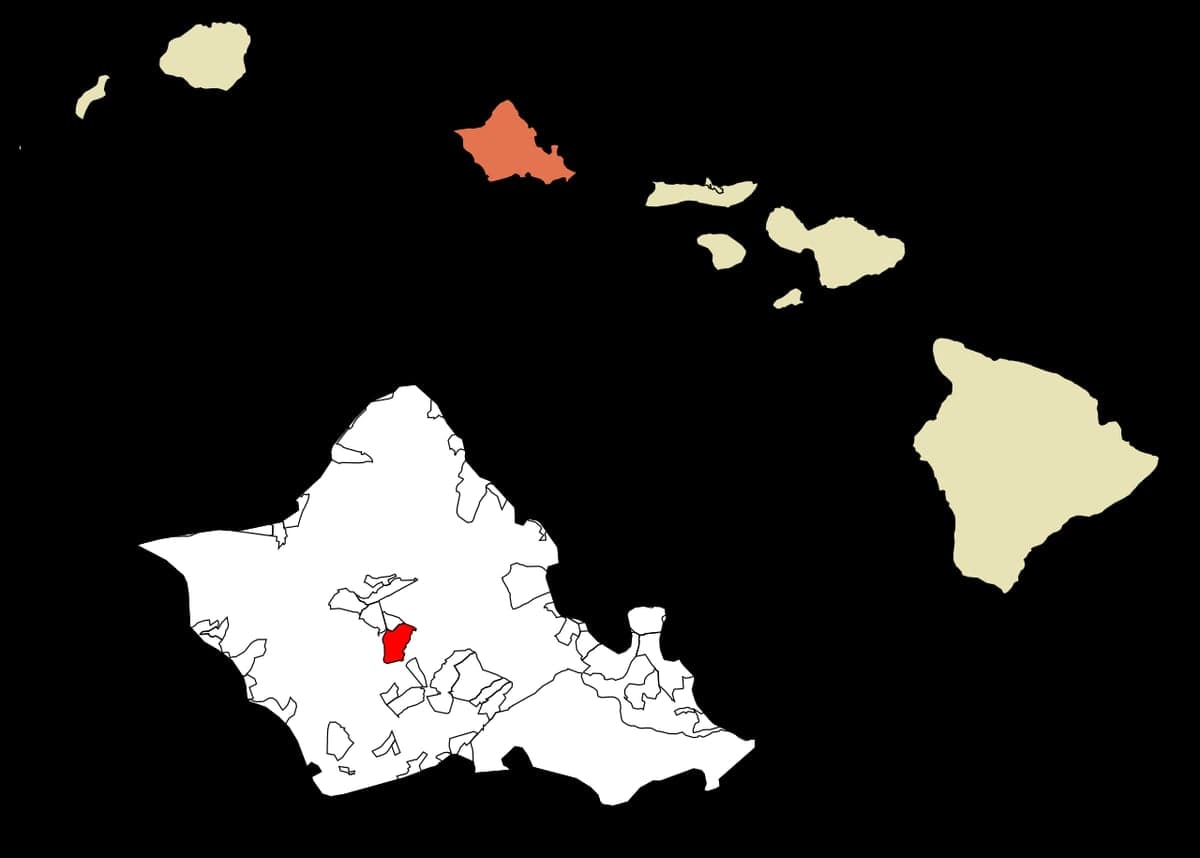
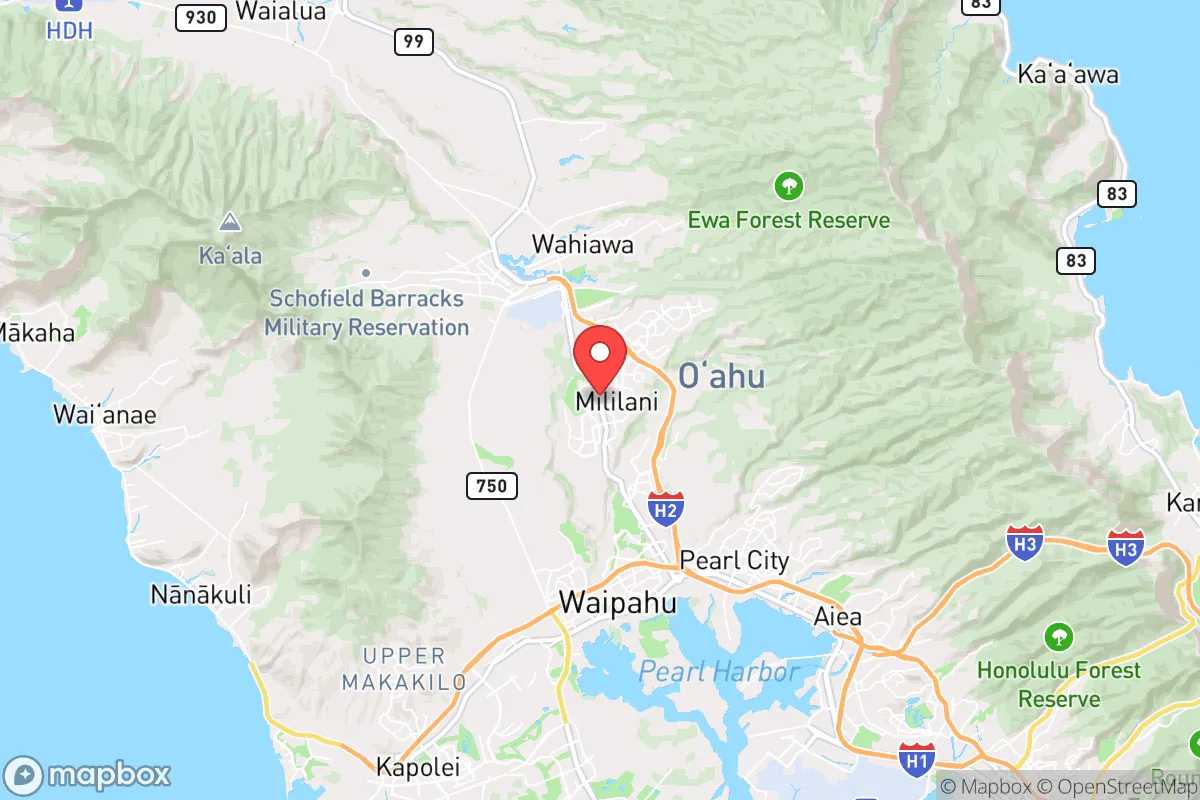
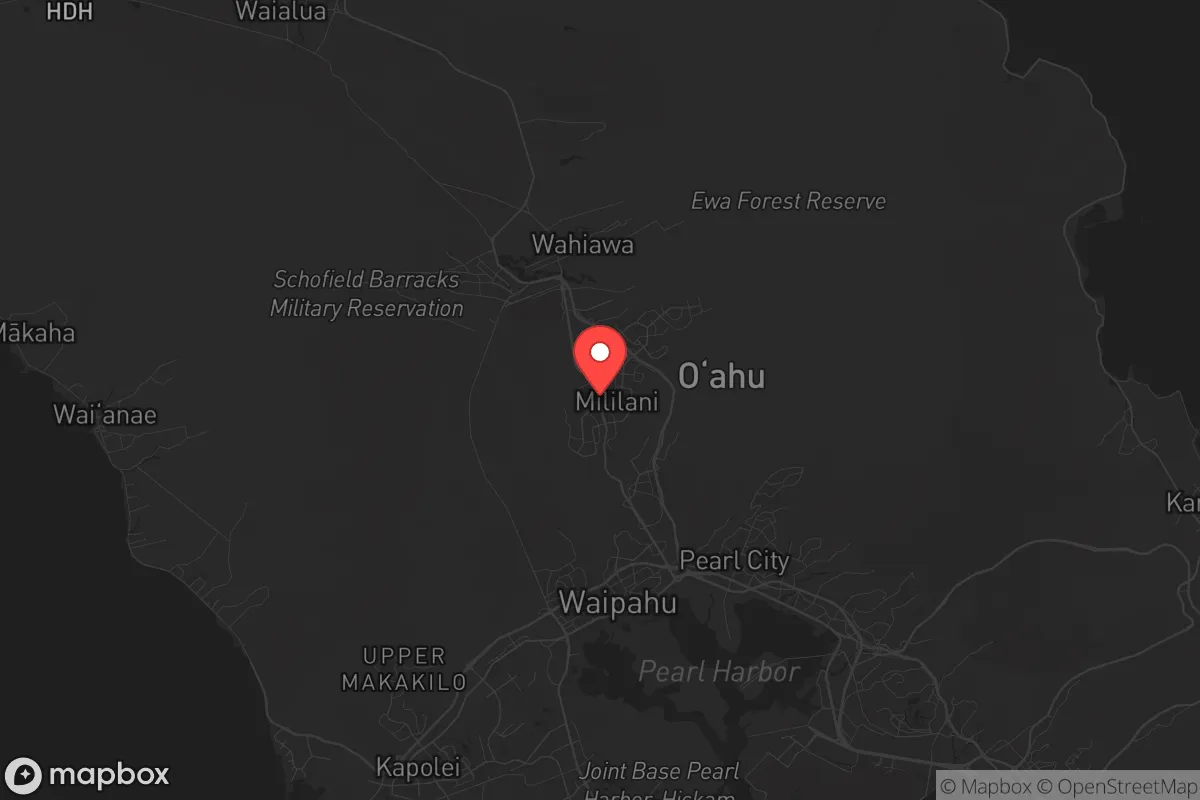
Photo: Wikipedia
Political ClimatePolitical Climate in Mililani Town, HI
District shown is the primary district for this city’s centroid. Cities may span multiple districts.
Local Political AnalysisPolitical Analysis of Mililani Town, HI
Mililani Town leans heavily Democratic, with a Cook PVI of D+13 that places it among the most reliably blue communities in Hawaii. This isn’t a recent shift—the area has voted consistently for Democratic candidates in presidential, state, and local elections for decades, and the margin has only widened since 2020. If you’re looking at the political trajectory here, it’s a slow but steady march leftward, with younger residents and new arrivals from the mainland pushing the needle further than what longtime locals remember from the 1990s and early 2000s.
How it compares
Mililani Town sits in central Oahu, and its politics stand in stark contrast to nearby communities like Wahiawa and Haleiwa. Wahiawa, just a few miles north, is more mixed—still Democratic-leaning but with a stronger independent and conservative streak, especially among military families stationed at Schofield Barracks. Haleiwa, on the North Shore, is a progressive enclave where environmental and social justice issues dominate local discourse. Mililani falls somewhere in between: it’s not as radical as Haleiwa, but it’s far more uniformly Democratic than Wahiawa. The real contrast, though, is with the Leeward Coast (Nanakuli, Waianae), where economic hardship and a stronger sense of local autonomy produce a more skeptical, less party-line voting pattern. In Mililani, you’ll find fewer “split-ticket” households—most folks here vote straight Democratic, and the local precincts routinely deliver 70%+ margins for the party’s candidates.
What this means for residents
For a conservative-leaning resident, the political climate in Mililani Town can feel like a constant headwind. Local governance tends to favor expanded government programs, higher taxes for public services, and stricter regulations on everything from housing development to business operations. The county council and state legislature representatives from this area are reliably progressive, which means policies like rent control, mandatory paid leave, and tight zoning laws are the norm. Property taxes here are among the highest in the state, and while services like schools and parks are well-funded, the trade-off is less personal freedom in how you use your land or run your small business. The school board and neighborhood boards are also dominated by progressive voices, so if you value parental rights in education or want to push back against curriculum changes, you’ll find yourself in the minority at public meetings. Voter turnout in Mililani is high—often above 70% in general elections—so the political machine here is well-oiled and hard to crack.
On the cultural front, Mililani Town has a distinct “master-planned community” vibe that shapes its politics. The town was built in the 1970s and 1980s as a bedroom community for Honolulu workers, and that origin story still influences local attitudes: there’s a strong sense of order, predictability, and reliance on centralized planning. Neighborhood associations here have real sway, and they tend to enforce strict rules on landscaping, parking, and home modifications—a level of government overreach that can chafe if you’re used to more autonomy. The long-term trend is concerning for anyone who values limited government: as the population ages and younger, more progressive families move in, the appetite for even more regulation and public spending is likely to grow. If you’re considering a move here, be prepared for a community where the political consensus leans left, and where pushing back against that consensus means being a vocal, persistent minority.

State Political ClimatePolitical Climate in Hawaii
State Political AnalysisPolitical Environment in the State
Hawaii has been a one-party Democratic stronghold for decades, with Democrats holding supermajorities in both legislative chambers and every statewide office since 1962. The state’s political culture is deeply collectivist, prioritizing government-led solutions on housing, environment, and social welfare. Over the last 10-20 years, the trajectory has been steadily leftward, with Honolulu and the urban core of Oahu driving the lean, while rural areas on the Big Island and Maui show pockets of resistance. For a conservative considering relocation, the key takeaway is that Hawaii’s political climate is dominated by a progressive consensus that often feels insulated from mainland trends.
Urban vs. rural divide
The political map of Hawaii is starkly divided between the urban core of Oahu and the rest of the state. Honolulu and its suburbs, including Waipahu and Kaneohe, are the engine of Democratic dominance, routinely delivering 70-80% of the vote for Democratic candidates. These areas are dense, diverse, and heavily unionized, with public-sector workers and tourism employees forming a reliable base. In contrast, the rural Big Island—places like Hilo, Pahoa, and Waimea—show a more mixed picture. While Hilo is reliably blue, the Puna district and the Kona coast have seen a rise in libertarian-leaning and independent voters, often tied to the homesteading and off-grid communities. Maui’s Upcountry (Kula, Makawao) and the North Shore of Oahu (Haleiwa) also trend more moderate, but they lack the population to shift statewide outcomes. The only county that occasionally flips is Hawaii County (the Big Island), which voted for Trump in 2016 and 2020 by narrow margins, but even that is an outlier in a state where Democrats hold a 2-to-1 registration advantage.
Policy environment
Hawaii’s policy environment is defined by high taxes, heavy regulation, and a strong social safety net. The state has the highest combined state and local tax burden in the nation, with a general excise tax of 4.5% that applies to nearly all goods and services, plus a progressive income tax topping out at 11%. Property taxes are relatively low, but the trade-off is a crushing cost of living. Education policy is centralized and union-dominated; the Hawaii Department of Education is the only statewide school district, and charter schools exist but are tightly controlled. Healthcare is heavily regulated, with a state-run insurance exchange and a strong push toward universal coverage. Election laws are moderately restrictive—no-excuse absentee voting is allowed, but same-day registration is not, and voter ID is not required. Gun laws are among the strictest in the country, with a permit-to-purchase system, a ban on most semi-automatic rifles, and a 14-day waiting period. For a conservative, the policy environment feels like a top-down, one-size-fits-all approach that leaves little room for local variation or individual choice.
Trajectory & freedom
Over the past five years, Hawaii has moved decisively toward expanding government control and contracting personal freedoms. In 2023, the legislature passed Act 2, which effectively bans the sale of most new handguns by raising the minimum age to 21 and requiring liability insurance—a move that is being challenged in court. In 2024, the state enacted a “sanctuary state” law for gender-affirming care, shielding providers from out-of-state lawsuits and criminal penalties. Parental rights have been eroded by a 2022 law that allows minors to consent to certain medical procedures without parental notification. On the economic front, the state’s mandatory paid family leave program, set to launch in 2026, will add a 0.5% payroll tax on all workers. Property rights are also under pressure, with a 2023 law allowing counties to impose rent control and a 2024 bill that would have capped short-term rentals statewide (it failed, but similar measures are expected to return). The overall trajectory is one of expanding state power, with little pushback from a compliant legislature and a governor who has vetoed only a handful of bills in his tenure.
Civil unrest & political movements
Hawaii has a history of organized protest, but it is overwhelmingly left-leaning. The 2019 Mauna Kea protests against the Thirty Meter Telescope drew thousands of Native Hawaiian activists and environmentalists, effectively halting construction for years. More recently, the 2023 Lahaina wildfires sparked grassroots anger over government mismanagement, but that energy has been channeled into demands for more regulation, not less. Conservative activism is small and fragmented, centered on gun rights groups like the Hawaii Firearms Coalition and a handful of libertarian-leaning homesteaders on the Big Island. There is no significant secession or nullification movement, though some rural residents quietly discuss “county sovereignty” as a way to push back against Honolulu’s dominance. Election integrity is not a major flashpoint—Hawaii’s all-mail voting system has been in place since 2020, and while some conservatives question the lack of voter ID, there have been no major fraud allegations. The most visible political flashpoint for a new resident would be the constant tension between development and environmental regulation, with activists on both sides using the courts to block or force projects.
Projection
Looking ahead 5-10 years, Hawaii’s political trajectory is likely to continue leftward, driven by demographic trends and in-migration. The state’s population is aging and declining, but the people moving in—mostly from California and the Pacific Northwest—tend to be progressive professionals or retirees who support the existing policy environment. The Native Hawaiian population, which is growing faster than the general population, is increasingly influential and leans left on most issues. The Republican Party is effectively a non-factor at the state level, with no path to a majority in either chamber. The most realistic scenario is a slow drift toward even higher taxes, more regulation, and a larger social safety net, with occasional court battles over gun rights and property rights. For a conservative moving in now, the expectation should be that the political climate will become less friendly over time, not more. The only wildcard is a potential economic crisis—if tourism collapses or housing becomes completely unaffordable, the current consensus could fracture, but that would likely produce a populist left-wing backlash, not a conservative one.
For a new resident, the bottom line is that Hawaii offers a beautiful environment and a unique culture, but it comes with a political system that is deeply entrenched in progressive governance. If you value low taxes, gun rights, school choice, or local control, you will find yourself swimming against a strong current. The state is not hostile to conservatives in a personal sense—neighbors are generally friendly—but the policy environment is designed to limit individual freedom in favor of collective outcomes. If you are considering a move, be prepared to pay a premium for the privilege of living in a place where your vote will have little impact on the direction of the state.
* Values derived from national, state, county, city and local statistics and may differ in a specific area. Last updated: 2026-04-24T07:29:05.000Z
Narrative content on this page is AI-generated and may contain mistakes. Verify any details that matter before acting on them.
ReloMaps may earn a commission from affiliate links at no extra cost to you.

