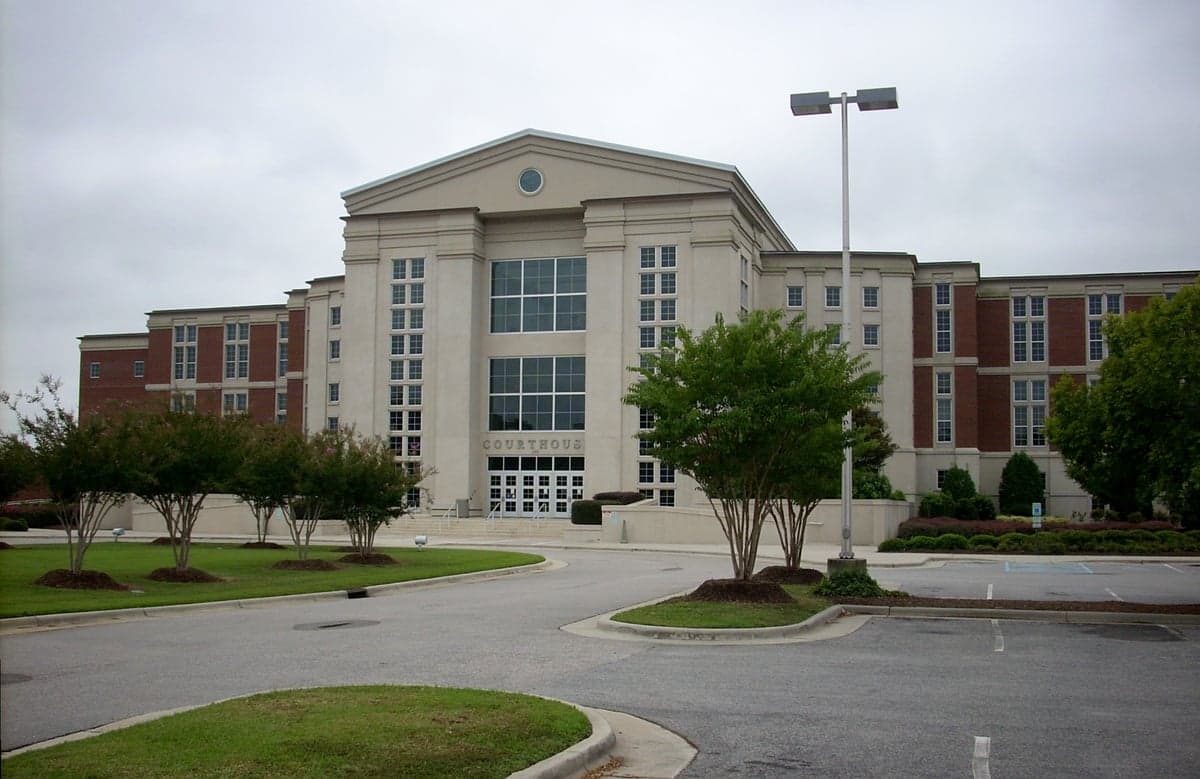
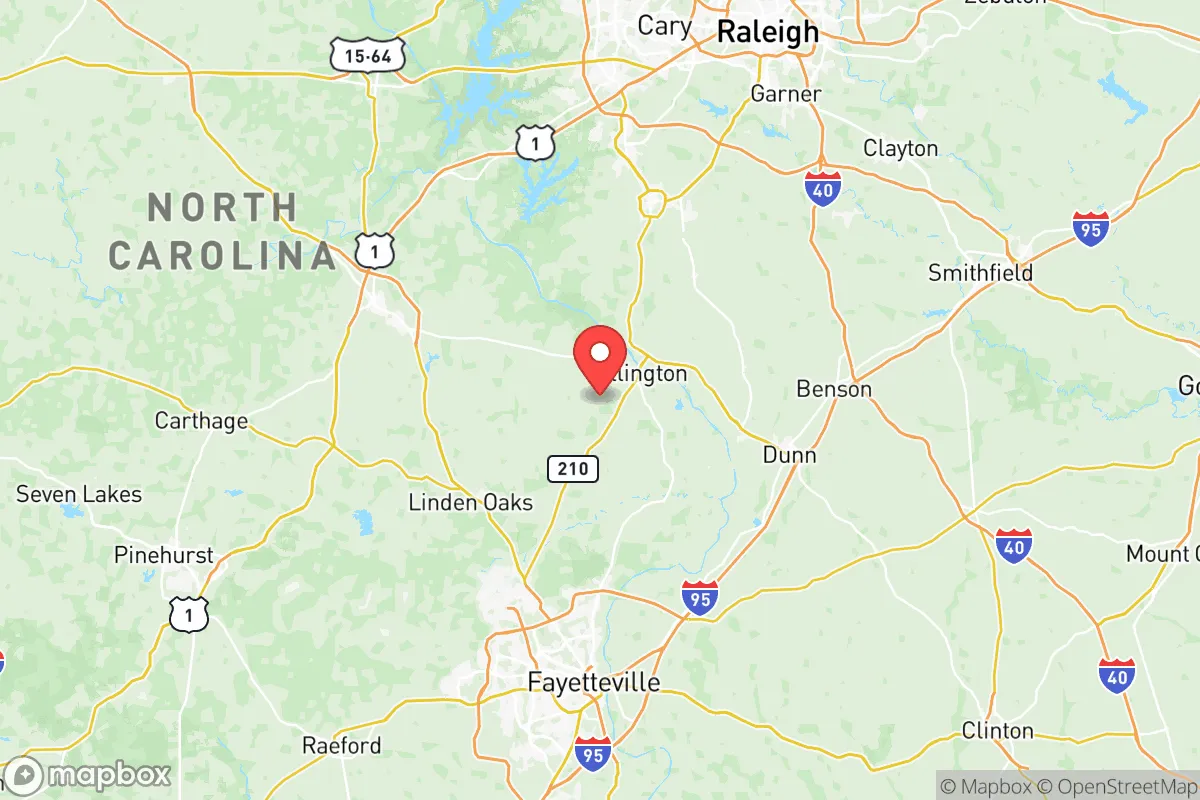
Photo: Wikipedia
Demographics of Harnett County
Affluence Level in Harnett County
A middle-class area roughly in line with national averages across income, home values, education, and employment.
People of Harnett County
Harnett County, North Carolina, is home to 136,503 residents who form a predominantly rural and small-town community with a strong military and agricultural heritage. The population is 58.9% White, 20.3% Black, and 14.6% Hispanic, with a foreign-born share of just 3.6%, reflecting a region shaped more by domestic migration than international immigration. The county's identity is anchored by the presence of Fort Liberty (formerly Fort Bragg) and its major towns—Lillington, Dunn, Erwin, and Coats—where a blend of long-standing families, military retirees, and a growing Hispanic workforce defines daily life.
Settlement & growth (pre-1960)
Before European settlement, the area now known as Harnett County was part of the homeland of the Siouan-speaking Waccamaw and Cape Fear Indians, who lived along the Cape Fear River and its tributaries. These groups were largely displaced by the early 1700s through warfare and disease brought by European contact. The first permanent European settlers were primarily of English and Scots-Irish descent, arriving in the mid-18th century via the Cape Fear River valley. They were drawn by fertile bottomlands for tobacco and cotton farming, and by the 1770s, small communities had formed at what would become Lillington, the county seat, and along the river at Fayetteville's periphery.
Harnett County was officially formed in 1855 from parts of Cumberland County, named for a local Revolutionary War figure. The county's early economy was built on agriculture—cotton, tobacco, and timber—worked by a mix of White yeoman farmers and enslaved Black laborers. By 1860, enslaved people made up roughly 40% of the county's population, concentrated on plantations near the Cape Fear River around Lillington and Dunn. After the Civil War and Reconstruction, many freedmen remained as sharecroppers and tenant farmers, establishing small Black communities in places like Erwin and the rural crossroads of Coats.
The arrival of the Wilmington and Weldon Railroad in the late 19th century transformed the county. The railroad spurred the growth of Dunn, which became a major tobacco market and rail hub, and Erwin, which grew around a cotton mill built in 1900. These towns attracted a wave of White farmers and mill workers from the surrounding countryside, as well as a small number of Black laborers who worked in the mills and on the railroad. The early 20th century saw little new immigration; the county remained overwhelmingly native-born White and Black, with a small number of Italian and Polish families settling in Dunn to work in the tobacco warehouses and rail yards.
World War II brought the single biggest change to Harnett County's population. The establishment of Fort Bragg (now Fort Liberty) in 1918 had already begun to influence the region, but the war's massive expansion of the base drew thousands of military personnel and civilian workers to the area. Many of these service members, after leaving the military, chose to retire in Harnett County, settling in the towns of Lillington, Dunn, and the newly developing areas near the base. This military-to-civilian pipeline became a defining feature of the county's growth, and by 1960, the population had reached roughly 50,000, still overwhelmingly White and Black, with a small but growing number of military families from other parts of the country.
Modern era (post-1965)
The 1965 Hart-Cellar Act had a limited direct impact on Harnett County, as the region did not attract large numbers of post-1965 immigrants. The foreign-born share remains low at 3.6%, well below the national average. However, the county has seen significant domestic migration since the 1970s, driven by the continued growth of Fort Liberty and the broader Sun Belt shift. Military personnel from all over the United States, including many from the Rust Belt and the West Coast, have moved to the area, often settling in the towns closest to the base, such as Lillington and the unincorporated areas around Fort Liberty. This has diversified the county's White population, bringing in families with roots in the Northeast, Midwest, and West.
The most notable demographic shift since 1965 has been the growth of the Hispanic population, which now stands at 14.6%. This growth began in the 1990s, driven by the expansion of agriculture—particularly the poultry and hog industries—and construction related to the military base. Hispanic workers, many from Mexico and Central America, settled in Dunn and Erwin, where they found work in poultry processing plants and on farms. A smaller number have moved to Lillington, where they work in construction and services. The Hispanic community is now the county's fastest-growing ethnic group, and it has established a visible presence in Dunn, where several Hispanic-owned businesses and churches serve the community.
The Black population, at 20.3%, has remained stable in share but has shifted geographically. Historically concentrated in rural areas and the older parts of Dunn and Lillington, many Black families have moved to newer subdivisions in the county's growing suburban fringe, particularly near the Harnett-Wake county line. The East/Southeast Asian population is very small at 0.9%, and the Indian subcontinent population is negligible at 0.1%, reflecting the county's lack of the high-tech and professional job sectors that attract these groups to the Research Triangle region. The county's college-educated share is 23.9%, lower than the state average, reflecting its working-class and military character.
Suburbanization has reshaped the county since 2000. The area around Lillington has seen the most growth, as commuters from Fort Liberty and Raleigh-Durham have built new subdivisions. The town of Coats, once a quiet crossroads, has grown rapidly as a bedroom community for Fort Liberty personnel. Dunn, while still the largest town, has seen slower growth, as its older housing stock and less convenient location relative to the base have made it less attractive to newcomers. The county's rural character is being slowly eroded by this suburban expansion, but large swaths of farmland and forest remain, particularly in the county's western and southern reaches.
The future
Harnett County's population is projected to continue growing, driven by the expansion of Fort Liberty and the spillover of growth from the Raleigh-Durham metro area. The county is becoming slightly more diverse, with the Hispanic share expected to rise to near 20% by 2040, while the White share will likely decline to around 50%. The Black population is expected to remain stable in share, but will continue to suburbanize, moving into newer developments near Lillington and along the US 401 corridor. The foreign-born share will likely increase slowly, as Hispanic families continue to settle in Dunn and Erwin, but the county will remain far less diverse than the state's urban centers.
The cultural identity of Harnett County is evolving from a purely rural, agricultural, and military community into a more suburban, commuter-oriented one. The influence of Fort Liberty will remain dominant, but the growing Hispanic population is adding a new layer to the county's cultural fabric, particularly in Dunn, where bilingual signs and Hispanic festivals are becoming more common. The county's political character, historically conservative, is likely to remain so, as the new suburbanites tend to lean Republican, and the Hispanic population, while growing, has not yet become a major political force. The next 10-20 years will see the county become more connected to the Raleigh metro area, with continued suburban development along the US 401 and NC 210 corridors, but it will retain its distinct identity as a place where military service, agriculture, and small-town life remain central.
For someone moving to Harnett County now, the region offers a lower cost of living and a slower pace of life than the nearby Research Triangle, with a strong sense of community rooted in its military and agricultural heritage. The population is becoming more diverse, but it remains a place where long-time residents and newcomers alike share a common identity shaped by the land and the base. The county is not a melting pot in the way that Charlotte or Raleigh are, but it is a place where different groups—White, Black, and Hispanic—live and work alongside each other, often in the same neighborhoods and schools, creating a quiet, practical form of integration that defines the modern Harnett County experience.

* Values derived from national, state, county, city and local statistics and may differ in a specific area. Last updated: 2026-10-17T06:31:44.000Z
Narrative content on this page is AI-generated and may contain mistakes. Verify any details that matter before acting on them.
ReloMaps may earn a commission from affiliate links at no extra cost to you.

