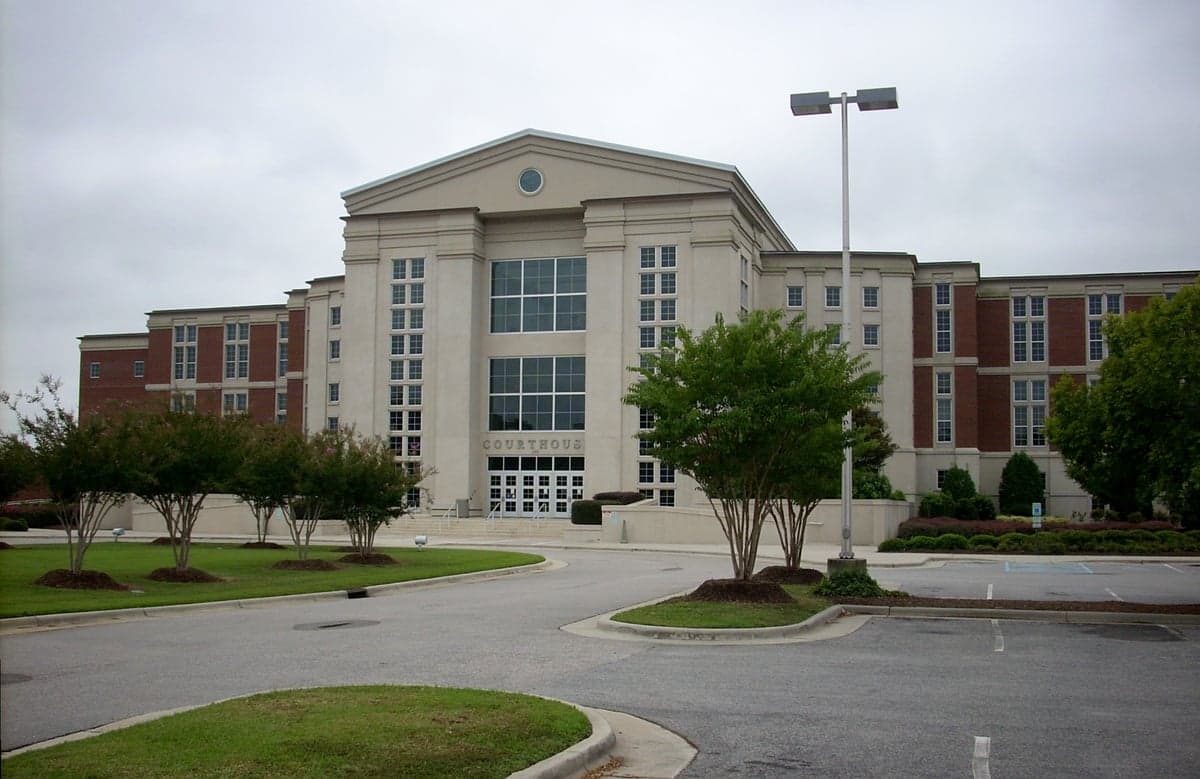
Photo: Wikipedia
Political ClimatePolitical Climate in Harnett County
Showing district-level results — no local-only data available.
Local Political AnalysisPolitical Analysis of Harnett County
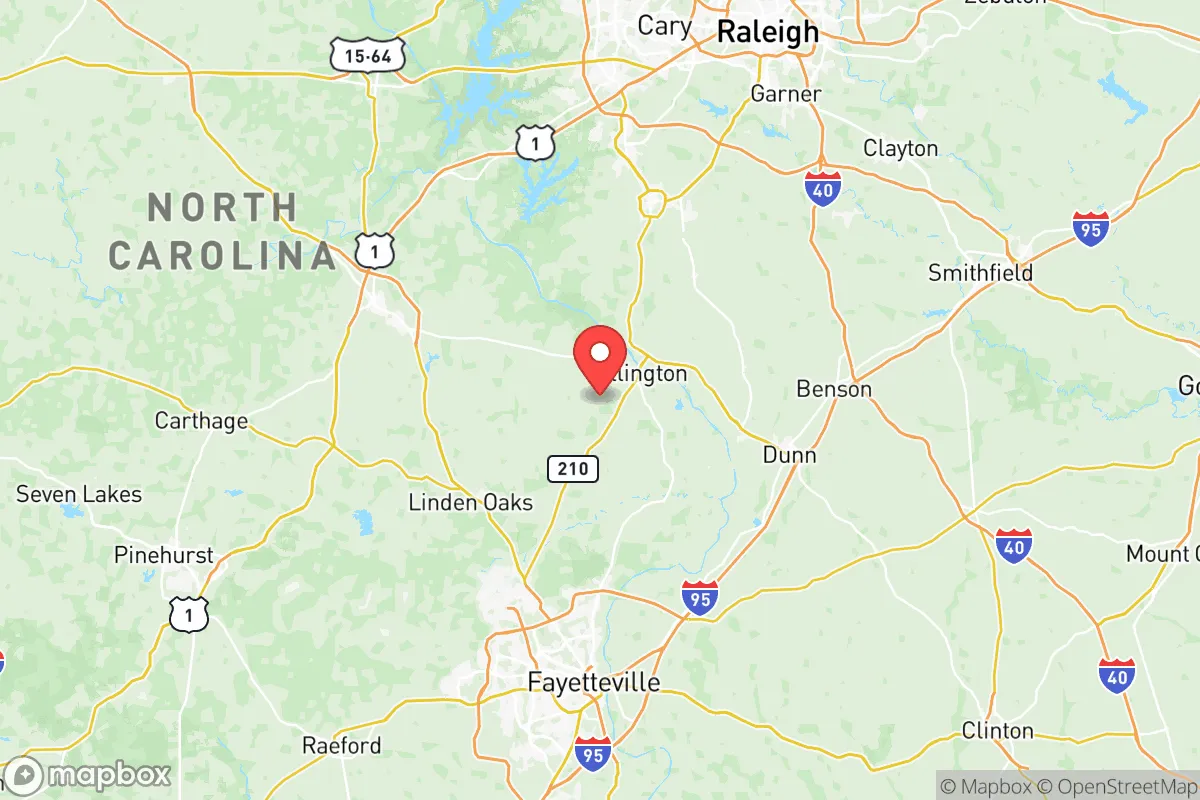
Harnett County, anchored by the city of Lillington and stretching through Dunn and Erwin, is a reliably Republican stronghold with a Cook Partisan Voting Index of R+8, meaning it votes about eight points more Republican than the national average. That's a full seven points redder than the state of North Carolina as a whole, which sits at R+1 and is considered a true toss-up. The county has been trending even more conservative in recent cycles, driven by rapid population growth in the exurban areas around Fuquay-Varina and Holly Springs, where new subdivisions are filling with families moving out of Wake County for cheaper land and lower taxes.
How it compares
To understand Harnett's politics, you have to look at the state map. North Carolina itself is a purple battleground—R+1 means presidential races are decided by a point or two, and control of the state legislature flips between parties. Harnett, by contrast, is deep red territory. In the 2024 presidential election, Donald Trump carried Harnett by roughly 20 points, while he won the state by less than 3. The difference is stark when you compare precincts: the rural western parts of the county around Lillington and Erwin vote 70-80% Republican, while the more urbanized eastern edge near Dunn is slightly less conservative, with some precincts dipping to 60-65% GOP. The only real blue dots are in a handful of precincts around Fayetteville State University and the Fort Liberty (formerly Fort Bragg) military base, where younger, more transient populations and a higher share of minority voters push Democratic turnout to 40-45%. But those are islands in a sea of red. The county's Republican lean is consistent down-ballot too—every county commissioner, sheriff, and school board member is a Republican, and the state legislative delegation from Harnett is entirely GOP.
What this means for residents
For conservative residents, Harnett is a comfortable place to live politically. Local government is reliably pro-business and pro-development, with minimal zoning restrictions and a tax rate that's among the lowest in the Triangle region. The county commission regularly approves new subdivisions and industrial parks without much public pushback. For liberal residents, the reality is more isolating. There's no organized Democratic Party presence in most precincts, and progressive candidates rarely bother to campaign here. That said, the county's rapid growth is slowly shifting the electorate. The new arrivals from Wake County tend to be younger and more moderate, and some local observers expect the R+8 PVI to edge closer to R+5 or R+6 by 2030, especially if the state's political map continues to tighten. But for now, Harnett remains a place where a Republican primary win is the de facto general election victory, and where the biggest political debates are about growth management and school funding, not cultural flashpoints.
Culturally, Harnett County is distinct from the rest of North Carolina in a few key ways. It's more rural and more military-connected—Fort Liberty is the county's largest employer, and a huge share of residents are active-duty soldiers, veterans, or defense contractors. That gives the area a pragmatic, patriotic, and somewhat transient feel. Unlike the more established conservative counties in the western part of the state, Harnett doesn't have a deep-rooted plantation-era aristocracy or a strong tradition of local dynasties. Politics here is less about family names and more about the immediate concerns of a growing exurb: traffic on US-401, school overcrowding in Harnett County Schools, and the availability of water and sewer infrastructure for new developments. The county's Republicanism is practical rather than ideological—most voters support lower taxes and less regulation, but they also back military spending and infrastructure investment. That makes Harnett a bellwether for the kind of Sun Belt conservatism that's reshaping North Carolina's political geography.

State Political ClimatePolitical Climate in North Carolina
State Political AnalysisPolitical Environment in the State
North Carolina is a classic swing state with a slight Republican lean, currently rated R+1 by the Cook Political Index, but the real story is how fast it's shifting. Over the last 10-20 years, the state has gone from reliably red in presidential races to a nail-biter, with Democrats winning the governorship and key statewide offices while the GOP holds the legislature and often carries the top of the ticket. The dominant coalition is a tug-of-war between a growing, diverse urban crescent and a deeply conservative rural and exurban base, with the suburbs of Charlotte and the Research Triangle acting as the ultimate battleground.
Urban vs. rural divide
The political map of North Carolina is essentially a story of two states. The urban crescent—stretching from Charlotte through the Piedmont Triad (Greensboro, Winston-Salem, High Point) and into the Research Triangle (Raleigh, Durham, Chapel Hill)—is the engine of Democratic growth. These metros are booming with transplants from the Northeast and Midwest, tech and finance workers, and a younger, more diverse population. Mecklenburg County (Charlotte) and Wake County (Raleigh) are now solidly blue, while Durham County is one of the most liberal in the South. Meanwhile, the rural east—places like Duplin, Sampson, and Robeson counties—and the western mountains, including Buncombe County (Asheville) which is a blue island in a red sea, vote heavily Republican. The suburbs are where the fight is: Cabarrus County outside Charlotte and Johnston County outside Raleigh have been trending right, but places like Union County are still deeply red. The 2020 presidential race saw Biden win the state by a razor-thin margin, but Trump carried it in 2024, showing the state is still up for grabs.
Policy environment
North Carolina's policy environment is a mix of conservative governance and pragmatic moderation. The state has a flat income tax rate of 4.75% and a sales tax of 4.75% (localities add up to 2.5%), making it relatively low-tax compared to the Northeast. There is no state property tax; it's levied locally. The regulatory posture is business-friendly, with a right-to-work law and a strong push to attract corporate relocations. On education, the state has a school choice program with charter schools and vouchers, but the public school system is underfunded relative to its growing population, leading to a long-running Leandro court case demanding more equitable funding. Healthcare is a mixed bag: the state expanded Medicaid in 2023 under a bipartisan deal, but the legislature has resisted the Affordable Care Act's full implementation. Election laws have been a flashpoint: the state has voter ID requirements (passed in 2018, upheld after legal challenges), and the GOP-controlled legislature has drawn congressional and state legislative maps that have been repeatedly challenged in court for partisan gerrymandering. The state also has a strict 20-week abortion ban, with exceptions for rape, incest, and life of the mother, passed in 2023.
Recent policy direction
Recent legislation points to a state that is moving right on social issues while maintaining a pro-business, low-tax posture. In 2023, the Republican supermajority overrode Governor Roy Cooper's veto to pass the 12-week abortion ban (down from the previous 20-week limit), along with restrictions on medication abortion. On gun rights, the state is a "shall-issue" for concealed carry, and in 2023, the legislature passed a law allowing permitless concealed carry for adults 21 and older, which took effect in 2024. On parental and education rights, the state passed the "Parents' Bill of Rights" in 2023, requiring schools to notify parents about curriculum changes and allowing them to opt their children out of certain materials. On speech and privacy, the state has no broad data privacy law yet, but a bill is pending. On medical and bodily autonomy, the state has banned gender-affirming care for minors, effective 2023, overriding the governor's veto. Property rights are strong, with no state-level rent control and a robust homestead exemption. On voting, the state has implemented strict voter ID, and in 2024, the legislature passed a law requiring all ballots to be returned by Election Day, ending the three-day grace period for mail-in ballots. The overall direction is a state that is tightening social restrictions while keeping taxes low and business regulations light.
Civil unrest & political movements
North Carolina has a history of visible political activism on both sides. The 2020 protests following George Floyd's murder were significant in Charlotte, Raleigh, and Durham, with some property damage and curfews. The state has a strong organized left, particularly around racial justice and abortion rights, with groups like the NC NAACP and Planned Parenthood South Atlantic. On the right, the state has a robust gun rights movement, with groups like Grass Roots North Carolina, and a growing "parents' rights" movement that has been active in school board meetings, particularly in suburban counties like Wake and Mecklenburg. Immigration politics are tense: the state has no sanctuary cities, and the legislature passed a law in 2019 requiring all sheriffs to cooperate with ICE, though some urban sheriffs have resisted. There is no serious secession or nullification rhetoric, but election integrity controversies have been a recurring theme, particularly around the 2020 and 2024 elections, with the state GOP challenging absentee ballot procedures. A visible flashpoint for new residents is the political polarization of local government: in Asheville, you'll see "Defund the Police" signs, while in Gastonia, you'll see "Thin Blue Line" flags. The state's "purple" nature means you'll encounter both sides regularly.
Projection
Over the next 5-10 years, North Carolina is likely to become more competitive, not less. The in-migration from blue states—particularly to the Charlotte and Raleigh metros—is bringing more Democratic-leaning voters, but many of these transplants are also fiscally conservative and socially moderate, which could keep the state in a purple equilibrium. The rural population is shrinking and aging, which helps Democrats, but the GOP has a structural advantage through gerrymandered legislative maps that are likely to persist. The 2024 election showed the state is still a toss-up at the presidential level, but the state legislature is likely to remain Republican for the foreseeable future. A new resident moving in now should expect a state where the political climate is constantly contested: you'll have a Democratic governor and a Republican legislature for the near term, with ongoing fights over abortion, education funding, and voting access. The state is not going to flip blue overnight, but it's also not going to become Texas. It's a place where your vote genuinely matters, and where the political culture is shaped by a constant, high-stakes tug-of-war.
For a new resident, the bottom line is this: North Carolina offers a low-tax, business-friendly environment with a relatively high quality of life, but the political climate is intensely polarized and likely to stay that way. If you're conservative, you'll find a legislature that reflects your values on guns, taxes, and social issues, but you'll have to contend with a Democratic governor and growing urban centers. If you're liberal, you'll find vibrant, progressive cities and a governor who can veto the worst of the legislature's bills, but you'll face a state government that is actively restricting abortion and voting access. The state is a true battleground, and that means your voice—and your vote—will matter more here than in a deep red or deep blue state. It's a place where you can find your tribe, but you'll also have to live with the other side.
* Values derived from national, state, county, city and local statistics and may differ in a specific area. Last updated: 2026-10-17T06:31:44.000Z
Narrative content on this page is AI-generated and may contain mistakes. Verify any details that matter before acting on them.
ReloMaps may earn a commission from affiliate links at no extra cost to you.

