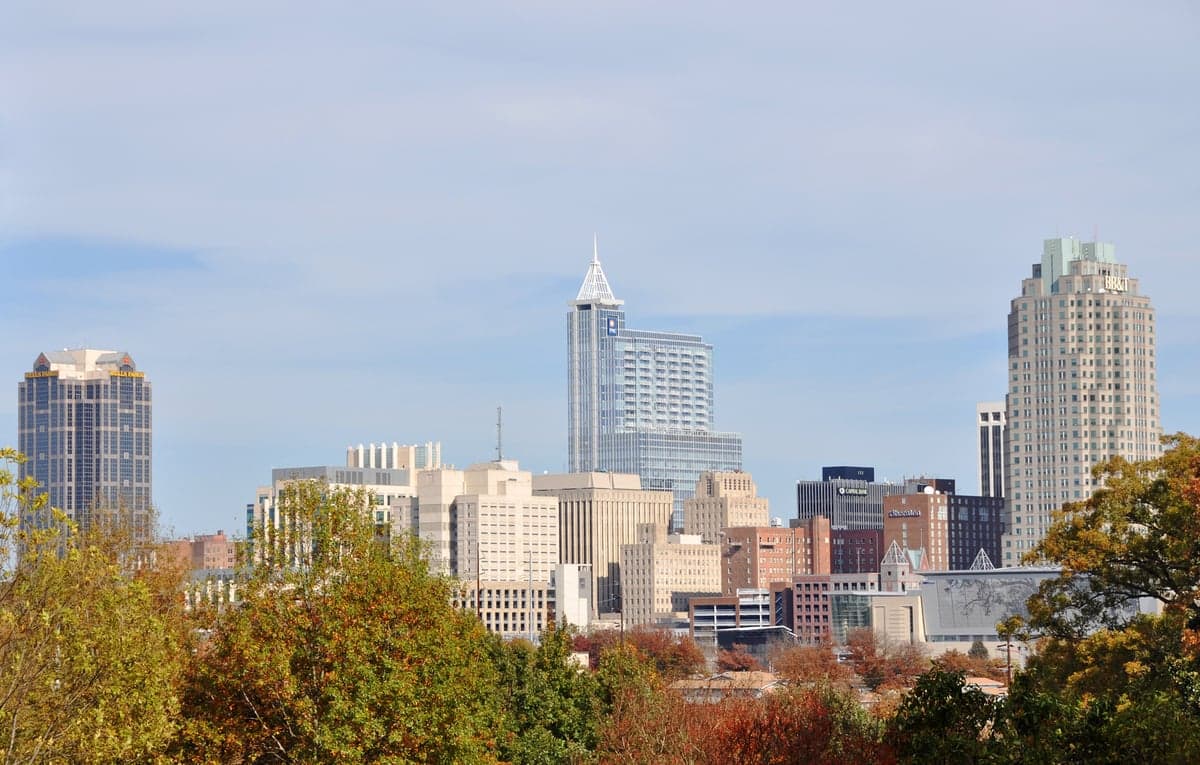
Photo: Wikipedia
Political ClimatePolitical Climate in Wake County
Showing state-level results — no local-only data available.
Local Political AnalysisPolitical Analysis of Wake County
Wake County has shifted hard to the left in recent years, and if you’re a conservative, it’s a tough place to feel at home. The Cook Partisan Voting Index (PVI) now sits at D+17, meaning the county votes 17 points more Democratic than the national average. That’s a massive swing from even a decade ago, when the county was a genuine battleground. The state of North Carolina as a whole is still a toss-up, with a PVI of R+1, but Wake County is pulling further and further away from the rest of the state. If you value limited government and personal freedoms, you need to know what you’re walking into.
How it compares
The contrast between Wake County and the rest of North Carolina is stark. While the state leans just slightly Republican, Wake County is one of the most reliably blue areas in the South. Raleigh and Cary are the Democratic strongholds, with precincts routinely voting 70-80% for Democratic candidates. Apex and Morrisville have followed suit, especially as tech and pharmaceutical transplants have flooded in. On the flip side, Fuquay-Varina and Garner still have pockets of red, but they’re shrinking fast. Zebulon and Wendell in the eastern part of the county are where you’ll find more conservative-leaning precincts, but even those are being squeezed by suburban sprawl. The swing precincts that used to decide elections—places like North Raleigh and Holly Springs—have mostly tipped blue. The result is a county where conservative voices are increasingly drowned out by a progressive majority that’s pushing policies many of us see as government overreach.
What this means for residents
For a conservative, living in Wake County means watching your values get sidelined. The county commission and school board are dominated by Democrats who have pushed for higher taxes, expanded government programs, and progressive social policies. Property taxes have risen steadily to fund initiatives many residents didn’t ask for, like diversity, equity, and inclusion (DEI) programs in schools and county hiring. There’s also been a push for more restrictive zoning and land-use regulations that limit what you can do with your own property. The school system has embraced critical race theory-inspired curricula and gender ideology policies that many parents find intrusive. If you believe in local control and parental rights, you’ll find yourself on the losing side of most votes. The political climate here feels less like a community of neighbors and more like a bureaucracy that knows what’s best for you.
Culturally, Wake County has become a place where traditional values are often treated as outdated or even offensive. The influx of out-of-state transplants—many from the Northeast and West Coast—has reshaped the social fabric. You’ll see more "In This House We Believe" signs than American flags in some neighborhoods. The county’s leadership has also taken a hard line on Second Amendment rights, with local ordinances that make concealed carry more difficult than in surrounding rural counties. If you’re a gun owner, you’ll want to stay informed about local laws. The bottom line: Wake County is a progressive island in a purple state, and if you’re a conservative, you’ll need to be ready to fight for your freedoms at every level of local government.

State Political ClimatePolitical Climate in North Carolina
State Political AnalysisPolitical Environment in the State
North Carolina has long been the quintessential swing state, but over the last decade it’s settled into a lean-Republican posture at the state level, with a Cook PVI of R+1. The dominant coalition is a mix of rural conservatives, suburban moderates, and a growing number of fiscally conservative transplants from the Northeast and Midwest. The 10-20 year arc has been a slow rightward drift on cultural and economic issues, even as the Research Triangle and Charlotte metros have pulled the state leftward in presidential races. The result is a state that feels politically schizophrenic — but for a conservative, the state-level policy environment has been increasingly friendly, especially compared to neighbors like Virginia.
Urban vs. rural divide
The political map of North Carolina is a textbook case of the urban-rural chasm. The Democratic strongholds are the state’s three major metros: Charlotte (Mecklenburg County), the Raleigh-Durham-Chapel Hill Research Triangle (Wake, Durham, Orange counties), and to a lesser extent Greensboro-Winston-Salem (Guilford and Forsyth counties). These areas vote blue by margins of 20-40 points, driven by university populations, tech workers, and a growing number of out-of-state transplants. Meanwhile, the rural east — places like Greenville, Jacksonville, and the coastal counties — and the western mountain counties like Hendersonville and Boone are deeply red. The real battlegrounds are the exurban and suburban counties that ring the metros: Union County (south of Charlotte) is one of the most reliably Republican counties in the nation, while Cabarrus County (northeast of Charlotte) has been trending redder as Charlotte sprawl pushes conservative families outward. The 2020 and 2024 presidential races saw Wake County flip blue decisively, but the rural vote in counties like Robeson and Cumberland (home to Fayetteville) has held the line for Republicans statewide.
Policy environment
North Carolina’s policy environment is a mixed bag, but the trend since the 2010 Republican takeover of the General Assembly has been broadly conservative. The state has a flat income tax rate of 4.5%, down from over 7% a decade ago, with a scheduled phase-down to 3.99% by 2027. Corporate income tax is already at 2.5% and dropping. There’s no state property tax, and sales tax is capped at 7.5% locally. On education, the state has a robust school choice program: the Opportunity Scholarship Program now provides vouchers for any family, regardless of income, to use for private school tuition — a major win for parental rights. The state also has a constitutional carry law (permitless concealed carry) passed in 2023, overriding Governor Roy Cooper’s veto. On healthcare, the state finally expanded Medicaid in 2023 under a bipartisan deal, which was controversial among conservatives but included work requirements and a sunset clause. Election laws have been tightened: voter ID is now required (passed in 2018, implemented in 2023 after court battles), and same-day registration during early voting was eliminated. The state also banned abortion after 12 weeks in 2023, with exceptions for rape, incest, and fetal anomalies — a significant shift from the previous 20-week limit.
Trajectory & freedom
On the freedom front, North Carolina has been moving in the right direction for conservatives, but not without some worrying backsliding. The 2023 constitutional carry law was a landmark expansion of Second Amendment rights, making North Carolina one of over 25 states with permitless carry. The same year, the legislature passed the Parents’ Bill of Rights, which requires schools to notify parents about curriculum changes and prohibits instruction on gender identity and sexuality in K-4 classrooms — a direct response to the overreach seen in states like California. On the downside, the 2023 Medicaid expansion, while pragmatic, added hundreds of thousands of able-bodied adults to the rolls, which some conservatives see as a step toward government dependency. The state also saw a controversial HB 2-style bathroom bill in 2016 that was repealed in 2017, but the memory of that national firestorm still lingers. Property rights have been generally strong, with no statewide rent control and a relatively low property tax burden. The biggest red flag for freedom-minded residents is the continued growth of local government overreach in blue cities: Charlotte and Raleigh have passed local ordinances on minimum wage and non-discrimination that conflict with state law, leading to ongoing preemption battles.
Civil unrest & political movements
North Carolina has seen its share of political flashpoints, but nothing like the sustained unrest of Portland or Seattle. The 2020 George Floyd protests in Charlotte and Raleigh were large but mostly peaceful, with some property damage in Charlotte’s South End. The state has a strong, organized conservative grassroots movement, particularly around gun rights (Grass Roots North Carolina) and school choice (Parents for Educational Freedom). Immigration politics are relatively muted compared to border states, but there have been flashpoints over sanctuary policies: Durham County and Orange County have declared themselves “sanctuary counties” for undocumented immigrants, refusing to honor ICE detainers. The state legislature has repeatedly tried to ban sanctuary policies statewide, but Governor Cooper vetoed those bills. Election integrity has been a major issue since 2020, with the state’s bipartisan election board (split 2-2 between Republicans and Democrats) frequently deadlocking on rule changes. The 2024 election saw a massive turnout in rural counties, with Union County and Cabarrus County reporting record early voting numbers. There’s also a growing secession-adjacent movement in the far western counties, with some residents in Boone and Hendersonville floating the idea of joining Tennessee or forming a new state — though it’s mostly talk.
Projection
Over the next 5-10 years, North Carolina is likely to become more Republican at the state level, even as the presidential race remains competitive. The in-migration pattern is key: the state is gaining about 100,000 new residents per year, and while many of them are moving to the blue metros, a significant number are conservative retirees from the Northeast and Midwest settling in the coastal and mountain counties. The state’s flat tax trajectory and school choice policies will continue to attract families from high-tax states like New York and California. The biggest wild card is the Research Triangle: if the tech boom continues to bring in young, left-leaning professionals, Wake and Durham counties could become solidly blue, but the rest of the state is likely to stay red or redden further. The 2024 election results showed that Donald Trump won North Carolina by about 1.5 points, while Republicans maintained supermajorities in both chambers of the General Assembly. Expect more preemption battles between Raleigh and Charlotte, more school choice expansion, and possibly a push for a state constitutional amendment on school vouchers. The Medicaid expansion will be a point of contention, with conservatives likely pushing to add work requirements and a time limit.
For a conservative moving to North Carolina, the bottom line is this: you’ll find a state that respects your gun rights, your parental rights, and your wallet — but you’ll need to pick your county carefully. If you move to Union County or Cabarrus County, you’ll be in a deep-red bubble with good schools and low taxes. If you move to Charlotte or Raleigh, you’ll be in a blue city with all the associated headaches — but even there, the state government keeps the worst excesses in check. The state is trending in the right direction on most freedom metrics, but the cultural battle is ongoing, especially in the schools and the courts. If you’re looking for a place where your vote actually matters and your values are reflected in state law, North Carolina is one of the best bets in the country right now.
* Values derived from national, state, county, city and local statistics and may differ in a specific area. Last updated: 2026-05-08T06:59:30.000Z
Narrative content on this page is AI-generated and may contain mistakes. Verify any details that matter before acting on them.
ReloMaps may earn a commission from affiliate links at no extra cost to you.

