Photo: Wikipedia
Political ClimatePolitical Climate in Clackamas County
Showing district-level results — no local-only data available.
Local Political AnalysisPolitical Analysis of Clackamas County
Clackamas County has long been Oregon’s political battleground, but the ground is shifting under our feet. While the county as a whole carries a Cook PVI of D+4—meaning it leans four points more Democratic than the national average—that number masks a deep internal divide. The real story is how Clackamas is being pulled leftward by Portland’s sprawl, even as its rural and suburban heartlands fight to hold the line. Compared to Oregon’s statewide D+8 rating, Clackamas is still a relative moderate, but that gap is narrowing faster than most folks realize.
How it compares
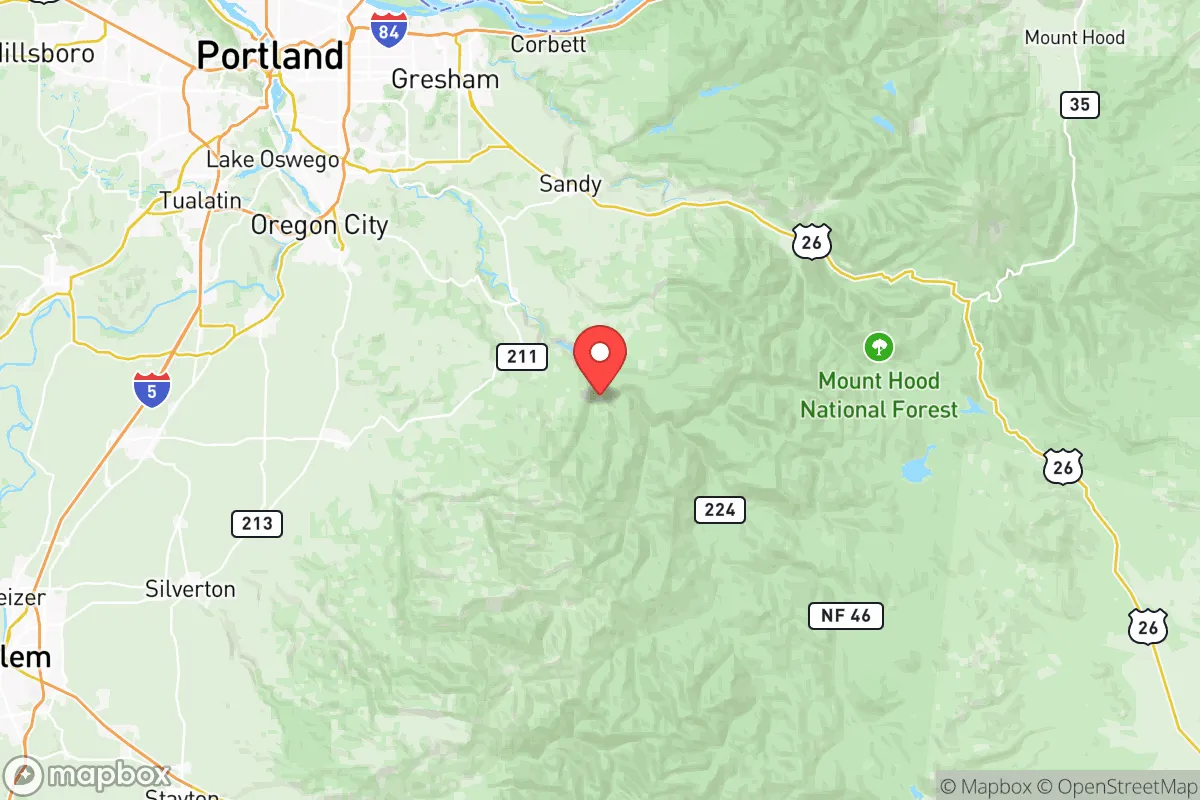
Oregon as a state is D+8, a solid blue lockbox driven by Multnomah County’s Portland machine. Clackamas County, at D+4, is the state’s most competitive large county—and it shows in the precinct-level numbers. The western towns like Lake Oswego and West Linn are deep blue, with precincts routinely hitting 60-70% Democratic. But drive east to Molalla, Estacada, or Sandy, and you’ll find precincts that vote 65-75% Republican. The real swing territory is in the middle: Oregon City, Gladstone, and Milwaukie are the toss-up zones where elections are won or lost. In 2024, the county’s presidential vote was within 2 points of a split, while the state as a whole went comfortably blue. That’s a huge gap—and it tells you Clackamas is the last redoubt of common sense in a state that’s gone off the deep end with progressive experiments.
What this means for residents
For those of us who value personal freedoms—like choosing our own healthcare, sending our kids to schools without ideological indoctrination, or running a small business without a mountain of new regulations—Clackamas County is a mixed bag. The county commission and many local city councils still have a conservative backbone, especially in the eastern towns. But the pressure is relentless. Portland’s homeless policies, drug decriminalization disasters, and tax hikes are creeping south. Oregon City recently saw a push to defund its police force, which failed, but only by a narrow margin. The real concern is that as more people flee Portland’s chaos, they bring the same voting habits that caused it. If you’re looking for a place where your Second Amendment rights are respected and your property taxes won’t skyrocket to fund pet projects, stick to the eastern half of the county. The western suburbs are already lost to the progressive agenda.
Culturally, Clackamas County still feels like the Oregon I grew up in—practical, independent, and wary of government overreach. But the policy battles are heating up. The county’s land-use planning, once a model for balancing growth and conservation, is now being weaponized to block new housing and drive up costs. Meanwhile, school boards in Canby and North Clackamas are fighting parental rights battles that would have been unthinkable a decade ago. The trajectory is clear: if the county’s D+4 rating slips to D+6 or D+8 in the next two cycles, we’ll lose the last check on Salem’s power. For now, Clackamas remains a place where your vote still counts—but don’t take it for granted. The fight for the soul of this county is real, and it’s happening block by block.

State Political ClimatePolitical Climate in Oregon
State Political AnalysisPolitical Environment in the State
Oregon is a state of stark political contradictions, carrying a Cook PVI of D+8 that masks a deep and growing urban-rural chasm. The state’s overall partisan lean is driven almost entirely by the Portland metro area—Multnomah, Washington, and Clackamas counties—which together cast roughly half the state’s votes and have shifted hard left over the past two decades. Meanwhile, the rest of Oregon, from the Willamette Valley farm towns to the high desert east of the Cascades, has swung just as dramatically in the opposite direction. The net result is a state that feels like two different countries sharing a border, with a single-party Democratic supermajority in Salem that has steadily expanded government control over nearly every aspect of daily life.
Urban vs. rural divide
The political map of Oregon is a textbook case of geographic polarization. Portland and its immediate suburbs—Beaverton, Hillsboro, Gresham—are among the most progressive jurisdictions in the nation, routinely voting 75-80% Democratic in presidential elections. Eugene and Corvallis, home to the University of Oregon and Oregon State University, add another deep-blue anchor in the southern Willamette Valley. Bend, once a purple mountain town, has drifted left as California transplants flood Deschutes County, though it still elects some Republicans locally. In stark contrast, the rest of the state is deeply red. Eastern Oregon counties like Malheur, Harney, and Lake routinely vote 70-80% Republican. The southern Oregon counties of Jackson and Josephine, anchored by Medford and Grants Pass, have become conservative strongholds, with Josephine County voting +32 R in 2024. Even historically competitive areas like Marion County (Salem) and Linn County (Albany) have trended right, though not enough to offset Portland’s weight. The rural-urban divide isn’t just about voting—it’s about worldview. Rural Oregonians feel increasingly ignored by Salem, which has led to serious talk of a Greater Idaho secession movement, with 13 counties voting to explore joining Idaho since 2020.
Policy environment
Oregon’s policy environment is a cautionary tale of what happens when one party holds unchecked power. The state has no sales tax, which sounds good until you realize property taxes are high and income taxes are among the steepest in the nation—top marginal rate of 9.9% on individual income over $125,000. The regulatory posture is aggressive: Oregon has some of the strictest land-use laws in the country, a cap-and-trade carbon program (though currently paused by ballot measure), and a statewide rent control law passed in 2019 that limits annual increases to 7% plus inflation. Education policy is dominated by teachers unions, with Portland Public Schools spending over $20,000 per student but producing mediocre outcomes. Healthcare is heavily regulated, with a state-run insurance exchange and Medicaid expansion that covers nearly 40% of residents. Election laws are among the most liberal: Oregon was the first state to vote entirely by mail (1998), automatically registers voters at the DMV, and allows same-day registration. Ballot measures are frequent and powerful—voters have legalized recreational marijuana, decriminalized hard drugs (later partially reversed), and approved assisted suicide. For a conservative, the cumulative effect is a state where government touches nearly everything, and the default answer from Salem is always more regulation, more taxes, and more mandates.
Trajectory & freedom
Oregon is becoming less free by almost any measure, and the trend has accelerated since 2020. On gun rights, the state passed Measure 114 in 2022, which requires a permit to purchase a firearm, bans magazines over 10 rounds, and mandates a waiting period. It’s currently tied up in court, but the intent is clear. On parental rights, Oregon was one of the first states to pass a law allowing minors to access gender-affirming care without parental consent (2023), and schools are not required to notify parents if a child changes their name or pronouns. On speech, the state has no campus free speech protections comparable to Texas or Florida, and Portland’s city council has repeatedly tried to restrict public assembly after the 2020 riots. Medical autonomy took a hit when the state decriminalized hard drugs in 2020 (Measure 110), then partially recriminalized possession in 2024 after overdose deaths spiked—a rare reversal that shows even progressive policies can fail. Property rights are under constant pressure from land-use regulations and a new transfer tax in Portland that adds 2-3% to home sales. The bottom line: if you value personal liberty in the traditional sense—gun ownership, parental authority, low taxes, minimal government—Oregon has been moving in the wrong direction for a decade, and the pace is accelerating.
Civil unrest & political movements
Oregon’s recent history of civil unrest is dominated by the 2020 Portland protests, which lasted for months and became a national flashpoint. The city saw nightly clashes between protesters and federal law enforcement, with the Justice Center and Mark O. Hatfield Federal Courthouse as epicenters. The movement was a mix of Black Lives Matter, antifa, and anarchist elements, and it left deep scars—businesses boarded up, police morale shattered, and a downtown that still hasn’t fully recovered. On the right, the Patriot Prayer and Proud Boys groups held counter-protests, and the state saw a rise in rural militia activity, particularly in Josephine and Jackson counties. Immigration politics are tense: Oregon is a sanctuary state (1987), and Portland has repeatedly refused to cooperate with ICE, even for criminal deportations. The Greater Idaho movement is the most serious secessionist effort in the country, with 13 counties voting to explore joining Idaho—a direct response to feeling politically orphaned by Salem. Election integrity is a hot-button issue: Oregon’s vote-by-mail system is secure but opaque to critics, and the 2020 election saw minor irregularities in Multnomah County that fueled distrust. A new resident would notice the political tension immediately—bumper stickers, yard signs, and conversations at the grocery store all reflect a state at war with itself.
Projection
Over the next 5-10 years, Oregon’s political trajectory points toward continued polarization and likely further leftward policy at the state level. Demographic trends favor Democrats: Portland’s population is stable, while rural counties are aging and losing young people. In-migration from California, while slowing, still brings more progressive voters than conservative ones. The state’s single-party rule is unlikely to break—Republicans haven’t won a statewide office since 2002, and gerrymandered legislative districts make a GOP majority nearly impossible. However, the rural backlash is real and growing. The Greater Idaho movement could gain traction if frustration reaches a tipping point, though the constitutional hurdles are massive. What a new resident should expect: higher taxes, more regulations, and a state government that continues to expand its reach into personal decisions. The one wild card is the housing crisis—if affordability continues to deteriorate, it could trigger an exodus of the very voters who keep Oregon blue. For now, the state is locked into a progressive trajectory, and anyone moving here should be prepared for a political environment that feels increasingly hostile to traditional conservative values.
Bottom line for a new resident: Oregon offers stunning natural beauty and a laid-back lifestyle, but the political climate is a serious consideration. If you value low taxes, gun rights, parental authority, and limited government, you will find yourself swimming against a strong current. The urban centers are deeply progressive, the rural areas are fiercely conservative, and the state government is firmly in the hands of the former. Choose your county carefully—living in Grants Pass is a very different experience than living in Portland—and understand that the state-level policies will affect you regardless of where you settle. Oregon is a beautiful place to live, but it is not a free one by conservative standards, and the trend lines suggest it will become less so.
* Values derived from national, state, county, city and local statistics and may differ in a specific area. Last updated: 2026-05-12T14:40:46.000Z
Narrative content on this page is AI-generated and may contain mistakes. Verify any details that matter before acting on them.
ReloMaps may earn a commission from affiliate links at no extra cost to you.

