Photo: Wikipedia
Political ClimatePolitical Climate in Plantation, FL
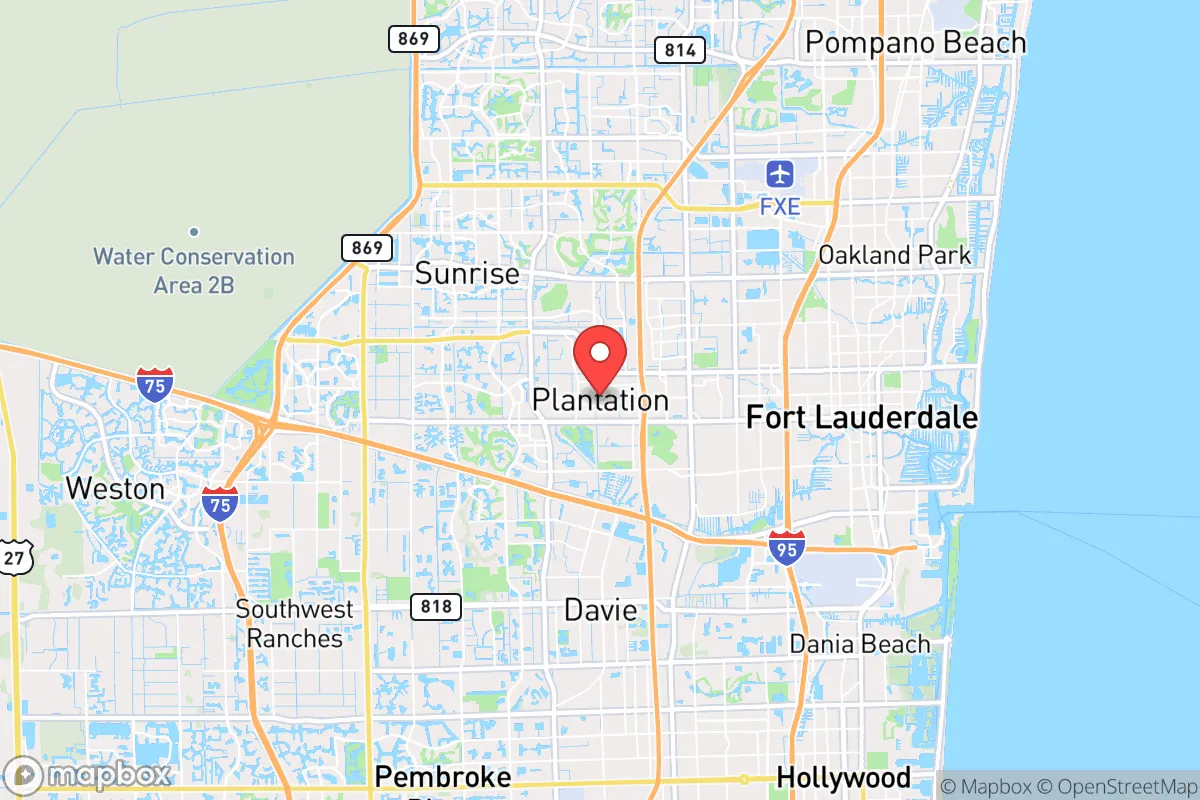
District shown is the primary district for this city’s centroid. Cities may span multiple districts.
Local Political AnalysisPolitical Analysis of Plantation, FL
Plantation, Florida, leans heavily Democratic, with a Cook PVI of D+22, meaning it votes about 22 points more Democratic than the national average. This wasn't always the case—back in the 80s and 90s, this was a reliably conservative, family-oriented suburb where folks minded their own business and the biggest political debate was about the HOA's lawn height rules. Over the last two decades, the shift has been dramatic, driven by an influx of younger families from the Northeast and a growing progressive activist presence in Broward County. The trajectory is clear: what was once a quiet, middle-class stronghold for traditional values is now firmly in the blue column, and the trend shows no signs of reversing.
How it compares
To understand Plantation's political climate, you have to look at its neighbors. Head west to Weston or Parkland, and you'll find communities that still lean more conservative—those areas tend to vote Republican in local races and have a stronger libertarian streak on issues like taxes and property rights. Drive east into Fort Lauderdale or south into Davie, and you're in deep-blue territory where progressive policies on zoning, policing, and school curriculum are the norm. Plantation sits right in the middle of this Broward County landscape, but its D+22 rating puts it squarely in the progressive camp. The contrast is stark: while Weston might elect a Republican mayor, Plantation's city council and school board are dominated by Democrats who often push for higher density housing, more government-funded programs, and stricter environmental regulations that can feel like overreach to longtime residents.
What this means for residents
For someone who values personal freedoms and limited government, living in Plantation today means navigating a local government that's increasingly comfortable telling you how to live. The city has embraced "smart growth" policies that limit single-family home expansions, and there's constant pressure to adopt Broward County's more aggressive mask and vaccine mandates—even after the pandemic peak. Property taxes have crept up as the city funds new parks and public art projects that not everyone asked for. The school board, which is heavily progressive, has pushed for DEI initiatives and critical race theory-aligned curricula that many parents find intrusive. If you're a conservative or libertarian, you'll find yourself in the minority at town hall meetings, and your voice on issues like Second Amendment rights or school choice is often drowned out by organized progressive groups. The long-term outlook is concerning: as more young, left-leaning professionals move in, the political center will keep shifting left, making it harder to preserve the traditional, hands-off atmosphere that made Plantation attractive in the first place.
Culturally, Plantation still has pockets of that old-school Florida feel—neighborhoods where people wave from their porches and the local diner knows your order. But the policy distinctions are growing. The city has banned plastic straws and is considering a "climate action plan" that could restrict car usage and mandate solar panels on new homes. These aren't just environmental gestures; they're examples of government overreach into daily life. For residents who remember when Plantation was a place where you could build a fence without a permit or park your boat in the driveway without a citation, the shift is jarring. If you're considering a move here, know that you'll be living in a community where progressive ideology is the default, and pushing back on it will require constant vigilance. It's still a safe, well-maintained city with good schools, but the political climate is increasingly at odds with the values of personal liberty and limited government that many of us hold dear.

State Political ClimatePolitical Climate in Florida
State Political AnalysisPolitical Environment in the State
Florida has transformed from a quintessential swing state into a solidly Republican-leaning powerhouse over the past decade, with registered Republicans now outnumbering Democrats by over 800,000 voters as of 2025. The dominant coalition is a mix of conservative retirees, Hispanic voters (especially Cuban-Americans and Venezuelans in Miami-Dade), and transplants from blue states seeking lower taxes and fewer restrictions. The trajectory has been a sharp rightward shift since 2018, driven by Governor Ron DeSantis’s aggressive conservative agenda and a massive influx of new residents from high-tax states like New York and California.
Urban vs. rural divide
The political map of Florida is a textbook study in geographic polarization. The major Democratic strongholds are the dense, diverse urban cores of Miami-Dade County (though it flipped from +29 D in 2016 to +11 R in 2024), Orlando (Orange County), and Tampa (Hillsborough County), along with college towns like Gainesville (Alachua County). These areas are driven by younger voters, public-sector unions, and minority populations that lean left. Meanwhile, the entire northern and central spine of the state—places like Ocala (Marion County), Pensacola (Escambia County), and Naples (Collier County)—vote Republican by 20-40 points. The Panhandle is culturally Deep South, while the southwest coast is a retiree haven for conservative Midwesterners. The most telling shift is in Miami-Dade, where Cuban and Venezuelan voters, repelled by socialist rhetoric from the national Democratic Party, have pushed the county from purple to red in just two cycles.
Policy environment
Florida’s policy environment is a conservative’s dream, built on low taxes and light regulation. There is no state income tax, a constitutional cap on property tax increases (Save Our Homes amendment), and a right-to-work law that keeps unions weak. Education policy is a national battleground: the state has universal school choice via vouchers and education savings accounts (HB 1, 2023), and the Parental Rights in Education Act (HB 1557, 2022) bans classroom instruction on sexual orientation and gender identity through third grade. Healthcare is market-driven, with no state-level Medicaid expansion under Obamacare and a strong telemedicine and direct-primary-care ecosystem. Election laws were tightened after 2020 (SB 90, 2021), requiring voter ID, limiting drop boxes, and banning ballot harvesting—measures that critics call suppression but supporters call integrity. The state also preempted local gun ordinances (SB 7026, 2018), ensuring uniform carry laws statewide, including permitless carry (HB 543, 2023).
Trajectory & freedom
Florida is arguably the most freedom-expanding state in the union over the past five years, but the trajectory is not without tension. On the plus side, permitless carry (HB 543) and the abolition of COVID-19 mandates (2021 executive orders banning vaccine passports and mask mandates in schools) were massive wins for personal liberty. The Individual Freedom Act (HB 7, 2022), known as the “Stop WOKE Act,” bans mandatory diversity training and critical race theory in workplaces and schools—a direct check on corporate and academic overreach. Property rights were strengthened with the Live Local Act (SB 102, 2023), which preempts local zoning to allow more affordable housing development. However, there are concerning signs: the state’s anti-riot law (HB 1, 2021) increased penalties for protest-related offenses, which some see as a necessary crackdown on disorder but others view as chilling free assembly. The 15-week abortion ban (HB 5, 2022) and subsequent 6-week ban (SB 300, 2023) represent a major contraction of medical autonomy. Overall, Florida is becoming more free on economic and speech fronts, but less free on social and medical choices—a trade-off that aligns with its conservative majority.
Civil unrest & political movements
Florida has seen its share of political flashpoints, but they are less frequent and less destructive than in states like Oregon or New York. The 2020 George Floyd protests in Miami, Tampa, and Jacksonville saw some looting and arson, but were met with a swift law enforcement response and the aforementioned anti-riot law. Immigration politics are hot: Governor DeSantis’s SB 1718 (2023) requires E-Verify for employers, bans local “sanctuary” policies, and makes transporting illegal immigrants a crime. This has led to legal battles and protests from immigrant-rights groups, especially in Miami and Orlando. The “Don’t Say Gay” controversy (HB 1557) sparked walkouts by high school students and national media outrage, but local support remains strong. Election integrity remains a live issue: the state’s Office of Election Crimes and Security (created 2022) has prosecuted dozens of cases of double voting and illegal registration, which supporters say restores trust but critics call voter intimidation. You won’t see daily street protests, but the culture war is fought in school board meetings and county commission chambers, especially in suburbs like St. Johns County (north of St. Augustine) and Lee County (Fort Myers).
Projection
Over the next 5-10 years, Florida will likely become more Republican and more conservative, driven by continued in-migration from blue states. The demographic shift is powerful: the state is gaining 1,000 new residents per day, many of them white-collar conservatives from the Northeast and Midwest. The Hispanic vote, especially in Miami-Dade, is trending right as younger Cuban-Americans and Venezuelans reject left-wing economic policies. The only wild card is the I-4 corridor (Tampa to Orlando), which remains competitive and could flip back if national Democrats moderate their message. However, the state GOP’s grip on the legislature and governor’s mansion is so strong that any Democratic wins would be limited to local offices. Expect continued expansion of school choice, further tax cuts (possibly eliminating the corporate income tax), and more preemption of local progressive ordinances. The biggest risk is overreach: if the state bans abortion entirely or restricts gun rights further, it could alienate the moderate suburbanites who have been key to the GOP’s success. But for now, the trajectory is clear: Florida is the conservative laboratory for the nation.
Bottom line for a new resident: If you’re moving to Florida for freedom from government overreach, you’re making a smart bet. You’ll find low taxes, strong parental rights, and a state government that actively fights federal overreach and corporate wokeness. Just be prepared for a hot culture war in local schools and a political environment where your vote actually matters in primaries, not just general elections. The state is not a libertarian paradise—it has its own rules on abortion, speech, and protest—but it is far more aligned with conservative values than any other large state in the country. Choose your county wisely: Collier or St. Johns for deep red comfort, Miami-Dade for a vibrant conservative Hispanic culture, or the Panhandle for a slower, more traditional pace.
* Values derived from national, state, county, city and local statistics and may differ in a specific area. Last updated: 2026-09-21T19:02:07.000Z
Narrative content on this page is AI-generated and may contain mistakes. Verify any details that matter before acting on them.
ReloMaps may earn a commission from affiliate links at no extra cost to you.

