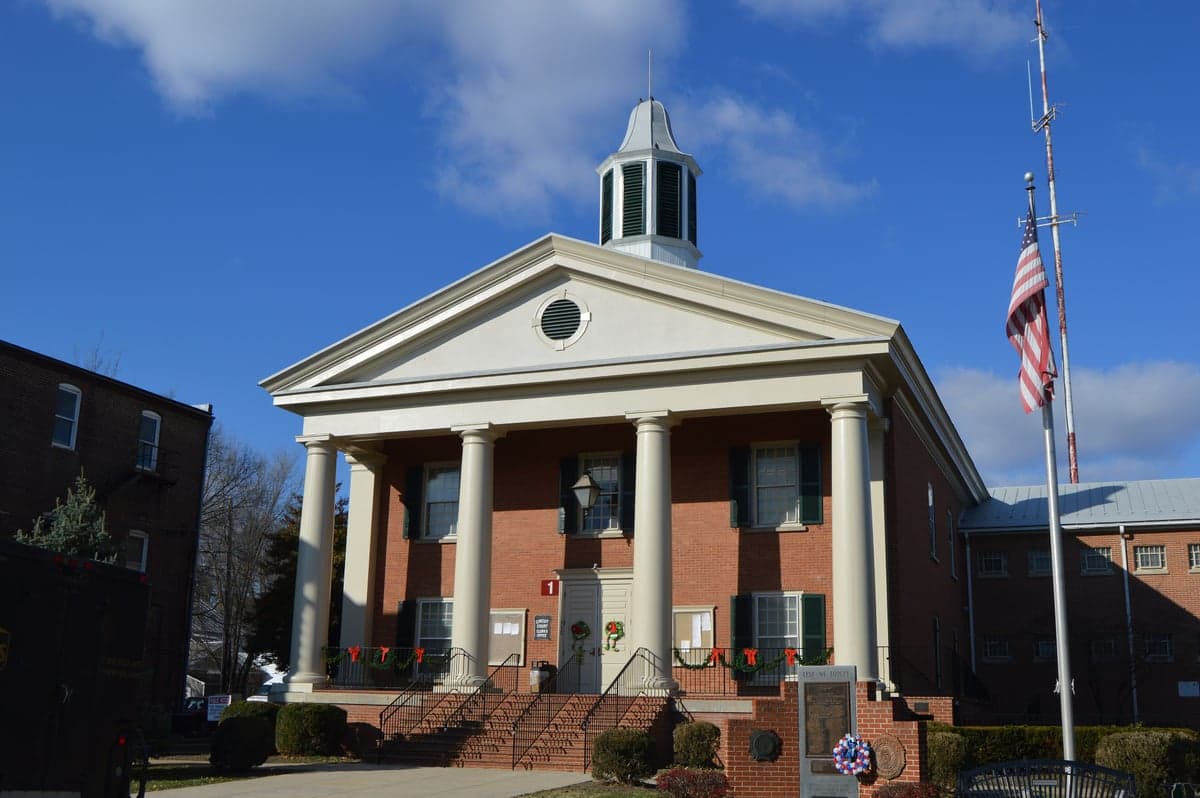
Photo: Wikipedia
Political ClimatePolitical Climate in Shenandoah County
Showing state-level results — no local-only data available.
Local Political AnalysisPolitical Analysis of Shenandoah County
Shenandoah County, Virginia, is a reliably conservative stronghold with a Cook Partisan Voting Index of R+12, meaning it votes about 12 points more Republican than the national average. This stands in stark contrast to the state of Virginia as a whole, which has shifted to a D+4 PVI, reflecting the Democratic lean driven by the populous suburbs of Northern Virginia, Richmond, and Hampton Roads. Over the past decade, the county has only grown more Republican, with Trump winning it by over 30 points in both 2016 and 2020, a trend that shows no sign of reversing in the near future.
How it compares
The political divide between Shenandoah County and the rest of Virginia is one of the sharpest in the state. While Virginia’s statewide elections are now reliably blue—Democrats have won every gubernatorial and presidential race since 2009—Shenandoah County remains a deep red outlier. The county’s R+12 PVI is a full 16 points more conservative than the state’s D+4 rating. This gap is not just theoretical; it plays out in local voting patterns. In the town of Woodstock, the county seat, you’ll find a slight moderating influence, with some precincts near the downtown core and the Shenandoah University campus occasionally voting within 5 points of a Democrat. But head to Mount Jackson or Edinburg, and the margins for Republican candidates routinely exceed 40 points. The swing precincts are almost nonexistent—most of the county is solidly red, with only a handful of precincts in Strasburg and Toms Brook showing any competitive lean, and even those still favor the GOP by 10-15 points.
What this means for residents
For conservative residents, living in Shenandoah County means your vote carries real weight in local elections—school board, board of supervisors, and sheriff races are almost always decided in the Republican primary. You’ll find a community that largely shares your views on gun rights, limited government, and traditional values, with local policies reflecting that. For liberal residents, it can feel like being in a political island. You’ll have few elected officials who share your perspective, and local debates—like those over land use, school curriculum, or renewable energy projects—often tilt heavily conservative. That said, the county is not hostile; most folks are neighborly regardless of party, and the small-town culture means personal relationships often trump political disagreements. The real tension comes during election season, when yard signs for Democratic candidates are rare and sometimes met with side-eye, but it’s a far cry from the heated partisan battles you’d see in Northern Virginia.
Culturally, Shenandoah County is distinct from the rest of Virginia in its deep-rooted agricultural and rural identity. You won’t find the tech-driven, fast-paced lifestyle of Loudoun County or the urban energy of Richmond. Instead, the area prizes self-reliance, local farming, and a slower pace of life. Policy-wise, the county has resisted many state-level mandates, particularly around gun control and COVID-19 restrictions, often passing resolutions to declare itself a “Second Amendment Sanctuary” or pushing back against school mask mandates. This creates a palpable sense of autonomy, but also a friction with state government in Richmond, which many locals view as out of touch with rural Virginia. Looking ahead, the county’s political trajectory seems locked in: as Virginia’s urban and suburban areas continue to grow and lean left, Shenandoah County will likely only become more of a conservative bastion, a place where the old Virginia—rural, traditional, and Republican—still holds firm.

State Political ClimatePolitical Climate in Virginia
State Political AnalysisPolitical Environment in the State
Virginia has shifted from a reliably red state to a solidly blue one over the past two decades, now carrying a Cook PVI of D+4. The transformation was driven largely by explosive growth in the Washington, D.C. suburbs—places like Loudoun County, Prince William County, and Arlington—which have turned from swing areas into Democratic strongholds. At the same time, the rest of the state, particularly rural Southside and the Shenandoah Valley, has moved sharply right, creating one of the most pronounced urban-rural political divides in the country. For a relocator, this means your experience of Virginia’s politics will depend almost entirely on which corner of the state you land in.
Urban vs. rural divide
The political map of Virginia is essentially a story of two states. The northern Virginia suburbs—Fairfax County, Arlington, Alexandria—are among the most Democratic areas in the nation, routinely delivering 65-70% of the vote to Democratic candidates. Richmond and Norfolk also lean blue, though less overwhelmingly. Meanwhile, rural and exurban areas like Lynchburg, Roanoke (the city itself is purple, but the surrounding counties are deep red), and the entire Southside region from Danville to Martinsville vote Republican by margins of 30-40 points. The key battlegrounds are the exurban counties that ring the D.C. suburbs—places like Stafford and Spotsylvania—which have trended blue in recent cycles but still host a strong conservative presence. In 2024, Loudoun County flipped back to the GOP at the presidential level after voting for Biden by 25 points in 2020, a sign that even the bluest suburbs are not monolithic.
Policy environment
Virginia’s policy environment is a patchwork. The state income tax is a flat 5.75% (as of 2026), with no local income tax, and the sales tax is 5.3% (higher in some localities). Property taxes are set locally and vary widely—Loudoun County has some of the highest rates in the state, while rural counties like Halifax are much lower. Education policy is a major flashpoint: the state has a strong school choice program (the Virginia Education Improvement Scholarship Tax Credit) but also maintains a robust public school system with some of the best-funded schools in the country in Northern Virginia. Healthcare is heavily regulated, with a state-run insurance exchange and Medicaid expansion under the Affordable Care Act. Election laws are relatively moderate—no-excuse absentee voting is allowed, but voter ID is required. The state has a Democratic governor (as of 2026) and a narrowly divided legislature, meaning policy can swing sharply with each election cycle.
Recent policy direction
Over the past five years, Virginia has enacted a series of laws that reflect its blue tilt, but with notable exceptions. On gun and self-defense law, the state passed a red-flag law (2020), a one-handgun-a-month purchase limit, and universal background checks, but it also preempts local governments from banning concealed carry in most public spaces. Parental and education rights have been a battleground: the state repealed a law requiring schools to notify parents of LGBTQ+ curriculum changes (2023), but a 2024 law now mandates that schools adopt policies on parental notification for student health services. On speech and privacy, Virginia passed the Consumer Data Protection Act (2021), one of the strongest state privacy laws, but also enacted a law (2024) that criminalizes “doxxing” of public officials. Medical and bodily autonomy is a mixed bag: abortion remains legal up to 26 weeks (with a 24-hour waiting period), but the state banned gender-affirming care for minors in 2025. Property rights are generally strong, with no statewide rent control and a relatively low property tax burden compared to neighboring Maryland. Voting and ballot access has been liberalized: same-day voter registration is now allowed, and early voting is available for 45 days before an election. The overall direction is a cautious leftward drift, tempered by a Republican governor who has vetoed the most aggressive progressive bills.
Civil unrest & political movements
Virginia has been a flashpoint for political activism on both sides. The 2017 Unite the Right rally in Charlottesville remains a defining moment, leading to a statewide ban on firearms at public demonstrations (later struck down in court). The 2020 protests in Richmond over the removal of Confederate statues drew both left-wing activists and counter-protesters, and the statues were eventually removed by the city. Immigration politics are less heated than in border states, but Prince William County has seen debates over sanctuary policies—it declared itself a “welcoming community” in 2021, but the state has no formal sanctuary law. Election integrity controversies flared after 2020, with Republican-led audits in Loudoun County finding no widespread fraud, but the issue remains a rallying point for conservative activists. A new resident would notice the prevalence of political yard signs and bumper stickers, especially in the exurbs, but actual civil unrest is rare outside of organized protests in Richmond and Charlottesville.
Projection
Over the next 5-10 years, Virginia is likely to remain a lean-blue state, but the margin could narrow. In-migration from the Northeast and California is slowing, while domestic out-migration from Northern Virginia to lower-cost states is accelerating. The fastest-growing parts of the state are the exurban counties south of Fredericksburg and west of Richmond, which tend to be more conservative. At the same time, the Hampton Roads area (Norfolk, Virginia Beach) is growing slowly and remains politically split. The Democratic advantage in Northern Virginia is unlikely to erode completely, but the GOP could become more competitive if they can hold onto the exurbs and make gains among Hispanic voters in Prince William County. A relocator moving in now should expect a state that will continue to swing between divided government and narrow Democratic control, with policy outcomes that are moderate by national standards—neither as progressive as California nor as conservative as Texas.
For a new resident, the bottom line is that Virginia offers a genuinely mixed political environment. If you’re a conservative, you’ll find a welcoming community in the Shenandoah Valley, Southside, or the exurbs, but you’ll be living under a state government that leans left on most issues. If you’re a liberal, you’ll feel at home in Northern Virginia or Richmond, but you’ll encounter strong conservative opposition in the legislature. The practical takeaway is to choose your locality carefully—your day-to-day experience of politics in Loudoun County versus Lynchburg will be night and day. The state as a whole is a purple-to-blue battleground, and that’s unlikely to change anytime soon.
* Values derived from national, state, county, city and local statistics and may differ in a specific area. Last updated: 2026-10-02T02:35:38.000Z
Narrative content on this page is AI-generated and may contain mistakes. Verify any details that matter before acting on them.
ReloMaps may earn a commission from affiliate links at no extra cost to you.

