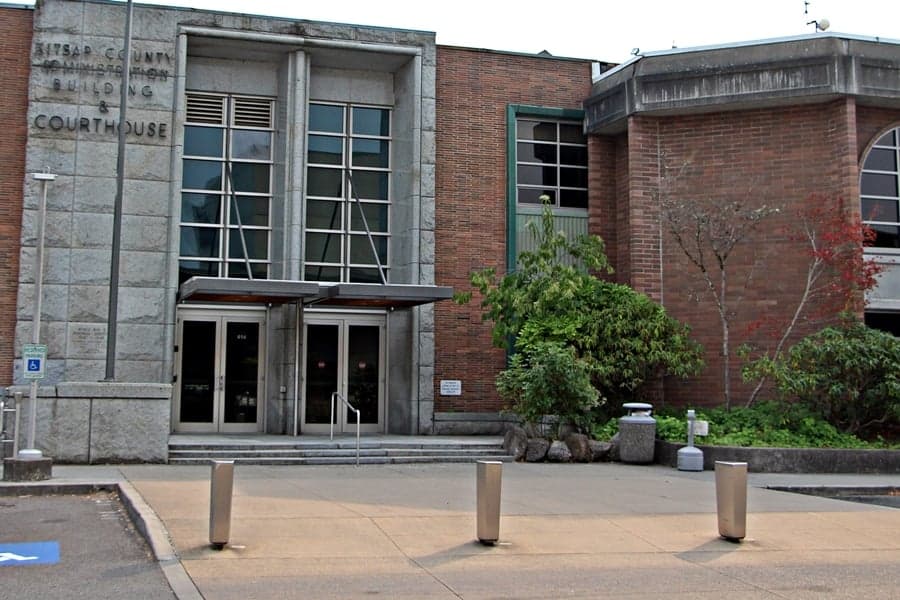
Photo: Wikipedia
Political ClimatePolitical Climate in Kitsap County
Showing district-level results — no local-only data available.
Local Political AnalysisPolitical Analysis of Kitsap County
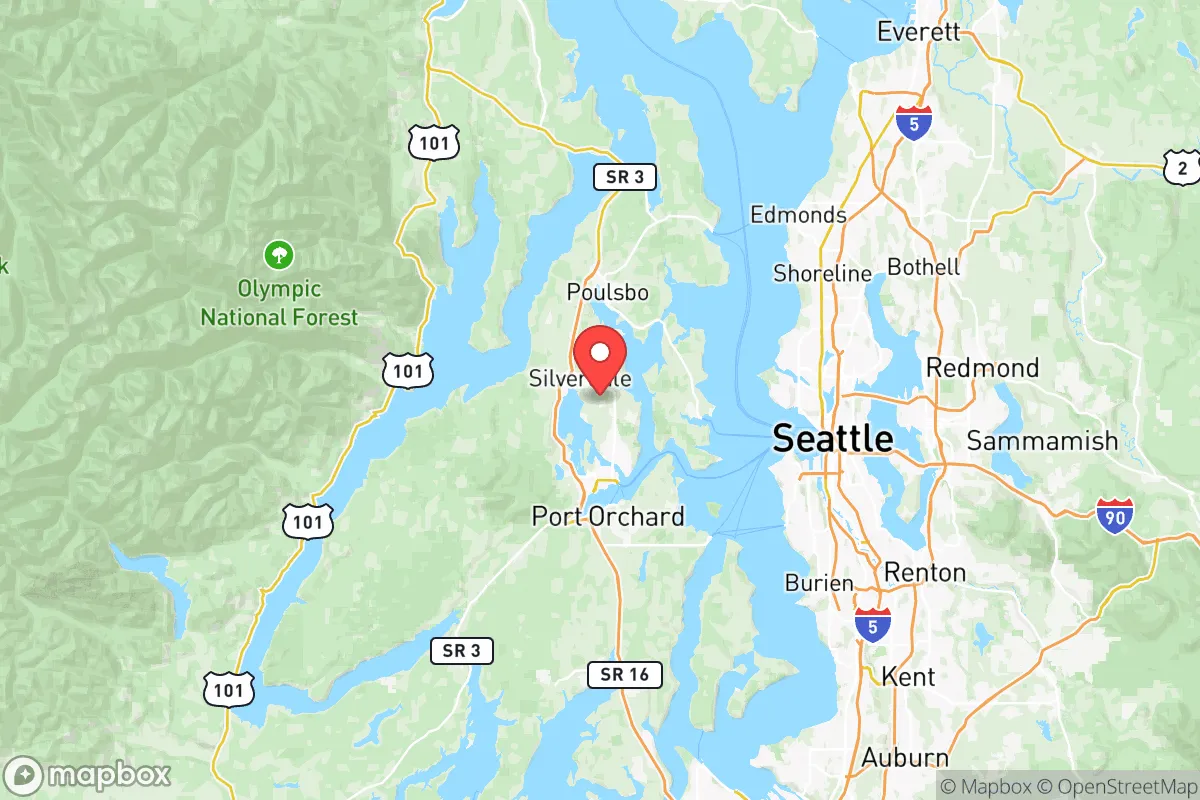
Kitsap County is a reliably Democratic stronghold with a Cook PVI of D+10, meaning it votes about ten points more Democratic than the national average. This isn't a recent shift—the county has voted blue in every presidential election since 2004, and the trend has only solidified. In 2024, Kamala Harris carried the county by roughly 15 points, mirroring the statewide margin in Washington. But that countywide number hides a lot of local texture. You’ve got deep-blue precincts in Bainbridge Island and Poulsbo, where progressive activism is the norm, and reliably red pockets in South Kitsap around Port Orchard and Belfair, where Trump flags still fly on rural roads. The real swing precincts are in Silverdale and Central Kitsap, where military families and defense contractors mix with commuters to Seattle, creating a more moderate, often split-ticket voting pattern.
How it compares
Compared to Washington state as a whole, Kitsap County is slightly more Democratic than the statewide average. Washington’s Cook PVI is also D+8, so Kitsap’s D+10 puts it a couple points left of the state. That’s less blue than King County (Seattle) but bluer than neighboring Pierce County (Tacoma) or Mason County. The difference is driven by Bainbridge Island, which votes like a mini-Berkeley, and the Suquamish and Port Madison Indian Reservation areas, where tribal sovereignty and environmental issues push turnout reliably Democratic. In contrast, Hansville and the Key Peninsula lean more conservative, though their populations are smaller. The net effect is that Kitsap’s politics feel more like a scaled-down version of Washington’s coastal counties than the inland, more conservative eastern part of the state.
What this means for residents
For liberal residents, the D+10 lean means local elections are rarely competitive in the primary, and progressive policies on housing density, ferry funding, and environmental protections tend to advance. The county council has a Democratic majority, and issues like the Bainbridge Island ferry terminal expansion or Poulsbo’s growth management get heavy public input from the left. For conservative residents, it means feeling like a minority voice in county government, but not an ignored one. The South Kitsap area still elects Republican precinct committee officers, and the Port Orchard city council has a conservative bloc. The practical effect is that property tax increases and land-use regulations often pass countywide, but rural areas push back successfully on things like urban growth boundaries. The Naval Base Kitsap presence—the largest employer in the county—creates a unique dynamic: the base’s mission is nonpartisan, but its workforce includes both active-duty military (often more conservative) and civilian defense contractors (often more moderate), which keeps local politics from swinging too far in either direction.
Culturally, the county’s political divide shows up in everyday life. On Bainbridge Island, you’ll see more "Black Lives Matter" signs and electric cars; in Belfair, more "Thin Blue Line" flags and lifted trucks. The Bremerton waterfront has gentrified with new condos and breweries, bringing younger, left-leaning residents, while Silverdale remains a middle-ground hub where the Kitsap Mall and the county fairgrounds host events that draw both sides. Policy-wise, the county has a higher minimum wage than the state floor (tied to inflation), and it’s one of the few in Washington with a dedicated mental health sales tax. The biggest cultural distinction is the ferry system: Kitsap’s reliance on Washington State Ferries means transportation policy is a constant political flashpoint, with liberals pushing for more service and electrification, and conservatives arguing for cost control and reliability. It’s a place where you can have a civil conversation about politics at a Poulsbo coffee shop, but you’ll know within five minutes which side of the ferry line your neighbor stands on.

State Political ClimatePolitical Climate in Washington
State Political AnalysisPolitical Environment in the State
Washington state has been a reliably Democratic stronghold for over a decade, but its reputation as a deep-blue monolith hides a fiercely contested and geographically polarized political landscape. The state hasn’t voted for a Republican presidential candidate since 1984, and Democrats control every statewide office and both legislative chambers. However, the margin of control has narrowed in recent cycles, driven by a growing suburban and exurban conservative vote, even as the Seattle metro area’s population boom cements the state’s overall leftward tilt. For a conservative relocator, the reality is nuanced: you’ll find blue cities and red counties, a state government that passes ambitious progressive legislation, and a growing number of communities where your vote actually matters more than in most of the country.
Urban vs. rural divide
The political map of Washington is a textbook case of the urban-rural chasm. King County, home to Seattle, alone casts about a third of the state’s votes and delivers a Democratic margin of roughly 500,000 votes—enough to decide every statewide election before the rest of the state is even counted. Pierce County (Tacoma) and Snohomish County (Everett) are now reliably blue as well, though with more moderate edges. In contrast, the eastern half of the state—places like Spokane, Yakima, and the Tri-Cities (Kennewick, Pasco, Richland)—votes overwhelmingly Republican. The most dramatic shift has been in the exurban counties ringing Puget Sound: Clark County (Vancouver) flipped from red to blue in 2020 and 2024, driven by Portland-area transplants and tech workers, while Thurston County (Olympia) has become solidly Democratic as state government employment expanded. Meanwhile, Kitsap County (Bremerton) remains a true swing county, voting within a few points of the national average. The only reliably red strongholds left are the rural interior and the far southwest, like Lewis County (Centralia) and Ferry County (Republic), which vote +30 to +40 Republican.
Policy environment
Washington’s policy environment is defined by a progressive tax structure and aggressive regulatory posture. The state has no personal or corporate income tax, relying instead on a high sales tax (state rate 6.5%, with local add-ons pushing it to 10%+ in Seattle) and high property taxes. This makes it attractive for high earners but punishing for low-income households. The regulatory climate is business-friendly in some sectors (tech, aerospace) but heavily restrictive in others (land use, environmental permitting). Education policy is a flashpoint: the state funds K-12 through a complex levy system that creates wide disparities between wealthy and poor districts, and voters have repeatedly rejected charter schools. Healthcare is dominated by the state’s robust Medicaid expansion and a strong insurance exchange. Election laws are among the most accessible in the nation: all elections are conducted by mail, with ballots automatically sent to every registered voter, same-day registration, and no voter ID requirement. This system has high turnout but has drawn criticism from conservatives over ballot security concerns.
Recent policy direction
The last five years have seen a rapid acceleration of progressive legislation that directly affects the liberties a relocator might weigh. On gun rights, Washington passed a ban on assault weapons (2023) and a 10-day waiting period for all firearm purchases (2024), with a magazine capacity limit already in place. Self-defense law is relatively permissive—the state has a “stand your ground” doctrine via case law—but the new restrictions make it harder to acquire certain firearms. On parental and education rights, the state passed a law requiring schools to notify parents of a student’s gender identity changes (2023), but also mandates that schools adopt policies protecting LGBTQ+ students from discrimination, creating tension in conservative districts. Speech is broadly protected under the state constitution, but a 2024 law criminalizes “malicious harassment” with a lower threshold than federal hate crime statutes. Privacy and surveillance: Washington has one of the strongest biometric privacy laws in the country (2021), requiring opt-in consent for facial recognition. Medical and bodily autonomy is fully protected—abortion remains legal without gestational limits, and the state has a shield law protecting providers and patients from out-of-state prosecution. Property rights are constrained by the Growth Management Act, which limits development in rural areas and has driven up housing costs. Taxation remains income-tax-free, but a 2023 capital gains tax (7% on gains over $250,000) was upheld by the state supreme court, signaling a potential future income tax. Voting and ballot access remain extremely easy, but a 2024 law requires signature verification for all mail ballots, a modest tightening.
Civil unrest & political movements
Washington has a history of high-profile civil unrest, particularly in Seattle. The 2020 CHOP/CHAZ occupation in Capitol Hill was a national flashpoint, and the city saw sustained protests for months. Since then, organized activism has shifted: the left is focused on housing and police reform (the state passed a sweeping police accountability law in 2021), while the right has built a robust grassroots network around school board elections and property rights. Immigration politics are a major dividing line: Washington is a “sanctuary state” by executive order, limiting local law enforcement cooperation with ICE, and the state funds legal defense for undocumented immigrants. This has created friction in agricultural counties like Yakima and Grant, where farm labor is heavily immigrant. Secession rhetoric is mostly confined to the “Liberty State” movement in eastern Washington, which periodically floats a 51st state proposal but has no serious political traction. Election integrity controversies flared in 2020 and 2022, with Republican candidates in close races (like the 3rd Congressional District) alleging irregularities, but no major fraud has been proven. The most visible flashpoint for a new resident is likely the homelessness crisis in Seattle, Tacoma, and Olympia, which has become a political battleground between “housing first” advocates and those pushing for more enforcement.
Projection
Over the next 5-10 years, Washington’s political trajectory points toward a slow but steady deepening of its blue lean, but with growing internal friction. The Seattle metro area continues to grow faster than the rest of the state, adding hundreds of thousands of new residents who vote overwhelmingly Democratic. However, the exurban counties like Clark and Pierce are becoming more competitive as housing costs push moderates and conservatives farther out. The state’s Democratic supermajority in the legislature is likely to hold, but the margin may narrow as rural areas become more energized. The biggest wild card is the state’s tax structure: the capital gains tax is almost certain to be challenged again, and if it survives, a broader income tax could be on the ballot within a decade. For a conservative moving in now, expect to live in a state where your vote for president and Senate is essentially meaningless, but your vote for local offices—county commission, school board, city council—can be decisive, especially in the growing exurbs. The state’s policy direction will continue to be progressive on social issues, but the lack of an income tax and the strong economy will keep it attractive for professionals.
Bottom line for a new resident: If you’re a conservative moving to Washington, you’re not moving to a deep-red state, but you’re also not moving to a place where your voice is irrelevant. The key is choosing your location wisely. Stick to the exurban counties like Clark, Kitsap, or the Spokane area, where your vote for local office matters and your lifestyle choices—schools, land use, taxes—are more aligned with your values. The state government will continue to pass laws you disagree with, but the practical impact is often blunted by local control and the state’s strong economy. If you can tolerate a blue state government in exchange for no income tax, beautiful geography, and a growing conservative counterweight in the suburbs, Washington can still work for you. Just don’t expect to change the state’s overall direction anytime soon.
* Values derived from national, state, county, city and local statistics and may differ in a specific area. Last updated: 2026-10-20T23:16:14.000Z
Narrative content on this page is AI-generated and may contain mistakes. Verify any details that matter before acting on them.
ReloMaps may earn a commission from affiliate links at no extra cost to you.

