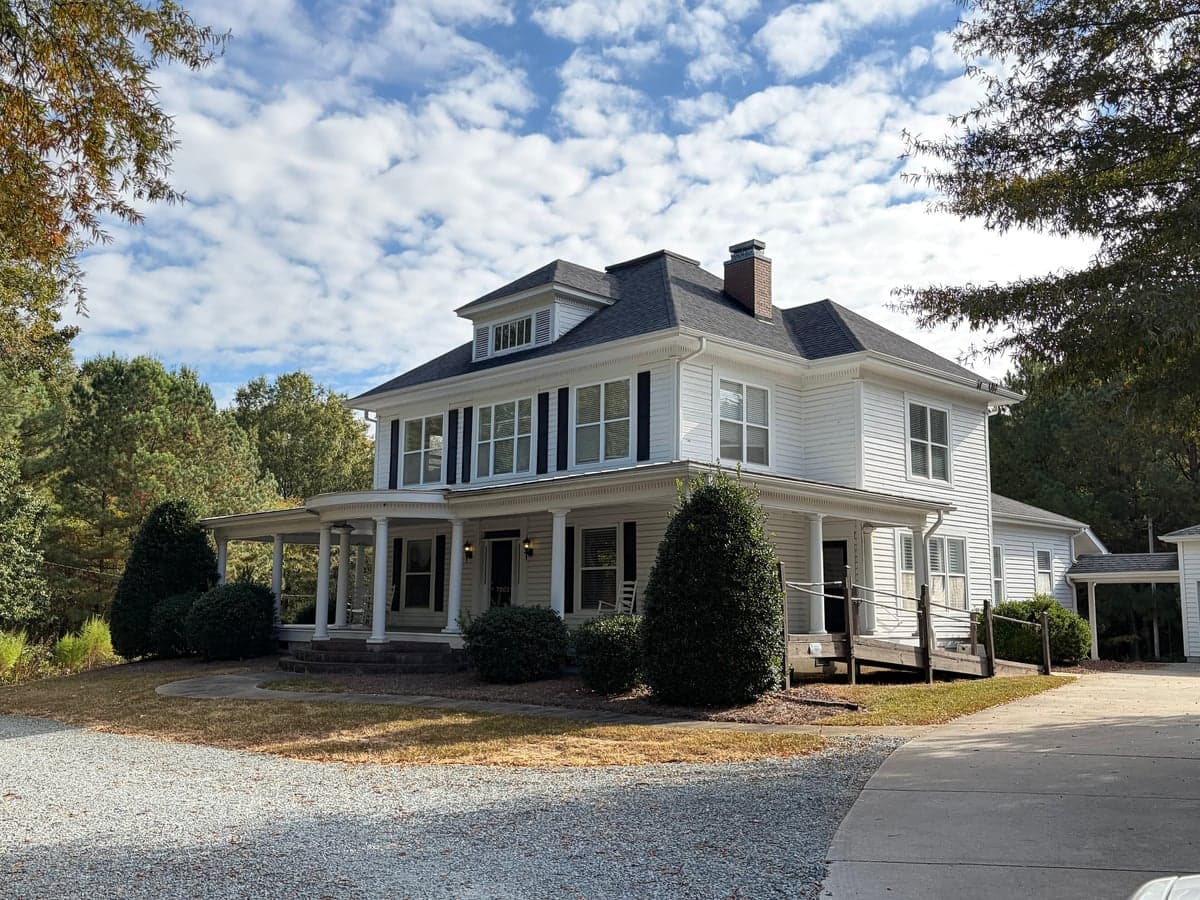
Photo: Wikipedia
Political ClimatePolitical Climate in Weddington, NC
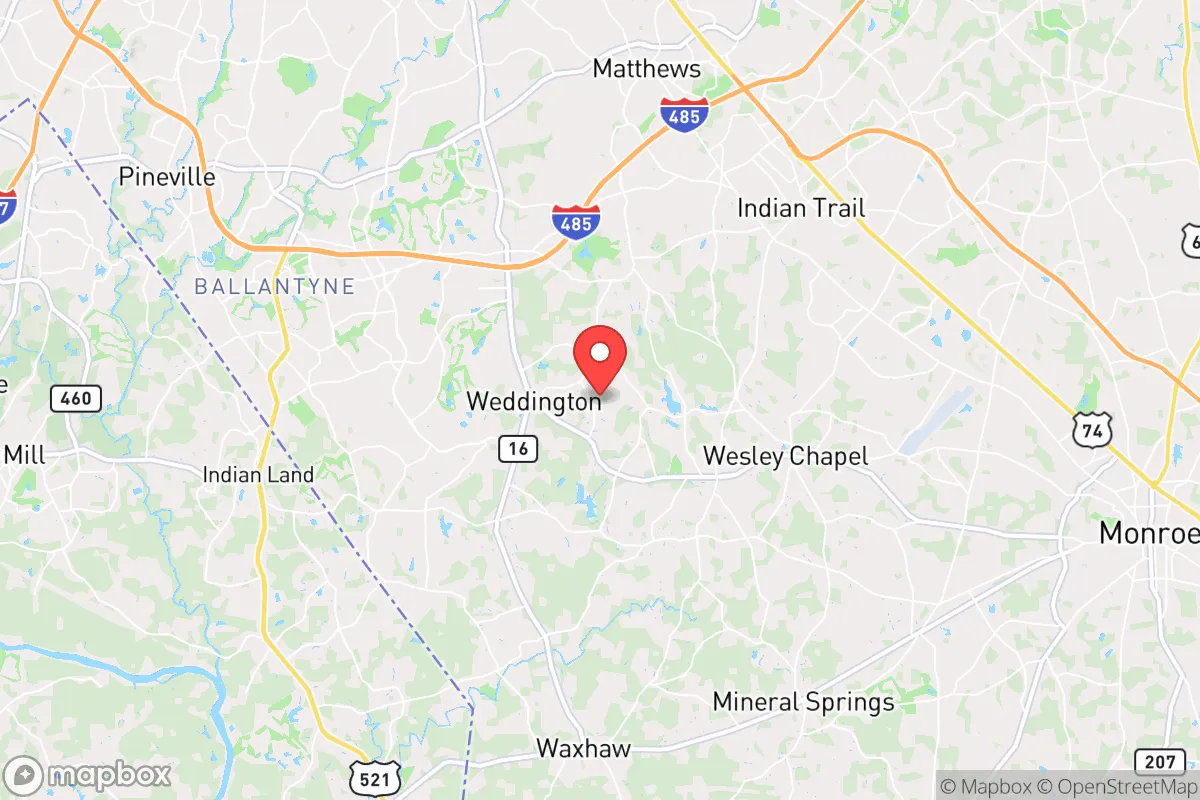
District shown is the primary district for this city’s centroid. Cities may span multiple districts.
Local Political AnalysisPolitical Analysis of Weddington, NC
Weddington, North Carolina, is a solidly conservative town, with a Cook Partisan Voting Index of R+10, making it significantly more Republican than the state as a whole, which sits at R+1. This isn't a recent shift; the area has long been a stronghold for GOP candidates, and the trend has only deepened as the town has grown. While the surrounding Charlotte metro area has seen some suburban drift toward the center, Weddington has remained reliably red, with local elections often decided in the Republican primary.
How it compares
Weddington's R+10 rating places it in a different political universe from Mecklenburg County (home to Charlotte, which leans Democratic) and even from neighboring Union County's more moderate towns like Indian Trail or Stallings. To get a sense of the contrast, consider that in 2024, Weddington precincts voted for the Republican presidential candidate by margins of 60-70%, while Charlotte's urban core went the other way by similar margins. The town's political DNA is closer to that of Waxhaw or Marvin—affluent, family-oriented suburbs where tax policy, school funding, and public safety dominate local discourse. Statewide, North Carolina's R+1 rating reflects a true battleground, but Weddington's voters are far less likely to be swayed by the national pendulum swings that decide the state's gubernatorial or Senate races.
What this means for residents
For conservative residents, Weddington offers a political environment where their views are the norm. Local government tends to favor limited regulation, low taxes, and a business-friendly approach. School board meetings and town council decisions generally reflect these priorities. For liberal residents, the reality is more isolating. While no one is hostile, progressive voices are a distinct minority, and candidates running on Democratic platforms rarely win local office. That said, the town's rapid growth has brought in some new residents from more diverse political backgrounds, and the local Democratic party presence, though small, is active. The practical effect is that Weddington's political culture is stable and predictable—not a place where political battles dominate daily life, but also not a place where ideological diversity is celebrated in public forums.
Culturally, Weddington's conservatism shows up in subtle ways: the prominence of church-affiliated community events, the emphasis on "family values" in school curriculum debates, and a general preference for low-key, private-sector solutions over government programs. There's no visible progressive activism like you'd see in Charlotte's Plaza Midwood or even in Matthews. The town's identity is wrapped up in its reputation as a safe, affluent, and orderly place—a reputation that its political leanings reinforce. For anyone moving here, the key takeaway is that Weddington's politics are baked into its character, and while the state may be a toss-up, this corner of Union County is reliably, comfortably red.

State Political ClimatePolitical Climate in North Carolina
State Political AnalysisPolitical Environment in the State
North Carolina is the quintessential swing state in 2026, with a Cook PVI of R+1 that barely hints at the internal tension. Over the past 20 years, the state has shifted from a reliably Republican stronghold in presidential elections to a true battleground, driven by explosive growth in the Charlotte and Raleigh-Durham metros. The dominant coalition is a split: a culturally conservative, rural and small-town base that controls the state legislature versus a rapidly growing, diverse, and college-educated urban and suburban population that has made the state competitive at the top of the ticket. The 10-20 year arc is a slow, grinding leftward drift at the presidential level, even as the state legislature remains firmly in GOP hands due to redistricting and geographic concentration of Democratic voters.
Urban vs. rural divide
The political map of North Carolina is a story of three distinct regions. The urban crescent, anchored by Charlotte (Mecklenburg County) and the Raleigh-Durham-Chapel Hill triangle (Wake, Durham, Orange counties), is the engine of the state's Democratic growth. These metros are home to major banking, tech, and pharmaceutical employers, attracting a highly educated, diverse workforce that votes reliably blue. In 2024, Mecklenburg and Wake counties alone delivered a massive vote margin for the Democratic presidential candidate, effectively canceling out huge rural GOP margins. The second region is the rural east and the Piedmont, places like Rocky Mount, Goldsboro, and Lumberton, which are heavily Republican, culturally conservative, and economically struggling. The third region is the western mountains, including Asheville (Buncombe County), which is a blue island in a sea of red, and the surrounding rural counties like Hendersonville and Boone, which are deeply Republican. The key battlegrounds are the fast-growing suburban counties that ring the major metros, like Cabarrus (Concord) and Johnston (southeast of Raleigh), which are trending purple but still lean right.
Policy environment
The state's policy environment is a direct reflection of its divided government. The tax structure is a major draw for conservatives: North Carolina has a flat individual income tax rate of 4.5% in 2026, down from a progressive top rate of 7.75% in 2013, and the corporate income tax is being phased out entirely. The regulatory posture is business-friendly, with a right-to-work law and a strong tort reform environment. On education, the state has a robust charter school law and a growing school voucher program (the Opportunity Scholarship Program), which has been expanded to all families regardless of income. This is a major point of contention, with public school advocates arguing it siphons resources from traditional districts. Healthcare policy is a mixed bag: the state did not expand Medicaid under the Affordable Care Act until late 2023, a decade-long political battle that finally ended with a Republican-led compromise. Election laws are a flashpoint: the state has a voter ID law, strict absentee ballot rules, and a Republican-controlled Board of Elections that has been the subject of repeated legal challenges over gerrymandering and voting access.
Recent policy direction
The last five years have seen a clear conservative legislative push, tempered by the governor's veto pen. On gun and self-defense law, North Carolina is a "shall-issue" state for concealed carry, and in 2023, the legislature overrode the governor's veto to repeal the requirement for a permit to purchase a handgun (the "permitless carry" law). On parental and education rights, the legislature passed the "Parents' Bill of Rights" in 2023, requiring schools to notify parents about instructional materials involving sexuality and to get parental consent before a child's name or pronouns change at school. On medical and bodily autonomy, the state enacted a 12-week abortion ban in 2023, with exceptions for rape, incest, and fetal anomalies, overriding the governor's veto. On property rights, the state has strong protections against eminent domain abuse. On voting and ballot access, the trend is toward restriction: the 2023 omnibus election law shortened the absentee ballot return window, tightened same-day registration rules, and gave poll observers more latitude, all of which were challenged in court. On speech and privacy, the state has not passed a comprehensive data privacy law, but there is active debate around social media regulation and age verification for minors.
Civil unrest & political movements
North Carolina has a history of visible political activism on both sides. The 2016-2020 period saw the "Moral Monday" protests at the state legislature, a sustained civil disobedience movement led by the NAACP against conservative policies on voting rights, education, and healthcare. More recently, the debate over the "Parents' Bill of Rights" and LGBTQ+ issues has energized conservative grassroots groups, particularly in suburban and rural areas. Immigration politics are a live wire: while the state does not have "sanctuary city" policies, some local sheriffs, particularly in Wake County and Mecklenburg County, have been criticized by conservatives for limiting cooperation with ICE detainers. There is no serious secession or nullification rhetoric, but the "election integrity" movement is strong, with activists regularly auditing voter rolls and challenging ballot procedures. A new resident would notice the intensity of local politics: school board meetings in places like Union County and Wake County have become battlegrounds over curriculum and library books, reflecting the national culture war.
Projection
Over the next 5-10 years, the trajectory is clear: the state will continue to become more competitive at the presidential level, with the urban crescent's growth slowly eating into the GOP's structural advantages. The state legislative maps, however, are likely to remain gerrymandered in favor of Republicans, meaning the policy environment will stay conservative on taxes, education, and gun rights, even as the state votes for Democratic presidential candidates. The wild card is the in-migration pattern: the state is attracting a mix of conservative retirees from the Northeast and Midwest, as well as younger, more liberal professionals from California and the Northeast. If the latter group continues to settle in the suburbs of Charlotte and Raleigh, those counties will flip blue, making statewide races for governor and Senate increasingly competitive. A new resident moving in now should expect a decade of political gridlock and high-stakes elections, with the state's direction hanging on a few thousand votes in the suburbs of Charlotte and Raleigh.
For a new resident, the bottom line is that North Carolina offers a conservative-leaning policy environment on taxes, guns, and education, but with a Democratic governor who can veto the most extreme legislation. You get low taxes and a business-friendly climate, but you also get a state that is perpetually in the national spotlight for its election laws and culture war battles. If you are a conservative, you will find a state legislature that reflects your values, but you will also live in a state that is slowly turning purple. If you are a liberal, you will find vibrant, progressive cities and a growing political coalition, but you will also face a state government that is actively working against many of your priorities. It is a state of constant tension, and that is unlikely to change anytime soon.
* Values derived from national, state, county, city and local statistics and may differ in a specific area. Last updated: 2026-08-16T20:34:13.000Z
Narrative content on this page is AI-generated and may contain mistakes. Verify any details that matter before acting on them.
ReloMaps may earn a commission from affiliate links at no extra cost to you.

