Photo: Wikipedia
Political ClimatePolitical Climate in Wichita Falls, TX
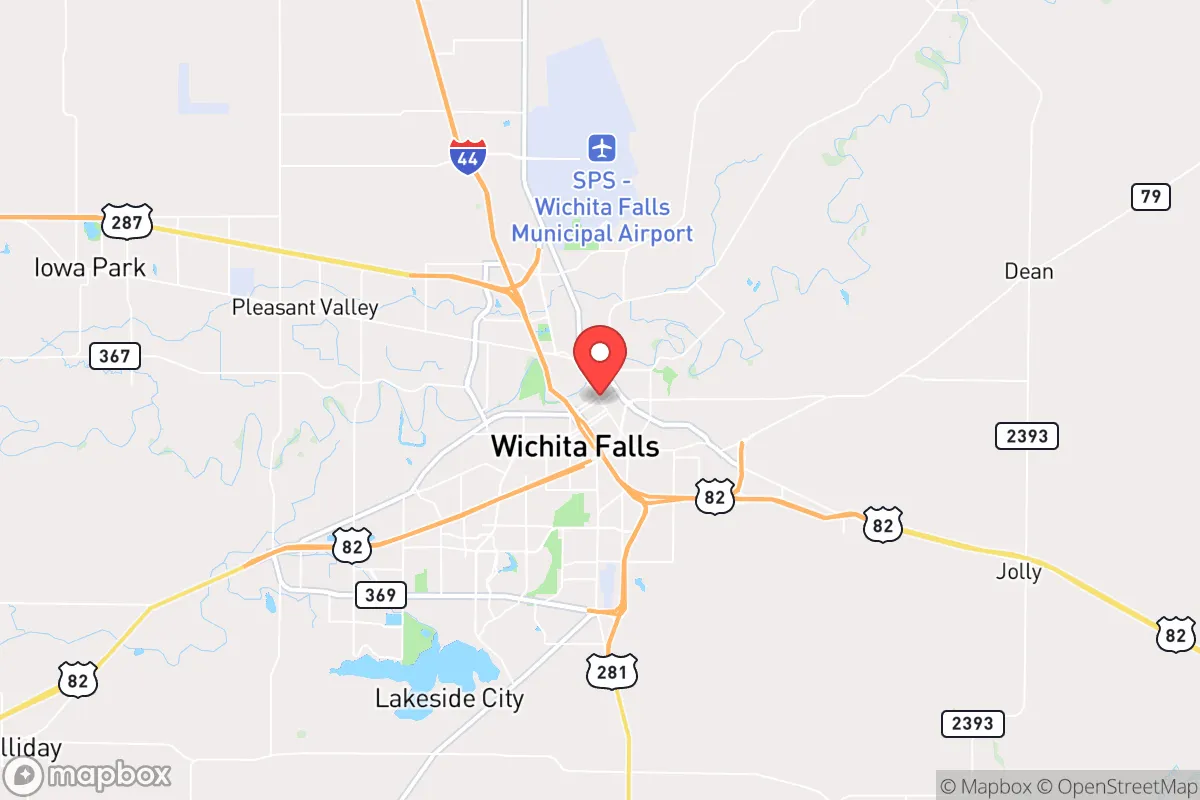
District shown is the primary district for this city’s centroid. Cities may span multiple districts.
Local Political AnalysisPolitical Analysis of Wichita Falls, TX
Wichita Falls leans heavily Republican, with a Cook PVI of R+24 that places it among the most conservative small cities in Texas. This isn't a recent shift—the area has voted solidly red in every presidential election since at least 2000, and local offices from county commissioner to school board have been held by conservatives for decades. If you're looking at the political trajectory, it's been remarkably stable: no real purple creep, no sudden lurches left. The biggest change I've seen in my years here is that the national GOP's internal fights over spending and liberty have started showing up in local primaries, but the overall conservative majority hasn't budged.
How it compares
Drive an hour south to Abilene, and you'll find a similar R+24 profile—both cities sit in the same deep-red West Texas corridor. But head east to Wichita Falls' neighbor, Burkburnett, and the politics get even more conservative, with a Cook PVI closer to R+30. The real contrast is with Denton, about 90 minutes southeast, which has a PVI of D+5 and a much younger, more progressive electorate. Here in Wichita Falls, you don't see the same kind of activist energy or progressive policy pushes. The county commissioners and city council have kept property taxes relatively low, and there's been no serious talk of adopting sanctuary city policies or defunding the police—issues that have popped up in larger Texas metros. The surrounding rural counties, like Archer and Clay, are even more conservative, often voting +35 to +40 points Republican in statewide races.
What this means for residents
For someone who values personal freedom and limited government, this political climate is a breath of fresh air. There's no city mask mandate, no local gun control ordinances, and no heavy-handed business regulations—the kind of government overreach you see in places like Austin or Dallas simply doesn't take root here. Property taxes are a real concern, but the city council has historically been reluctant to raise them, and the county keeps a tight leash on spending. The school board has resisted critical race theory and gender ideology curriculum, which matters to families who want their kids taught basics, not activism. The biggest worry I hear from longtime residents is that as Wichita Falls grows—and it is growing, slowly—there's pressure from outside developers and state-level mandates that could chip away at local control. But so far, the community has held the line.
Culturally, this is a place where the Second Amendment is a given, not a debate. You'll see "Come and Take It" flags on trucks and gun stores on every main drag. The city's biggest annual event, the Hotter'N Hell Hundred bike ride, draws 10,000 cyclists but doesn't come with the progressive politics you'd expect in a cycling scene elsewhere. There's a strong military presence from Sheppard Air Force Base, which reinforces the conservative, patriotic ethos. The one policy distinction worth noting: Wichita Falls has a strict no-smoking ordinance in public places that passed years ago—a rare instance of local government stepping in on personal choice, and it still rankles some old-timers. But by and large, the city's political culture is one of live-and-let-live, as long as you're not asking for taxpayer-funded programs or new regulations. If you're looking for a place where the government stays out of your business and your wallet, this is it.

State Political ClimatePolitical Climate in Texas
State Political AnalysisPolitical Environment in the State
Texas remains a solidly Republican state at the statewide level, but the political climate is far from monolithic. The dominant coalition is a mix of rural conservatives, suburban moderates, and a growing libertarian-leaning base, but the last 15 years have seen a slow, steady leftward shift in the major metro areas, driven by massive in-migration from blue states. While no statewide Democrat has won since 1994, the margin of victory has shrunk from 20 points in 2012 to under 10 points in 2022 for Governor Greg Abbott, signaling a state that is still red but no longer a lock.
Urban vs. rural divide
The political map of Texas is a tale of two worlds. The vast rural expanse—places like Lubbock, Amarillo, and the Panhandle—votes Republican by 70-80% margins. These areas are the backbone of the party, driven by gun rights, energy policy, and traditional values. The urban centers, however, are the engine of the state's demographic change. Austin and El Paso are deep blue, with Travis County voting 71% for Biden in 2020. Dallas and Houston are purple-to-blue, with Harris County flipping to Biden by 13 points in 2020 after going for Trump by 1 point in 2016. The real battleground is the suburbs. Places like Collin County (north of Dallas) and Fort Bend County (southwest of Houston) were once reliably red but are now competitive. Collin County, for example, went from a 27-point Trump win in 2016 to a 14-point win in 2020—a massive shift driven by educated, moderate transplants who are fiscally conservative but socially liberal. The Rio Grande Valley, historically a Democratic stronghold, has been trending right, with counties like Starr and Hidalgo flipping to Trump in 2020, a sign that Hispanic voters are increasingly receptive to conservative messaging on economics and religion.
Policy environment
Texas's policy environment is a mixed bag for conservatives. On the plus side, there is no state income tax, which is a huge draw for high-earners and businesses. The regulatory posture is business-friendly, with a right-to-work law and limited zoning in many areas. Property taxes, however, are among the highest in the nation, averaging 1.6% of home value, which is a hidden cost that many newcomers don't anticipate. Education policy is a flashpoint. The state has a school choice program via the Texas Education Agency's charter school expansion, but a full voucher bill failed in 2023 due to opposition from rural Republicans who fear it will drain funding from local districts. Healthcare is largely unregulated, with no state-level Medicaid expansion, which keeps premiums lower but leaves 18% of the population uninsured. Election laws have tightened: the 2021 SB 1 banned 24-hour and drive-through voting, added ID requirements for mail ballots, and empowered partisan poll watchers. This has been praised by conservatives for security and criticized by progressives as suppression. The state also has a permitless carry law (HB 1927, 2021) and a near-total abortion ban (SB 8, 2021, and the trigger law post-Dobbs).
Trajectory & freedom
On the freedom front, Texas is a study in contradictions. Gun rights have expanded significantly: permitless carry is now law, and there are no red flag laws. Property rights are strong, with no state-level rent control and limited eminent domain abuse. Parental rights were bolstered by the 2023 law banning gender-transition procedures for minors (SB 14), which is a major win for conservative families. However, personal liberty has been curtailed in other areas. The abortion ban is the most restrictive in the nation, with no exceptions for rape or incest, which some see as government overreach into private medical decisions. The state also aggressively prosecuted voter fraud cases under the 2021 law, which critics say chills participation. On medical autonomy, the state banned COVID-19 vaccine mandates for private employers in 2023 (SB 7), a clear win for bodily autonomy. The overall trajectory is toward more conservative policy on social issues and more libertarian on economic ones, but the high property tax burden is a growing concern for many residents who feel the state is taxing them out of their homes.
Civil unrest & political movements
Texas has seen its share of political flashpoints. The 2020 Black Lives Matter protests in Austin and Houston were large and sometimes violent, leading to a backlash that helped fuel the 2021 "defund the police" repeal movement. The border crisis is a constant source of tension. Governor Abbott's Operation Lone Star, launched in 2021, deployed state troopers and National Guard to the border, busing migrants to sanctuary cities like New York and Chicago. This has been wildly popular with conservatives but has drawn lawsuits over civil liberties. Secession rhetoric, while fringe, has a real presence. The Texas Nationalist Movement (TNM) has pushed for a 2024 referendum on secession, though it has no legal path. Election integrity remains a hot-button issue: the 2020 election saw Trump win Texas by 5.5 points, but many conservatives remain skeptical of mail-in ballot security, leading to the 2021 reforms. A new resident would notice the "Don't Mess with Texas" attitude—it's a state where people are proud of their independence and suspicious of federal overreach.
Projection
Over the next 5-10 years, Texas will likely become more purple, but not blue. The in-migration from California and New York is slowing, and many of those transplants are actually conservative-leaning or libertarian, not progressive. The Hispanic vote is trending right, which could offset the leftward drift of the suburbs. However, the urban cores will continue to grow, and the state's legislative maps are likely to be challenged in court again. The biggest wildcard is the property tax issue—if the state doesn't find a way to lower them, it could spark a populist revolt that benefits either a libertarian or a progressive candidate. The 2026 gubernatorial race will be a bellwether: if a Democrat can break 47% in a midterm, the state is in play. For now, expect more of the same: conservative social policy, business-friendly economics, and a growing tension between the rural base and the suburban swing voters.
Bottom line for a new resident: If you're moving to Texas for freedom, you'll find it on guns, taxes (income), and parental rights. But you'll pay for it in property taxes and a healthcare system that leaves you on your own. The political climate is stable but shifting—you'll feel at home in the suburbs of Fort Worth or San Antonio, but you'll want to avoid Austin if you're tired of progressive city politics. The state is still a conservative stronghold, but it's no longer a safe bet for the long haul. Keep an eye on the 2026 elections and the property tax debate—those will tell you where Texas is really headed.
* Values derived from national, state, county, city and local statistics and may differ in a specific area. Last updated: 2026-04-19T07:24:44.000Z
Narrative content on this page is AI-generated and may contain mistakes. Verify any details that matter before acting on them.
ReloMaps may earn a commission from affiliate links at no extra cost to you.

