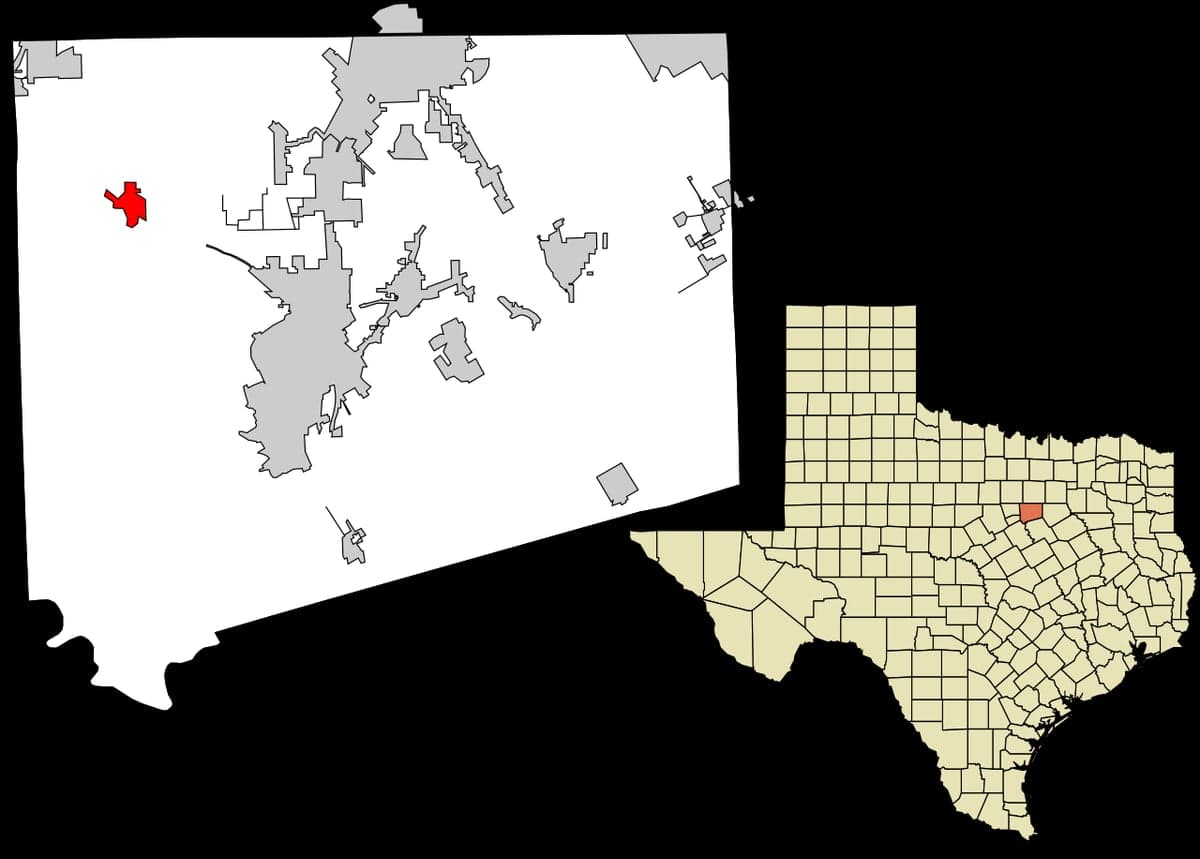
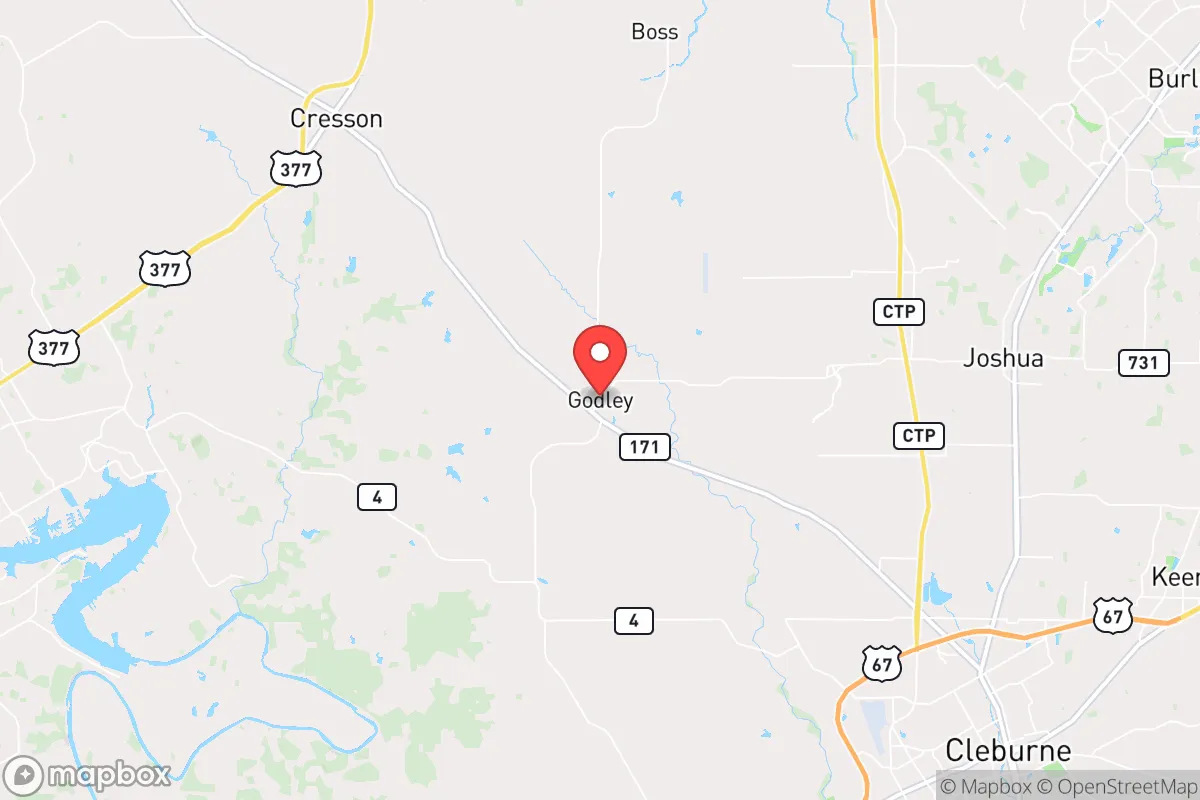
Photo: Wikipedia
Political ClimatePolitical Climate in Godley, TX
District shown is the primary district for this city’s centroid. Cities may span multiple districts.
Local Political AnalysisPolitical Analysis of Godley, TX
Godley, Texas, sits squarely in one of the most reliably conservative corners of the state, and that’s not changing anytime soon. The Cook PVI rating of R+18 tells you the math—this area votes Republican by a margin nearly 20 points above the national average, and that’s been the pattern for as long as anyone can remember. You won’t find many yard signs for the other side here, and the local elections tend to be decided in the Republican primary, not the general. The trajectory is steady: Godley is growing, but the new folks moving in are largely coming from other conservative suburbs or rural areas, not from blue cities, so the political character is holding firm.
How it compares
Drive 15 minutes east to Cleburne, and you’ll find a similar story—Johnson County as a whole is deep red, with Godley being one of the more conservative pockets. But head south toward Burleson or further into Tarrant County, and you start to see the shift. Burleson has held its own, but Fort Worth’s influence creeps in with every new subdivision. Godley, though, is far enough off the interstate that it’s avoided the worst of that. Compare it to Aledo, which has seen an influx of Dallas-Fort Worth commuters and a slight softening of its conservative edge—Godley hasn’t had that problem yet. The surrounding towns like Joshua and Keene are cut from the same cloth, but Godley feels more insulated, more like the old Texas where people still wave at you on the road and don’t appreciate being told how to live.
What this means for residents
For the people who live here, the political climate translates directly into daily life. You’re not going to see mask mandates or business shutdowns from the local government—Godley’s city council and school board are made up of folks who believe in limited interference. Property taxes are a constant gripe, but that’s a Texas-wide issue, not a local one. What you get instead is a community where the sheriff’s office is pro-Second Amendment, the schools still say the Pledge of Allegiance without controversy, and the biggest political fights are about road improvements and water rights, not social experiments. If you’re worried about government overreach into your personal freedoms—whether that’s how you raise your kids, what you do on your own land, or how you run your business—Godley is the kind of place where that concern is shared by your neighbors. The long-term worry here isn’t a sudden flip to blue; it’s the slow creep of state-level policies from Austin that try to override local values. So far, Godley’s been good at pushing back.
Culturally, Godley still feels like a small town where church potlucks and Friday night football are the social calendar. There’s no push for bike lanes or density zoning—the talk is about keeping the rural character intact. The biggest policy distinction you’ll notice is the lack of any real progressive agenda in local ordinances. No sanctuary city talk, no defunding police debates, no public art projects that make you scratch your head. It’s straightforward: low taxes, personal responsibility, and a general distrust of anyone who thinks they know better than you how to run your life. That’s Godley, and if you’re looking for a place where the politics match the pace of life—slow, steady, and conservative—you’ve found it.

State Political ClimatePolitical Climate in Texas
State Political AnalysisPolitical Environment in the State
Texas remains a solidly Republican state, but the margins have tightened noticeably over the past decade. In 2024, Donald Trump carried the state by roughly 9 points, down from 11 points in 2020 and 16 points in 2016. The dominant coalition is still a mix of rural conservatives, suburban families, and business-oriented professionals, but explosive growth in the urban cores—especially Austin, Dallas, and Houston—is slowly shifting the ground beneath the state’s political foundations. If you’re looking at Texas for its low taxes, gun rights, and limited government, you’re still in good company, but you need to understand where the pressure points are forming.
Urban vs. rural divide
The political map of Texas is a tale of two worlds. The vast rural expanse—places like Lubbock, Amarillo, and the Panhandle—votes overwhelmingly Republican, often by 70-80% margins. These areas are the backbone of the state’s conservative identity. Meanwhile, the major metros are increasingly blue. Austin is the most liberal city in the state, with Travis County voting +50 points for Biden in 2020ched. Dallas County has flipped from red to reliably blue over the past two cycles, and Harris County (Houston) is now a Democratic stronghold. The suburbs are the real battleground. Places like Collin County (north of Dallas) and Fort Bend County (southwest of Houston) were once reliably red but are now competitive—Collin went from +30 R in 2012 to +10 R in 2024. The key takeaway: if you move to a suburb like Frisco or McKinney, you’ll still find plenty of conservative neighbors, but the political culture is becoming more mixed every year.
Policy environment
Texas’s policy environment is a major draw for conservatives. There is no state income tax, which is a huge advantage over California or New York. Property taxes are high (around 1.6-2.0% of assessed value), but the state offers a homestead exemption and a 10% cap on annual appraisal increases for homeowners. The regulatory posture is famously business-friendly: no state-level minimum wage above the federal $7.25, right-to-work laws, and limited zoning in many cities. On education, the state has expanded school choice through the Texas Education Savings Account program (passed in 2023), which allows parents to use state funds for private school or homeschooling. Healthcare is a mixed bag—Texas has the highest uninsured rate in the nation (around 18%), and the state has refused Medicaid expansion under the ACA. Election laws were tightened in 2021 with Senate Bill 1, which added voter ID requirements and limited drive-through and 24-hour voting. For a conservative, this is a state that generally respects local control and keeps government out of your wallet—but the property tax burden is a real cost of living in a no-income-tax state.
Trajectory & freedom
The trajectory of freedom in Texas is a mixed picture. On the positive side, the state has been a national leader in expanding gun rights: permitless carry (constitutional carry) was signed into law in 2021, allowing any legal gun owner to carry a handgun without a license. Parental rights were strengthened with the 2023 passage of the Parental Bill of Rights, which gives parents more say in their children’s education and medical decisions. On the medical autonomy front, Texas banned nearly all abortions in 2021 with the Heartbeat Act (SB 8), and the trigger law in 2023 made it a felony. Property rights were bolstered by the 2023 law limiting the ability of cities to ban natural gas hookups in new construction. However, there are concerning trends. The state has seen a rise in government overreach in the name of “public health” during the pandemic—Governor Abbott’s executive orders on mask mandates and business closures were controversial among conservatives. More recently, the state has cracked down on “election integrity” in ways that some see as overbearing, like the criminal penalties in SB 1. The biggest red flag for freedom-minded folks is the growing influence of big tech and corporate interests in Austin and Dallas, which are pushing for more progressive policies at the local level. Overall, Texas is still freer than most states, but the trend line is not uniformly upward.
Civil unrest & political movements
Texas has seen its share of political flashpoints. The 2020 Black Lives Matter protests in Austin, Dallas, and Houston were large and sometimes violent, leading to property damage and a lasting sense of unease among conservatives. The state has also been a battleground over immigration: Governor Abbott’s Operation Lone Star has deployed state troopers and National Guard to the border, and the state has bused thousands of migrants to sanctuary cities like New York and Chicago. This has created a visible political divide—border towns like El Paso and Brownsville are more moderate on immigration, while the rest of the state is increasingly hardline. There is a growing secessionist movement, the Texas Nationalist Movement, which advocates for independence, but it remains fringe. Election integrity remains a hot topic: the 2020 and 2024 elections saw allegations of irregularities in Harris County, leading to a state takeover of the county’s election administration in 2023. For a new resident, you’ll notice that political signs and bumper stickers are common, and people are not shy about their views. The culture is generally polite, but the tension between the growing blue metros and the red rural areas is palpable.
Projection
Over the next 5-10 years, Texas is likely to become more competitive at the statewide level. The in-migration from California, New York, and Illinois is bringing a mix of conservatives and liberals, but the net effect is a slow leftward drift in the suburbs. The state’s Hispanic population, which has historically leaned Democratic, is shifting rightward—especially in border areas like the Rio Grande Valley, where counties like Starr and Zapata flipped from D to R in 2024. This could offset some of the urban growth. However, the biggest wildcard is the continued growth of Austin and its surrounding suburbs (Round Rock, Cedar Park), which are becoming more liberal every cycle. If the state legislature continues to pass conservative policies on guns, abortion, and school choice, the rural base will stay energized, but the suburbs may continue to slip. For a new resident, expect Texas to remain a red state for at least another decade, but the margin will likely shrink to 5-7 points. The practical implication: you’ll still have a conservative state government, but local politics in the major metros will be increasingly progressive.
For a conservative moving to Texas, the bottom line is this: you’re coming to a state that still values low taxes, gun rights, and local control, but you need to pick your county carefully. If you want a reliably conservative environment, look at the exurbs like Granbury, New Braunfels, or the Hill Country around Kerrville. If you move to Austin or Dallas proper, you’ll be in a blue bubble with high property taxes and progressive city policies. The state government will continue to protect your rights on the big issues, but the local culture is increasingly split. Texas is still a great bet for freedom, but it’s not the monolithic red state it was 20 years ago. Keep an eye on the suburbs—they’ll decide the state’s future.
* Values derived from national, state, county, city and local statistics and may differ in a specific area. Last updated: 2026-04-18T19:35:35.000Z
Narrative content on this page is AI-generated and may contain mistakes. Verify any details that matter before acting on them.
ReloMaps may earn a commission from affiliate links at no extra cost to you.

