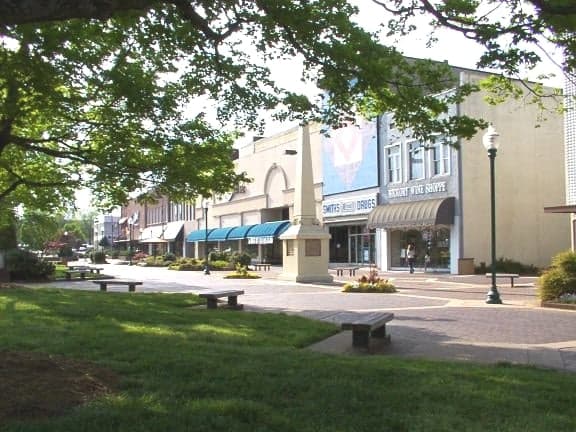
Photo: Wikipedia
Political ClimatePolitical Climate in Hickory, NC
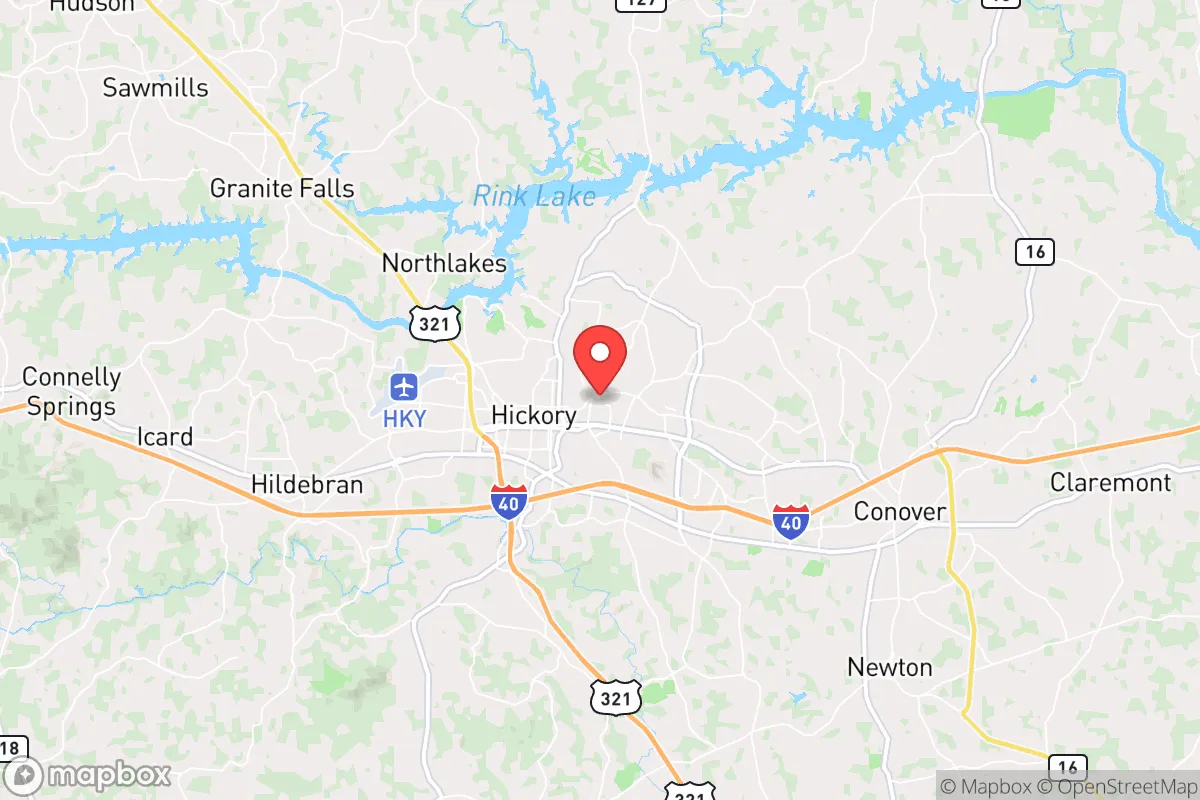
District shown is the primary district for this city’s centroid. Cities may span multiple districts.
Local Political AnalysisPolitical Analysis of Hickory, NC
Hickory, North Carolina, has long been a solidly conservative community, and that hasn't changed much despite the national trends. The Cook PVI rating of R+9 tells you the basics—this area leans Republican by a comfortable margin, and it's been that way for decades. But if you've lived here a while, you know the real story is more about how the local culture and politics have held steady while other parts of the state have shifted left. The surrounding towns like Morganton and Lenoir are similar in their conservative bent, but you'll notice a different vibe if you drive east toward Charlotte or south toward Gastonia—those areas are getting more purple, while Hickory remains reliably red.
How it compares
Compared to the rest of Catawba County and the broader region, Hickory is actually a bit of a bellwether for the area's political identity. The county itself voted for Trump by about 20 points in 2020, and local races tend to follow suit. If you head west into the mountains, places like Boone are more liberal due to the university influence, but that's a different world. Down in the Piedmont, cities like Salisbury and Statesville are more mixed, but Hickory's R+9 rating puts it squarely in the camp of places like Mooresville or Concord—conservative, but not as deep red as rural counties further west. The real contrast is with Asheville, which is a progressive island about an hour away; Hickory folks tend to see that as a cautionary tale of what happens when local government gets too involved in people's lives.
What this means for residents
For someone moving here, the political climate means you can expect a government that mostly stays out of your business. Property taxes are reasonable, zoning is light, and there's a general sense that local leaders trust residents to make their own choices. That's a big deal if you're coming from a place where the city council is micromanaging everything from lawn heights to business hours. The downside is that if you're hoping for rapid progressive change—like big public transit projects or aggressive climate policies—you'll be disappointed. But for most folks, that's a feature, not a bug. The long-term trend is a bit concerning, though: as Charlotte's metro area expands, you're seeing more transplants who bring different ideas, and some local races are getting tighter. If you value personal freedoms and limited government, it's worth keeping an eye on school board and county commission elections, because that's where the real battles are happening.
Culturally, Hickory still feels like a place where people wave at neighbors and leave their doors unlocked, but there are some policy distinctions worth noting. The city has a strong tradition of gun rights, and you'll see "Come and Take It" stickers on trucks around town. There's also a noticeable resistance to mask mandates and vaccine passports—during the pandemic, local officials were quick to push back on state-level restrictions. On the flip side, the area has a growing Hispanic community, and while that's brought some cultural tension, most folks are pretty live-and-let-live as long as everyone follows the law. If you're looking for a place where the government respects your autonomy and doesn't try to engineer society from the top down, Hickory is still that kind of town—for now. Just don't expect it to stay that way forever if the Charlotte sprawl keeps creeping north.

State Political ClimatePolitical Climate in North Carolina
State Political AnalysisPolitical Environment in the State
North Carolina has long been considered a classic swing state, but the reality on the ground is more nuanced. Over the past 20 years, the state has shifted from a reliably Republican stronghold in presidential elections to a true battleground, with the GOP still holding firm majorities in the General Assembly and most county commissions. The 2024 presidential race saw the state go red by roughly 3 points, a margin that has narrowed from the 8-point win in 2012. The dominant political coalitions are a mix of traditional rural conservatives, suburban moderates, and a rapidly growing progressive urban base, creating a constant tug-of-war that keeps the state from swinging too far in either direction.
Urban vs. rural divide
The political map of North Carolina is a textbook case of the urban-rural split. The major metros—Charlotte (Mecklenburg County), Raleigh-Durham (Wake and Durham Counties), and Greensboro-Winston-Salem (Guilford and Forsyth Counties)—are deep blue strongholds, driven by transplants from the Northeast and West Coast, major research universities, and a growing tech and finance sector. These three metros alone account for nearly half the state's population and reliably deliver 60-70% Democratic margins. In contrast, the vast rural and exurban areas—places like Lumberton (Robeson County), Hickory (Catawba County), and Jacksonville (Onslow County)—vote Republican by 20-30 points. The real battlegrounds are the fast-growing suburban counties like Union County (southeast of Charlotte) and Johnston County (southeast of Raleigh), which have been trending red but are seeing an influx of moderate voters. Wake County itself flipped from red to blue in the 2008 Obama wave and has stayed there, while Mecklenburg has been solidly blue for decades. The rural counties, meanwhile, are losing population and becoming more conservative, creating a geographic polarization that makes statewide races incredibly tight.
Policy environment
North Carolina's policy environment is a mixed bag that reflects its divided government. The state has a flat income tax rate of 4.5% (down from 7% in 2013), with a scheduled phase-down to 3.99% by 2027—a clear win for fiscal conservatives. The corporate tax rate is a low 2.5%, making it attractive for business relocation. There is no state property tax, though local rates vary. On education, the state has a robust school choice program, including Opportunity Scholarships (vouchers) that were expanded in 2023 to cover all income levels, a major victory for parental rights. However, the state also has a Common Core-based curriculum that many conservatives find objectionable, and the debate over critical race theory and LGBTQ+ content in schools remains heated. Healthcare is a sore spot: the state expanded Medicaid in 2023 under a bipartisan deal, which many conservatives opposed as a federal overreach, but it did include work requirements and a hospital assessment fee. Election laws have been a flashpoint: the state requires voter ID (upheld by the courts in 2024), has strict absentee ballot rules, and bans ballot harvesting—all measures that conservatives argue protect election integrity. The state also has a Republican supermajority in the General Assembly (as of 2025), which can override the Democratic governor's vetoes, though the governor still controls appointments and the budget.
Trajectory & freedom
On the freedom front, North Carolina has been a mixed bag but is trending in the right direction on several key issues. Gun rights are strong: the state has permitless carry (effective 2023), no red flag law, and a strong preemption law that prevents local governments from enacting their own restrictions. This is a clear win for the Second Amendment. Parental rights got a boost with the 2023 Parents' Bill of Rights, which requires schools to notify parents about medical and mental health services and prohibits instruction on gender identity and sexuality in K-4 classrooms. However, the state still has a statewide mask mandate ban (repealed in 2023) that was controversial, and the governor's emergency powers during COVID were a sore point for many. On medical autonomy, the state has not expanded abortion restrictions beyond the current 12-week ban (with exceptions), which is a compromise that satisfies neither side fully. Property rights are generally strong, though the state has seen some controversial eminent domain cases, particularly around the Atlantic Coast Pipeline (which was canceled in 2020). The biggest freedom concern is the state's regulatory environment: while business-friendly, the state still has a complex permitting process for new construction and energy projects, and the clean energy mandates (requiring 70% carbon-free electricity by 2030) are seen by some as government overreach into energy markets.
Civil unrest & political movements
North Carolina has seen its share of political activism, but it's generally less volatile than states like Oregon or Georgia. The 2020 protests in Charlotte and Raleigh over George Floyd's death were large but mostly peaceful, though there were some instances of property damage and looting. The Moral Monday movement, led by the NAACP, has been a persistent left-wing protest force since 2013, targeting the Republican legislature on voting rights, Medicaid, and education funding. On the right, the Carolina Journal and John Locke Foundation are influential think tanks pushing for limited government. Immigration politics are a hot-button issue: the state has a sanctuary city ban (HB 10, 2015) that requires sheriffs to cooperate with ICE, but some counties like Durham and Orange have resisted. The 3%ers and other militia groups have a presence in rural areas, particularly around Fayetteville and the Sandhills, but they are not as visible as in Western states. Election integrity remains a live issue: the 2020 election saw a 74,000-vote margin for Trump, but the state's election board (controlled by Democrats) faced criticism for last-minute rule changes. The 2024 election was smoother, with the voter ID law in effect. A new resident would notice the Confederate monument debates in places like Chapel Hill and Wilmington, which have been flashpoints for both sides.
Projection
Looking ahead 5-10 years, North Carolina is likely to become more competitive but not necessarily bluer. The key demographic shift is the massive in-migration from blue states—Mecklenburg County alone added 150,000 people between 2020 and 2025, many from New York and California. These transplants tend to be moderate-to-liberal on social issues but fiscally conservative, which could push the state toward a more libertarian-leaning center. However, the rural counties are not going anywhere, and the GOP's control of the General Assembly is likely to persist due to gerrymandering (which the courts have largely upheld). The biggest wild card is the Hispanic population, which is growing rapidly in places like Charlotte and the Piedmont Triad; this group leans Democratic but is not monolithic. Expect continued fights over school choice, tax cuts, and energy policy. The state is unlikely to become a deep blue state like Virginia, but it also won't become a deep red state like Tennessee. A new resident moving in now should expect a state that is purple with a red tint, where the culture wars are constant but the economy is booming.
For a conservative-leaning individual or family, North Carolina offers a strong business climate, gun rights, and school choice, but you'll need to pick your county carefully. If you want a deep red environment, look at Union County or Johnston County. If you want a more moderate suburban feel, Wake County (outside Raleigh) or Cabarrus County (north of Charlotte) are solid options. Avoid Durham and Orange County if progressive politics bother you. The state's trajectory is toward a more competitive, divided future, but the fundamentals—low taxes, strong property rights, and a growing economy—are still in your favor.
* Values derived from national, state, county, city and local statistics and may differ in a specific area. Last updated: 2026-04-21T17:14:29.000Z
Narrative content on this page is AI-generated and may contain mistakes. Verify any details that matter before acting on them.
ReloMaps may earn a commission from affiliate links at no extra cost to you.

