Photo: Wikipedia
Political ClimatePolitical Climate in Lakewood, CO
District shown is the primary district for this city’s centroid. Cities may span multiple districts.
Local Political AnalysisPolitical Analysis of Lakewood, CO
Lakewood, Colorado, leans solidly Democratic, with a Cook PVI of D+8, meaning the city votes about eight points more Democratic than the national average. This wasn't always the case; I remember when this area was a lot more purple, a place where your neighbor might be a union electrician or a small business owner who just wanted to be left alone. Over the last decade or so, the shift has been pretty dramatic, driven by an influx of folks from the coasts and younger voters who see things very differently. The trajectory is clearly toward a more progressive, one-party rule kind of vibe, which raises some real questions about how much the local government thinks it should be involved in your daily life.
How it compares
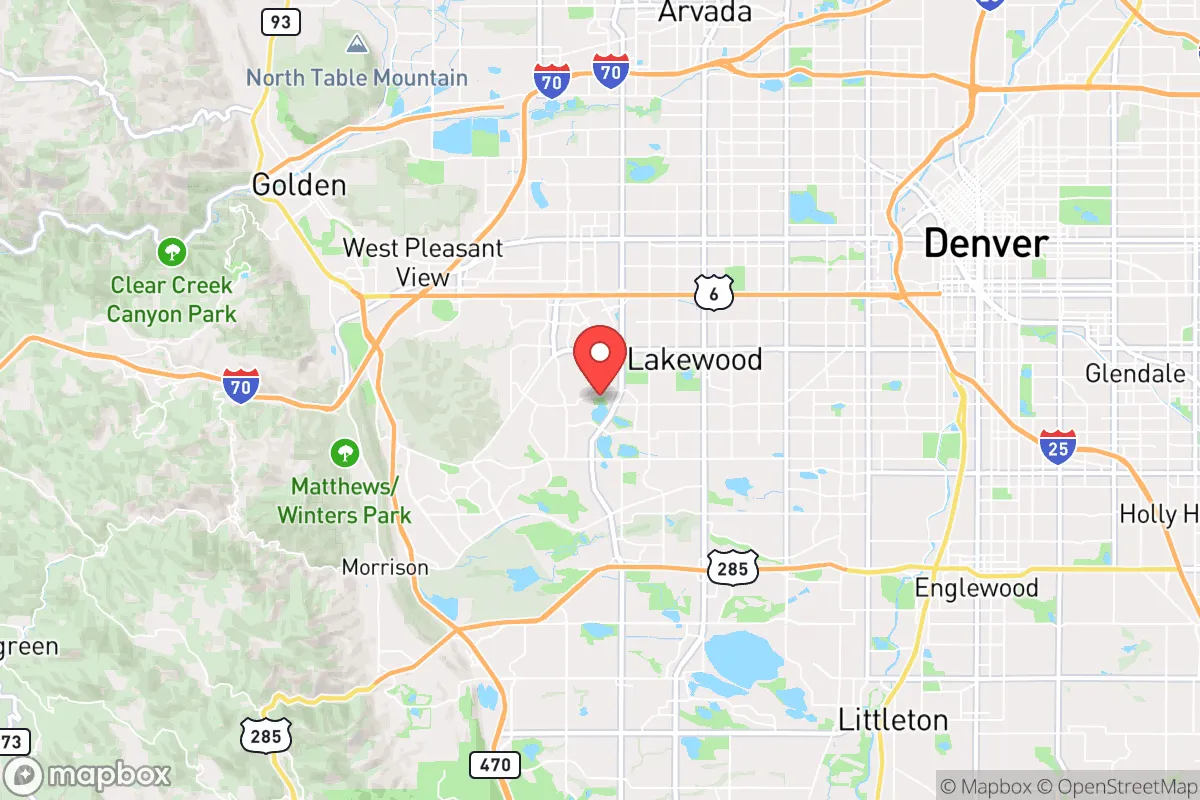
To really get a feel for Lakewood's politics, you have to look at the places around it. Head west into the foothills, to places like Golden or Evergreen, and you'll find a much more independent, live-and-let-live streak—Jefferson County as a whole is a lot more balanced. Drive east into Denver proper, and you're in a deep-blue ocean where the progressive agenda is basically law. Lakewood sits right in the middle, but it's been getting pulled further and further eastward. The contrast is stark when you compare it to Arvada to the north, which still has a stronger conservative undercurrent, or Littleton to the south, which has its own battles over growth and regulation. Lakewood's city council and county commissions are now almost uniformly progressive, which means policies that might have been debated a decade ago are now just pushed through.
What this means for residents
For those of us who value personal freedom and limited government, the practical effects are starting to pile up. You're seeing more zoning restrictions that make it harder to run a home-based business or even build a simple ADU for a family member. There's a constant push for higher taxes and fees, often wrapped in the language of "sustainability" or "equity," which hits small business owners and homeowners the hardest. The local school board has become a battleground over curriculum and parental rights, with a clear tilt toward top-down mandates from the state. If you value the Second Amendment, you've likely noticed that Lakewood has been quicker than surrounding towns to adopt restrictive local ordinances. The general feeling is that the city government sees itself as a manager of your life, not a protector of your rights.
One of the biggest cultural distinctions here is the attitude toward growth and development. Lakewood is practically built-out, so every new apartment complex or mixed-use project comes with a fight. The progressive majority tends to favor high-density, transit-oriented development, which sounds good on paper but often means more traffic, less parking, and a loss of the quiet, suburban character that drew many of us here in the first place. Looking ahead, I worry that the next few years will bring even more aggressive climate mandates and housing policies that squeeze out the middle class. The long-term trend is clear: Lakewood is becoming a place where the government's hand is felt in more and more aspects of daily life, and if that bothers you, you might start eyeing a move to the more rural parts of the county or further west.

State Political ClimatePolitical Climate in Colorado
State Political AnalysisPolitical Environment in the State
Colorado has shifted from a classic purple swing state to a solidly blue-leaning one over the past two decades, driven by explosive growth in the Denver metro and Front Range corridor. The state’s overall partisan lean now sits roughly D+9, with Democrats controlling the governorship, both chambers of the legislature, and all statewide offices. This wasn’t always the case — as recently as 2004, Colorado voted for George W. Bush, and it had a split legislature as late as 2012. The trajectory is unmistakably progressive, and for a conservative considering relocation, the key question is whether there are still pockets of freedom worth the trade-offs.
Urban vs. rural divide
The political map of Colorado is a tale of two worlds. The Denver metroplex — including Denver, Aurora, Boulder, and the sprawling suburbs of Jefferson County and Arapahoe County — accounts for roughly 60% of the state’s vote and is overwhelmingly Democratic. Boulder County is the bluest of the bunch, routinely voting D+50 or more. The I-25 corridor from Fort Collins down to Colorado Springs is a mixed bag: Fort Collins (Larimer County) has trended blue, while Colorado Springs (El Paso County) remains a conservative stronghold, though even there the margins have shrunk. Rural Colorado — the Eastern Plains, the Western Slope, and the San Luis Valley — votes heavily Republican, but these areas lack the population to counterbalance the Front Range. El Paso County is the largest red county, but its influence is waning as Denver’s suburbs fill with out-of-state transplants. The divide isn’t just political; it’s cultural, with rural residents feeling increasingly ignored by a state government that caters to Denver’s priorities.
Policy environment
Colorado’s policy environment is a mixed bag for conservatives, with some bright spots and many red flags. On the positive side, the state has a flat income tax rate of 4.4% (down from 4.55% after a 2024 ballot measure), and property taxes are relatively low compared to states like Texas or Illinois — though they’re rising fast due to soaring home values. The Taxpayer’s Bill of Rights (TABOR) still limits state spending growth and requires voter approval for tax increases, though lawmakers have found creative ways to work around it. On the negative side, Colorado has become a regulatory heavyweight: it has some of the strictest environmental and energy regulations in the country, a 2023 oil and gas reform law that effectively bans new drilling near homes and schools, and a red flag gun law (2019) that allows temporary firearm seizure without a criminal conviction. Education policy is dominated by teachers’ unions, and the state has a universal preschool program funded by a nicotine tax. Election laws are among the most liberal: universal mail-in voting, same-day registration, and automatic voter registration are all standard. For a conservative, the regulatory creep is the biggest concern — it’s not just about taxes, but about how much the state controls your daily life.
Trajectory & freedom
Colorado is becoming less free by almost any measure, especially for conservatives. The most glaring example is the 2021 “Family Friendly Schools Act” (HB21-1108), which effectively codified CRT-adjacent curriculum standards and gave the state board of education power to override local school boards on controversial topics. Parental rights took a hit with the 2023 “Protections for LGBTQ Youth” law (SB23-188), which allows minors to access certain medical procedures without parental consent — a major red flag for conservative parents. On the Second Amendment front, the 2024 “Assault Weapons Ban” (HB24-1292) passed along party lines, banning the sale and transfer of many semi-automatic firearms. Medical autonomy took a blow with the 2022 “Reproductive Health Equity Act” (HB22-1279), which codified abortion access and removed parental notification requirements for minors. On the property rights side, the 2023 “Land Use Act” (SB23-213) preempted local zoning in favor of state-mandated density near transit — a direct assault on local control. The only bright spot is the 2024 “Parental Bill of Rights” ballot initiative, which passed with 58% support, requiring schools to notify parents about curriculum changes and medical services. But the overall trajectory is clear: the state government is centralizing power and eroding individual liberties at an accelerating pace.
Civil unrest & political movements
Colorado has seen its share of political flashpoints. The 2020 George Floyd protests in Denver turned violent, with property damage and clashes between police and demonstrators that lasted weeks. The “Defund the Police” movement had real traction in Denver, leading to a 2021 ballot measure that cut police funding by $8 million (later partially restored). On the right, the “Colorado Springs shooting” at Club Q in 2022 became a political lightning rod, with activists on both sides using it to push their agendas. Immigration politics are tense: Denver has a sanctuary city policy, and the state has a 2023 “Immigrant Driver’s License” law (SB23-079) that grants licenses regardless of status. The “Colorado State Patrol” has been accused of selective enforcement in rural areas, and there have been secession movements in the Eastern Plains (the proposed “State of Jefferson”) and on the Western Slope, though none have gained serious traction. Election integrity is a hot-button issue: the 2020 election saw widespread use of mail-in ballots, and while no major fraud was proven, the process left many conservatives uneasy. The 2022 “Election Security Act” (SB22-153) tightened some procedures but didn’t address concerns about voter ID or ballot harvesting. A new resident would notice the political tension most in the suburbs — places like Douglas County and Weld County are battlegrounds where conservative parents clash with progressive school boards over curriculum and library books.
Projection
Over the next 5-10 years, Colorado will likely become more progressive, not less. The demographic trends are relentless: the Front Range is growing faster than the rest of the state, and the new arrivals are overwhelmingly from blue states like California, Illinois, and New York. The 2024 election results showed that even Colorado Springs is trending purple — El Paso County voted for Trump by only 8 points, down from 14 in 2020. The rural counties are losing population, meaning their political influence will continue to shrink. The state legislature is likely to pass more gun control, more environmental regulations, and more centralized education mandates. The only wildcard is a potential backlash: the 2024 “Parental Bill of Rights” showed that even in a blue state, there’s a limit to how much government overreach parents will tolerate. But that’s a single issue — on the broader trajectory, Colorado is on a path to becoming a West Coast-style state within a decade. Someone moving in now should expect higher taxes, more regulations, and a political environment that’s increasingly hostile to conservative values.
For a conservative considering Colorado, the bottom line is this: the state offers incredible natural beauty, a strong economy, and a relatively low tax burden compared to the coasts, but the political climate is hostile and getting worse. If you’re willing to fight for your values at the local level — in places like Douglas County or Weld County — you can still find a decent quality of life. But if you’re looking for a state that respects your personal freedoms, your gun rights, and your parental authority, Colorado is no longer that place. The best advice is to visit, talk to locals, and understand that the Colorado you remember from 20 years ago is gone — and it’s not coming back.
* Values derived from national, state, county, city and local statistics and may differ in a specific area. Last updated: 2026-05-01T08:54:37.000Z
Narrative content on this page is AI-generated and may contain mistakes. Verify any details that matter before acting on them.
ReloMaps may earn a commission from affiliate links at no extra cost to you.

