Political ClimatePolitical Climate in Marco Island, FL
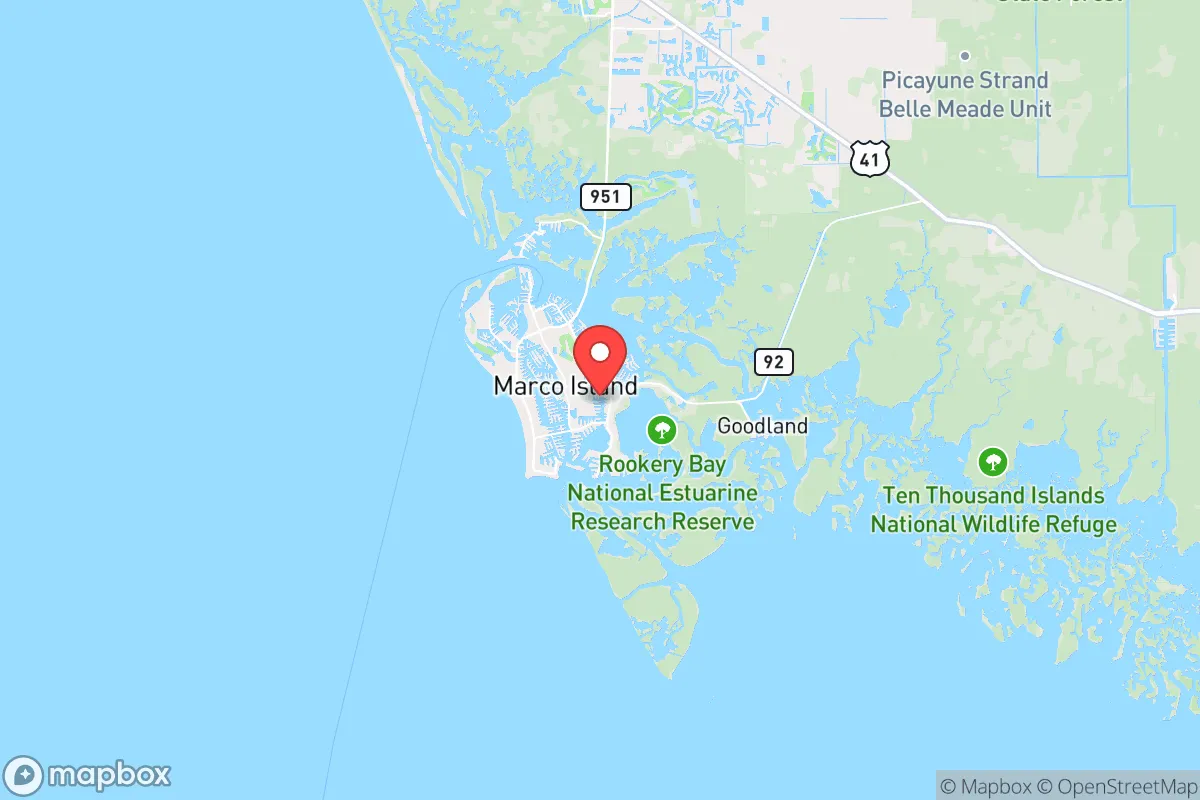
District shown is the primary district for this city’s centroid. Cities may span multiple districts.
Local Political AnalysisPolitical Analysis of Marco Island, FL
Marco Island has long been a conservative stronghold, and that hasn't changed. With a Cook Partisan Voting Index (PVI) of R+14, the island votes significantly more Republican than the state of Florida as a whole, which sits at R+5. This isn't a recent shift; it's been the bedrock of local politics for decades. You'll see it in the yard signs, the local commission meetings, and the general attitude that government should stay out of your business and your wallet. While the rest of the state has seen some purple creeping in, especially in places like Miami-Dade or Orlando, Marco Island has held the line.
How it compares
The difference between Marco Island and the broader state is stark. Florida's R+5 rating reflects a competitive, swing-state dynamic where a few percentage points can flip a county. Here on the island, that's not the case. We're nearly three times more Republican than the state average. Drive up the coast to Naples, and you'll find a similar conservative vibe, but it's not as concentrated. Head inland to Immokalee or east to the more suburban parts of Collier County, and you'll see a mix, but Marco Island is reliably red. The contrast is even sharper if you compare us to a place like Fort Lauderdale or Tampa, where progressive policies on taxes and regulations have gained more traction. Here, the conversation is still about property rights, low taxes, and keeping the federal government out of local decisions.
What this means for residents
For someone living here, the political climate translates directly into daily life. You don't see the same kind of government overreach that you might in more progressive areas. There's a strong presumption that you know what's best for your property, your family, and your business. Local officials are generally responsive to the idea that less regulation is better. You won't find the same push for high-density development or aggressive environmental mandates that can stifle personal freedom. The tax burden is relatively low, and there's a real resistance to new fees or assessments. It's a place where the phrase "leave us alone" isn't a complaint; it's a guiding principle. The recent push for more state-level control over local ordinances, like the "Live Local Act," has been watched closely here, with many residents wary of any state overreach that could override local conservative values.
That said, there are some cultural distinctions that set Marco Island apart even from other conservative areas in Florida. The community is older, wealthier, and more transient than inland towns, which means the politics can sometimes feel more focused on property values and amenities than on broader cultural battles. You won't see the same kind of grassroots activism you might in a rural county. The shift, if any, is subtle. The biggest concern among long-time residents isn't a sudden progressive takeover, but a slow erosion of the island's character through increased regulation from the state or federal level. The fear is that outside forces—whether from Tallahassee or Washington—will try to impose one-size-fits-all solutions on a community that values its independence. For now, the island remains a reliable conservative haven, but the vigilance is real. The next few years will be about whether that local control can hold against the tide of bigger government.

State Political ClimatePolitical Climate in Florida
State Political AnalysisPolitical Environment in the State
Florida has transformed from a quintessential swing state into a solidly Republican-leaning powerhouse, carrying a Cook PVI of R+5 and delivering decisive wins for Donald Trump in both 2020 and 2024 by margins exceeding three points. The dominant coalition today is a blend of conservative retirees, Hispanic voters (especially Cuban-Americans and Venezuelans), and native-born transplants fleeing high-tax states, all of whom have pushed the state steadily rightward over the past two decades. This isn’t your grandfather’s Florida—the days of hanging chads and razor-thin margins are gone, replaced by a durable red majority that shows no signs of cracking.
Urban vs. rural divide
The political map of Florida is starkly divided, with the I-4 corridor acting as the traditional battleground that has now tilted decisively red. The Miami-Dade County area, once a Democratic stronghold, has been the biggest story: in 2020, Trump improved his margin there by over 20 points compared to 2016, and by 2024, the county was nearly competitive, with Republican gains concentrated in Cuban and Venezuelan neighborhoods like Hialeah and Doral. Meanwhile, the Tampa Bay region—especially Hillsborough and Pinellas counties—has shifted right as well, with suburban communities like Wesley Chapel and Lutz flipping from purple to light red. The rural Panhandle, from Pensacola to Tallahassee, remains deeply conservative, with counties like Okaloosa and Santa Rosa routinely delivering 70%+ Republican margins. On the flip side, the Democratic vote is now concentrated in a shrinking number of urban islands: Orlando’s Orange County, Broward County (Fort Lauderdale), and Alachua County (Gainesville) are the last blue holdouts, but even there, Democratic margins have eroded as transplants from blue states bring their conservative values with them.
Policy environment
Florida’s policy environment is a model of limited government, and that’s exactly why people are moving here. There is no state income tax, a constitutional cap on property tax increases (the Save Our Homes amendment), and a regulatory climate that actively courts business—permitting for new construction is notoriously fast compared to the Northeast or West Coast. On education, Governor Ron DeSantis signed the Parental Rights in Education Act (HB 1557) in 2022, which prohibits classroom instruction on sexual orientation and gender identity in grades K-3, and the state has aggressively expanded school choice through the Family Empowerment Scholarship program, giving parents direct control over their children’s education. Healthcare policy is similarly freedom-oriented: Florida did not expand Medicaid under Obamacare, and the state has banned COVID-19 vaccine mandates for private employers and government workers. Election integrity is taken seriously here—Florida passed SB 90 in 2021, which tightened voter ID requirements, limited drop boxes, and banned mass mail-in ballot applications. The result is a state where the government stays out of your wallet, your child’s classroom, and your medical decisions.
Trajectory & freedom
Florida is becoming more free, not less, and the trajectory is accelerating. The 2023 legislative session was a masterclass in expanding personal liberty: the state passed a permitless carry law (HB 543), allowing law-abiding citizens to carry a concealed firearm without a government-issued permit, and it banned local governments from imposing their own gun restrictions, preempting the kind of patchwork regulations you see in states like California. On parental rights, the “Don’t Say Gay” law was expanded in 2023 to cover all grades, and the state banned the use of puberty blockers and cross-sex hormones for minors (SB 254). Property rights were strengthened with the “Live Local Act” (HB 1025), which preempts local zoning restrictions to allow more housing development, and the state has continued to cut taxes, including a permanent reduction in the corporate income tax rate to 5.5%. The only area where freedom has arguably contracted is on abortion: Florida passed a 15-week ban in 2022 (HB 5), and in 2023, DeSantis signed a six-week ban (SB 300), which is now in effect. For conservatives who value life, this is a positive step; for those who prioritize abortion access, it’s a limitation. Overall, the trend is clear: Florida is doubling down on individual liberty, parental authority, and economic freedom.
Civil unrest & political movements
Florida has seen remarkably little civil unrest compared to states like Oregon or New York, but there have been flashpoints. The 2020 Black Lives Matter protests in Miami, Orlando, and Jacksonville were largely peaceful, though some property damage occurred in downtown Miami. More recently, the state has become a battleground over immigration: Governor DeSantis has made national headlines by busing illegal immigrants to Martha’s Vineyard and California, and the state passed SB 1718 in 2023, which requires businesses with 25+ employees to use E-Verify and makes it a felony to transport illegal immigrants into the state. This has created a visible tension in agricultural communities like Immokalee and Homestead, where migrant labor is essential but the state’s enforcement posture is aggressive. On the left, activist groups like the Florida Rising coalition have organized protests against the six-week abortion ban and the Parental Rights law, but these have been small and localized. On the right, the “Moms for Liberty” movement has become a powerful force in school board elections, particularly in suburban counties like Sarasota and St. Johns. Election integrity controversies have been minimal—Florida’s 2020 and 2022 elections were widely praised as smooth and secure, a stark contrast to states like Georgia and Arizona. A new resident will notice that political activism here is more about school boards and local zoning than street protests.
Projection
Over the next 5-10 years, Florida will only get redder. The in-migration pattern is clear: roughly 1,000 people move to Florida every day, and the vast majority come from high-tax, high-regulation states like New York, California, and Illinois. These transplants are not bringing their old politics with them—they’re fleeing the very policies they voted for, and they’re registering as Republicans or independents at record rates. The Hispanic vote, especially among Cuban-Americans in Miami-Dade and Venezuelans in Collier County, will continue to shift right as these communities associate Democratic policies with socialism. The only demographic headwind for conservatives is the influx of younger, more liberal transplants to cities like Tampa and Orlando, but even there, the growth is in the suburbs—places like Riverview and Winter Garden—where families are prioritizing schools and safety over progressive activism. Expect the state to pass further school choice expansion, possibly a universal voucher program, and to continue preempting local gun control and zoning restrictions. The six-week abortion ban is likely to hold, and the state may even move toward a full ban if the political winds allow. For someone moving in now, the Florida of 2035 will be even more conservative, more affordable, and more free than it is today.
For a conservative individual or parent considering relocation, Florida offers a rare combination of low taxes, strong parental rights, secure elections, and a government that respects your freedom to live your life without interference. The political climate is stable and trending in your favor, with no serious threat of a blue wave on the horizon. You’ll find like-minded communities in places like Naples, Ponte Vedra Beach, or Lakeland, and you can send your kids to a school that teaches math and reading, not gender ideology. Just be prepared for the heat—both the weather and the political passion. This is a state that takes its freedom seriously, and it shows in every policy, every election, and every conversation you’ll have at the local barbecue.
* Values derived from national, state, county, city and local statistics and may differ in a specific area. Last updated: 2026-05-14T01:32:48.000Z
Narrative content on this page is AI-generated and may contain mistakes. Verify any details that matter before acting on them.
ReloMaps may earn a commission from affiliate links at no extra cost to you.

