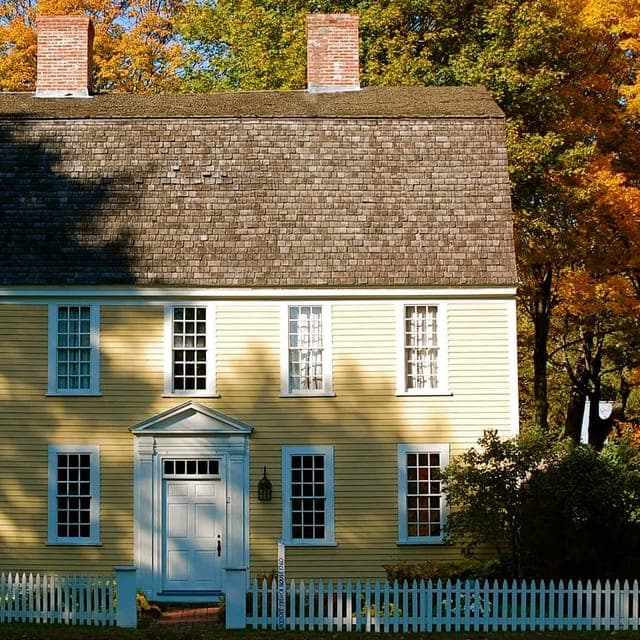
Photo: Wikipedia
Demographics of Massachusetts
Affluence Level in Massachusetts
A wealthy area with high-earning, well-educated households. Incomes, home values, and educational attainment meaningfully outpace national averages.
People of Massachusetts
The people of Massachusetts today are a densely settled, highly educated, and historically rooted population of nearly 7 million, concentrated in the Boston metro area and its satellite cities. The state is defined by its deep colonial history, a legacy of 19th-century industrial immigration, and a modern influx of highly skilled professionals drawn to its world-class universities and biotech sector. With a foreign-born population of 8.0% and a population that is 67.8% white, 12.9% Hispanic, 6.5% Black, 4.9% East/Southeast Asian, and 2.2% Indian (subcontinent), Massachusetts is less ethnically diverse than the national average but is becoming more so, particularly in its urban and suburban cores.
Settlement & growth (pre-1960)
The human history of Massachusetts begins with the Algonquian-speaking peoples, including the Wampanoag, Massachusett, Nipmuc, and Narragansett nations, who lived in seasonal villages along the coast and river valleys for thousands of years. European contact began with the Pilgrims, English Separatists who landed at Plymouth in 1620, followed a decade later by the Puritan-led Massachusetts Bay Colony, which established Boston in 1630. These English settlers, seeking religious autonomy, created a society of tightly-knit towns centered on the Congregational church, with Salem, Cambridge, and Springfield emerging as early hubs. By the time of the American Revolution, Massachusetts was the most densely populated of the thirteen colonies, its people overwhelmingly of English descent, with small pockets of Scots-Irish and French Huguenots.
The 19th century brought transformative waves of immigration. From the 1840s onward, the Irish Potato Famine drove hundreds of thousands of Irish Catholics to Massachusetts, settling in Boston's North End and South Boston, as well as industrial mill towns like Lowell and Lawrence. They provided the labor for the state's booming textile mills and factories. By the 1880s, French Canadians crossed the northern border to work in the mills of Holyoke and Fall River, creating a distinct Franco-American community. Simultaneously, Italians, Poles, Portuguese, and Jews from Eastern Europe arrived in large numbers, filling the tenements of Boston's North End, East Boston, and the working-class neighborhoods of Worcester and New Bedford. The Portuguese, in particular, established a strong presence in the fishing ports of New Bedford and Provincetown on Cape Cod. By 1900, Massachusetts was a patchwork of ethnic enclaves, each with its own churches, social clubs, and newspapers, but all were being slowly Americanized through the public school system and industrial labor.
The period from 1900 to 1960 saw the Great Migration of Black Americans from the South, who moved to Boston, Cambridge, and Roxbury for industrial jobs and to escape Jim Crow. This wave, combined with ongoing European immigration, made Massachusetts a majority-white but ethnically plural state by mid-century. The post-World War II era brought suburbanization, as white ethnic families moved from dense city neighborhoods to newly built suburbs like Quincy, Newton, and Framingham, reshaping the state's population distribution.
Modern era (post-1965)
The 1965 Hart-Cellar Act fundamentally altered Massachusetts's demographic trajectory. While the state's foreign-born share (8.0%) remains below the national average, the origins of immigrants have shifted dramatically. The largest modern wave has been from Latin America, particularly Puerto Rico (a U.S. territory, not an immigrant group in the legal sense), the Dominican Republic, and Central America. These Hispanic populations have concentrated in Boston's Roxbury and Jamaica Plain neighborhoods, as well as in Lawrence, Holyoke, and Springfield, where they have revitalized aging industrial cities. The Hispanic share of the state's population now stands at 12.9%, making it the largest minority group.
East and Southeast Asian communities, including Chinese, Vietnamese, and Cambodian populations, have grown significantly since the 1970s. Boston's Chinatown remains a cultural anchor, but many Chinese and Taiwanese professionals have moved directly to affluent suburbs like Lexington and Newton, drawn by the technology and education sectors. The Cambodian community, one of the largest in the U.S., is centered in Lowell and Lynn. The Indian (subcontinent) population, at 2.2%, is a more recent and highly educated wave, concentrated in the tech corridor along Route 128 and in Framingham, Shrewsbury, and Acton, where they work in engineering, medicine, and information technology.
Domestic migration has also reshaped the state. The decline of manufacturing in the 1970s and 1980s led to population loss in older industrial cities like Fall River and New Bedford, while the rise of the knowledge economy fueled growth in Boston, Cambridge, and their inner-ring suburbs. The state's high cost of living and cold winters have discouraged large-scale domestic in-migration from other states, but the draw of elite universities and the biotech industry has kept the population stable. Suburbanization has continued, with many white and Asian families moving to exurbs like Westford and Franklin, while Black and Hispanic populations have increasingly suburbanized as well, particularly in Brockton and Randolph.
The future
Massachusetts is likely to become more diverse and more stratified in the coming decades. The white, non-Hispanic population (67.8%) is aging and declining in share, while Hispanic and Asian populations are younger and growing through both immigration and higher birth rates. The state's foreign-born population, though modest by national standards, is becoming more Asian and Indian, with East/Southeast Asian and Indian communities projected to increase their share as the state's knowledge economy continues to attract global talent. The Black population is expected to remain stable, with growth from African immigrants (particularly from Cape Verde and Somalia) offsetting out-migration of native-born Black residents to the South.
The state is not homogenizing; rather, it is tribalizing into distinct enclaves based on income and ethnicity. Affluent, highly educated suburbs like Lexington and Newton are becoming majority-minority in their school-age populations, driven by Asian and Indian families, while older industrial cities like Lawrence and Holyoke are becoming overwhelmingly Hispanic. The cultural identity of Massachusetts is being reshaped by these new arrivals, but the state's deep-rooted institutions—its universities, hospitals, and political culture—are absorbing and integrating these groups, much as they did with the Irish and Italians a century ago. The next 10-20 years will likely see continued growth in the Boston metro area, stagnation in the western part of the state, and a slow but steady increase in the share of residents who are foreign-born or the children of immigrants.
For someone moving to Massachusetts now, the state offers a stable, highly educated, and increasingly diverse population, but one that is expensive and geographically concentrated. The opportunities are greatest in the Boston-Cambridge corridor, where the economy is driven by innovation and global talent, while the older industrial cities offer lower costs but face economic and demographic challenges. The state's character remains distinctly New England—dense, historic, and institutionally strong—but it is becoming more cosmopolitan, more Asian and Hispanic, and more stratified by education and income with each passing year.

Most Diverse Cities in Massachusetts
Most Homogenous Cities in Massachusetts
* Values derived from national, state, county, city and local statistics and may differ in a specific area. Last updated: 2026-04-18T22:53:10.000Z
Narrative content on this page is AI-generated and may contain mistakes. Verify any details that matter before acting on them.
ReloMaps may earn a commission from affiliate links at no extra cost to you.

