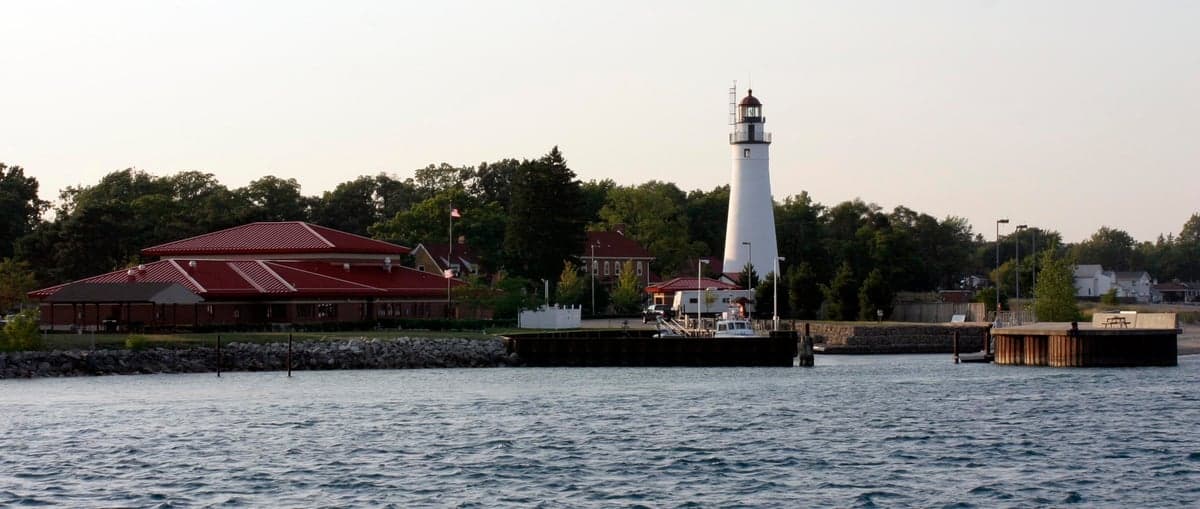
Photo: Wikipedia
Political ClimatePolitical Climate in St Clair County
Showing district-level results — no local-only data available.
Local Political AnalysisPolitical Analysis of St Clair County
St Clair County is a reliably Republican stronghold in southeast Michigan, carrying a Cook Partisan Voting Index of R+16 — a stark contrast to the state of Michigan as a whole, which sits at EVEN. That 16-point gap is one of the widest between any Michigan county and the state average, and it has held steady through the last several election cycles. The county has voted for the GOP presidential nominee in every election this century, often by double digits, even as Michigan flipped blue in 2008, 2012, and 2020.
How it compares
To put the R+16 in perspective: while Michigan as a whole is a true toss-up state — decided by roughly 2.8 points in 2020 and 1.4 points in 2024 — St Clair County handed Donald Trump a 20-point victory in 2020 and a similar margin in 2024. That's a bigger Republican edge than neighboring Macomb County (which leans Democratic but has trended right) and far more conservative than Wayne County to the south. The county's politics more closely resemble the rural and exurban regions of mid-Michigan than the suburban Detroit collar counties it borders geographically. The political geography inside St Clair County isn't uniform, though. The city of Port Huron, the county seat and largest municipality, is the clear blue anchor — it's the only place in the county where Democrats consistently win precincts, and even then it's narrowly split. The lakeshore communities of St Clair and Marine City lean Republican but are more competitive, often landing within 5-8 points. The real GOP firepower comes from the inland townships — Fort Gratiot, Burtchville, and the sprawling rural townships like Columbus, Casco, and Riley — where Republican margins routinely hit 30-40 points. The swing precincts are almost all in the southern tier, around Algonac and Clay Township, where working-class voters have drifted right over the past decade.
What this means for residents
For conservative residents, the county's lean means local elections are rarely competitive at the countywide level — the Board of Commissioners and county offices have been held by Republicans for decades, and the primary is often the real contest. For liberal residents, it means organizing is an uphill climb, but not hopeless: Port Huron's Democratic precincts do elect a few city council members and the county's Democratic Party maintains a small but active presence. In practice, the political climate shapes daily life in subtle ways — local government tends to emphasize low taxes and limited regulation, and the county has been a vocal opponent of some state-level environmental mandates on the St Clair River. But it's also a pragmatic conservatism: the county accepts federal and state funding for infrastructure and the Blue Water Bridge, and there's little appetite for the culture-war intensity you'd see in more deeply polarized regions.
Culturally, St Clair County feels more like a Great Lakes maritime community than a typical Michigan political battleground. The Blue Water Area's identity is tied to the river, the bridge to Canada, and the working-class history of shipbuilding and paper mills — not to the auto industry politics that dominate downriver Detroit. That identity produces a distinctive strain of conservatism: pro-union on trade issues, skeptical of foreign entanglements, but firmly Republican on taxes, guns, and social policy. The trajectory is clear — the county is getting redder as Port Huron's population slowly declines and the townships grow — but the shift is gradual, not dramatic. Expect St Clair County to remain a reliable R+15 to R+20 county for the foreseeable future, even as Michigan itself stays a coin-flip state.

State Political ClimatePolitical Climate in Michigan
State Political AnalysisPolitical Environment in the State
Michigan is the definition of a battleground state, with a Cook PVI of EVEN, meaning it votes almost exactly like the nation as a whole. The state’s politics are a knife’s-edge fight between the heavily Democratic, unionized urban cores of Detroit, Ann Arbor, and Grand Rapids’ inner ring, and the overwhelmingly Republican rural and exurban expanses of the Upper Peninsula and the western and northern Lower Peninsula. Over the last 20 years, the state has swung violently — from a Republican trifecta in the 2010s, to a narrow Trump win in 2016, to a Democratic sweep of every statewide office in 2022 and 2024, making it one of the most volatile political environments in the country.
Urban vs. rural divide
The political map of Michigan is a tale of three distinct regions. The southeastern corner, anchored by Detroit and its suburbs, is the Democratic engine room. Wayne County alone delivers roughly 30% of the state’s Democratic vote, and the city’s Black population remains the most loyal Democratic bloc in the state. Ann Arbor, home to the University of Michigan, is the state’s most liberal city, consistently voting 80%+ Democratic. The surprising shift has been in Grand Rapids, historically a conservative stronghold, which has flipped decisively blue in the last decade as the city’s furniture and healthcare industries attracted a younger, college-educated workforce. Kent County, which voted for Trump by 3 points in 2016, went for Biden by 8 in 2020 and Harris by 9 in 2024.
Conversely, the rural north and west are deeply red. Traverse City is a blue island in a sea of red, but the surrounding Grand Traverse County and the entire Upper Peninsula — including Marquette and Sault Ste. Marie — vote Republican by wide margins, driven by hunting, fishing, and a strong distrust of downstate regulation. The true bellwether is Macomb County, the working-class suburban county north of Detroit. Macomb voted for Obama twice, flipped hard to Trump in 2016, and then flipped back to Democrats in 2022 and 2024, making it the single most-watched county in the state for national election forecasters.
Policy environment
Michigan’s policy environment is a study in contradictions. The state has a flat income tax of 4.25%, which is moderate by national standards, but it also has some of the highest property taxes in the country, averaging about 1.5% of home value annually. The state’s regulatory posture is mixed: it’s a right-to-work state on paper, but the 2023 repeal of that law means unions are regaining strength in the auto and manufacturing sectors. Education policy is a flashpoint — Detroit’s public schools have been under state control for over a decade, while wealthy suburbs like Birmingham and Bloomfield Hills fund their schools at levels that rival private institutions. Healthcare is a bright spot for liberals: Michigan expanded Medicaid under the Affordable Care Act, and the state has some of the strongest patient protections in the Midwest. Election laws are moderate — no voter ID requirement at the polls, but also no same-day registration, and the state has automatic voter registration through the Secretary of State’s office.
Recent policy direction
The 2023-2024 legislative session was a seismic shift. Democrats, holding a trifecta for the first time in 40 years, passed a sweeping package that tells you everything about the state’s direction. On gun policy, they enacted universal background checks and a "red flag" law allowing courts to temporarily seize firearms from individuals deemed a threat — a major change in a state with deep hunting traditions. On parental rights, they passed a law requiring schools to notify parents of any changes to a student’s gender identity, a move that pleased conservatives but angered LGBTQ advocates. On bodily autonomy, they codified abortion rights into state law in 2023, making Michigan a safe haven for women from neighboring Ohio and Indiana. On property rights, they banned local governments from restricting short-term rentals like Airbnb, a win for cottage owners in Holland and Saugatuck. On voting, they expanded absentee voting to all voters without an excuse and added nine days of early in-person voting. The tax picture is stable — the flat income tax is being gradually reduced to 4.05% by 2026, but the state’s gas tax remains among the highest in the Midwest.
Civil unrest & political movements
Michigan has been a national flashpoint for political extremism on both sides. The most infamous incident was the 2020 plot to kidnap Governor Gretchen Whitmer, foiled by the FBI, which involved militia members from the Lansing area. That event, combined with the armed protests at the state capitol over COVID-19 lockdowns, put Michigan at the center of the national debate over government overreach. On the left, the state has seen massive union mobilization, particularly the 2023 UAW strike against the Big Three automakers, which shut down plants in Flint and Dearborn for six weeks. Immigration politics are quieter than in border states, but Detroit and Ann Arbor have declared themselves sanctuary cities, refusing to cooperate with federal immigration enforcement. Election integrity has been a persistent controversy — Trump’s 2020 loss in the state by 154,000 votes led to a Republican-led legislative investigation that found no widespread fraud, but the state’s Republican Party remains deeply divided between establishment and Trump-aligned factions, a split that cost them several winnable races in 2022 and 2024.
Projection
Looking ahead five to ten years, Michigan’s trajectory is toward a stable, if narrow, Democratic lean. The demographic trends are clear: the state’s rural population is aging and shrinking, while the urban and suburban cores of Detroit, Grand Rapids, and Ann Arbor are growing, driven by in-migration of young professionals and immigrants. The auto industry’s transition to electric vehicles is a wildcard — if it succeeds, it will cement the Democratic coalition in the southeast; if it fails, it could trigger a populist backlash that favors Republicans. The Republican Party’s path back to competitiveness runs through Macomb County and the working-class suburbs, where economic anxiety and cultural conservatism still resonate. A new resident moving to Michigan in 2026 should expect a state that remains politically competitive but leans slightly Democratic in statewide races, with a policy environment that is increasingly liberal on social issues but still moderate on taxes and business regulation.
For a new resident, the practical takeaway is that Michigan rewards political engagement. Your vote genuinely matters here — the state has decided the last three presidential elections by margins of less than 3 points. If you’re conservative, you’ll find a welcoming community in the rural north and west, but you’ll need to accept that state-level policy will lean left for the foreseeable future. If you’re liberal, you’ll find a robust progressive infrastructure in the cities, but you’ll be living in a state where half your neighbors voted the other way. Either way, Michigan is a place where politics is personal, local, and impossible to ignore — and that’s exactly what makes it one of the most politically interesting states in the country to call home.
* Values derived from national, state, county, city and local statistics and may differ in a specific area. Last updated: 2026-10-16T04:02:23.000Z
Narrative content on this page is AI-generated and may contain mistakes. Verify any details that matter before acting on them.
ReloMaps may earn a commission from affiliate links at no extra cost to you.

