
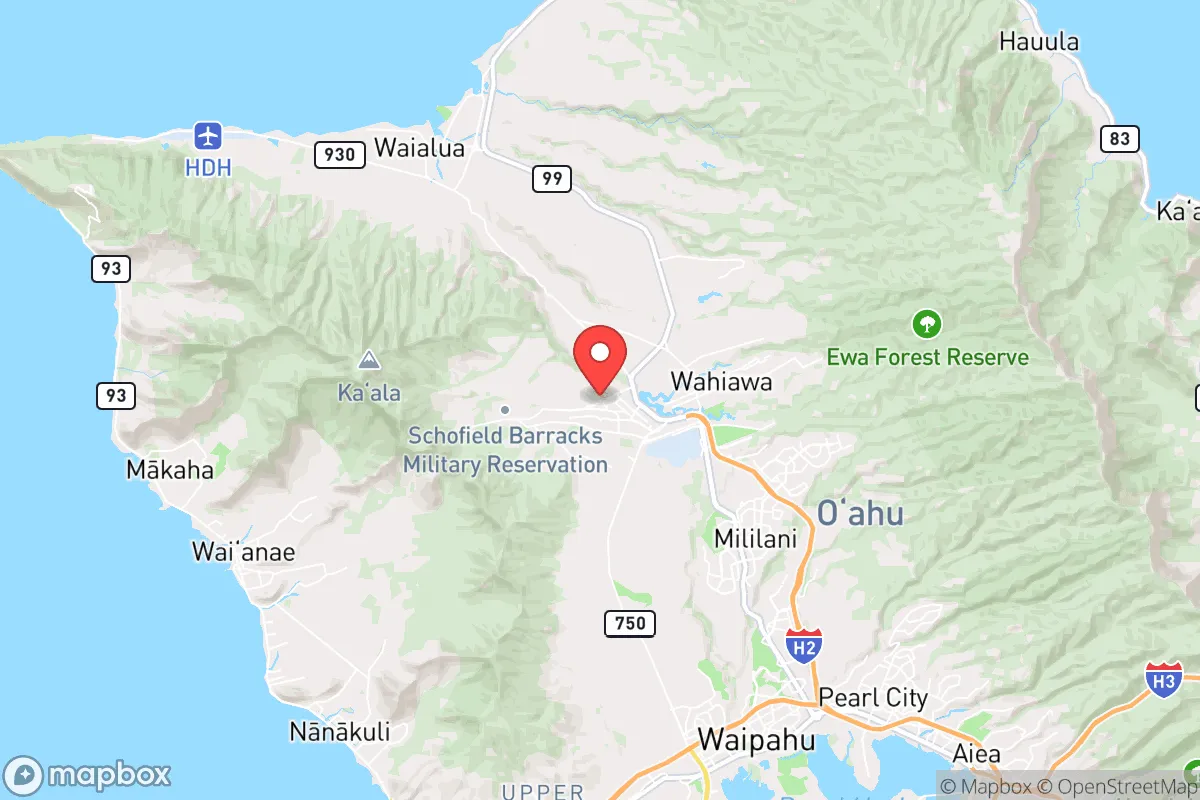
Photo: Wikipedia
Political ClimatePolitical Climate in Schofield Barracks, HI
District shown is the primary district for this city’s centroid. Cities may span multiple districts.
Local Political AnalysisPolitical Analysis of Schofield Barracks, HI
Schofield Barracks sits in a unique political bubble within Hawaii, a state that leans heavily Democratic with a Cook PVI of D+12, but the base itself and the surrounding communities like Wahiawa and Mililani have historically been more conservative-leaning than the rest of Oahu. The military population here tends to vote for smaller government and stronger national defense, but over the last decade, you've seen the politics of Honolulu and the state legislature creep further into daily life here. It's not the same place it was even ten years ago, and the trajectory is concerning for anyone who values personal freedoms and local control.
How it compares
If you drive 20 minutes south into Honolulu or even over to Kailua, you're in a completely different political world—those areas are solidly progressive, with policies that often feel like they're written for people who don't own guns, don't drive trucks, and don't mind heavy-handed government mandates. Schofield Barracks and the North Shore towns like Haleiwa still have a more independent, live-and-let-live vibe, but the state government in Honolulu keeps pushing regulations that affect everyone here. The contrast is stark: while the base community leans right on issues like the Second Amendment and property rights, the surrounding county and state governments are moving left fast, especially on housing, land use, and environmental rules that can feel like overreach.
What this means for residents
For military families and long-time residents, the biggest red flag is how state-level policies are starting to limit personal choices. Hawaii's strict gun laws, for example, are among the toughest in the nation, and they apply to everyone on the island, including those living on base. You're also seeing more local ordinances that affect everything from what you can build on your property to how you can use your vehicle. The push for higher taxes and more government programs in Honolulu doesn't always sit well with folks who just want to be left alone to raise their families and serve their country. The cost of living keeps climbing, and a lot of that is tied to government fees and regulations that make it harder to get ahead.
Looking ahead, the political climate here is likely to keep shifting toward the progressive side as more people move in from the mainland and as the state government continues to centralize power. The military presence is still a strong counterbalance, but it's not enough to stop the tide of new laws and mandates that feel like they're written by people who don't understand or respect the conservative values that many residents here hold. If you're thinking about moving to Schofield Barracks, just know that the local politics are increasingly at odds with the traditional American ideals of personal responsibility and limited government. It's still a great place to live for the community and the mission, but you'll have to keep an eye on what Honolulu is doing, because it affects everything from your property taxes to your right to defend your home.

State Political ClimatePolitical Climate in Hawaii
State Political AnalysisPolitical Environment in the State
Hawaii has been a one-party Democratic stronghold for decades, with Democrats holding supermajorities in both legislative chambers and every statewide office since 1962. The state’s overall partisan lean is roughly D+20 in presidential elections, though the 2024 results showed a slight rightward shift—Trump improved his margin by about 3 points compared to 2020, pulling 37% of the vote. Over the past 20 years, the Democratic grip has tightened in Honolulu and the urban core, but rural areas and the neighbor islands have shown growing independence, with some precincts in Hawaii County and Kauai flirting with Republican or libertarian-leaning candidates. For a conservative considering relocation, the key takeaway is that while the state is deeply blue, the political landscape is not monolithic—and the cracks are widening.
Urban vs. rural divide
The political map of Hawaii breaks cleanly along development lines. Honolulu and urban Oahu (including Waikiki, Manoa, and Kakaako) are the engine of Democratic dominance, routinely delivering 70-75% of the vote to Democratic presidential candidates. The city’s dense, union-heavy workforce and large Asian-American and Native Hawaiian populations align with progressive economic and social policies. In contrast, Hawaii County (the Big Island) is the most politically divided—its rural districts like Puna and Ka’u lean left, but the Kona and Kohala coasts, along with ranching communities like Waimea and Kamuela, often vote Republican or independent. Maui County is a mixed bag: the tourist-heavy areas of Kihei and Lahaina lean blue, while upcountry towns like Kula and Hana are more conservative. Kauai is surprisingly purple—its north shore and Hanalei are progressive enclaves, but the west side and Lihue show stronger Republican support. The urban-rural divide is sharpest on Oahu itself: the Windward side (Kailua, Kaneohe) is moderate, while the Leeward coast (Waianae, Nanakuli) is reliably Democratic but increasingly skeptical of Honolulu’s political establishment.
Policy environment
Hawaii’s policy environment is among the most interventionist in the nation. The state has the highest combined state and local tax burden in the U.S., with a general excise tax (GET) of 4% that applies to nearly all goods and services, plus county surcharges that push it to 4.5% in Honolulu and 4.75% on the Big Island. Property taxes are relatively low (0.3-0.5% of assessed value), but the state’s regulatory posture is heavy: building permits can take 18-24 months, and land use laws are among the strictest in the country, limiting new housing supply. Education policy is centralized under the state Department of Education—there are no local school districts—and charter schools are limited. Healthcare is dominated by the Hawaii Medical Service Association (HMSA), a Blue Cross affiliate, and the state mandates employer-provided health insurance for workers over 20 hours per week. Election laws are moderately restrictive: no-excuse absentee voting is allowed, but same-day registration is not available, and voter ID is not required. The state has a sanctuary policy (Act 2, 2019) that limits cooperation with federal immigration enforcement, and it was the first state to implement a statewide rent control law (Act 157, 2023), capping annual rent increases at 5% plus inflation.
Trajectory & freedom
Hawaii is trending less free across multiple dimensions. On gun rights, the state passed Act 52 in 2022, which bans the open carry of firearms and requires a permit for concealed carry—one of the strictest laws in the nation. In 2024, the legislature overrode the governor’s veto to pass Act 208, which bans the sale of semiautomatic rifles to anyone under 21 and mandates microstamping for handguns. On parental rights, the state passed Act 159 in 2023, which prohibits schools from notifying parents if a student changes their gender identity or pronouns—a direct blow to parental authority. On medical autonomy, Hawaii legalized assisted suicide (Our Care, Our Choice Act) in 2018 and expanded telehealth abortion access in 2023. Property rights are under constant pressure: the state’s land use commission can rezone agricultural land for development only after years of hearings, and the 2023 Act 157 rent control law directly limits what landlords can charge. On taxation, there is no sign of relief—the GET is regressive and broad, and a 2024 proposal to create a state wealth tax (HB 2400) failed by only a few votes. The trajectory is clear: more regulation, less individual autonomy, and a growing gap between what the government promises and what it delivers.
Civil unrest & political movements
Hawaii has a history of organized activism, but it’s not the kind that makes national headlines. The Thirty Meter Telescope (TMT) protests on Mauna Kea (2015-2019) were the most visible flashpoint, drawing thousands of Native Hawaiian activists and their allies who blocked construction, citing cultural and environmental concerns. The movement was largely left-aligned but also tapped into anti-colonial and anti-government sentiment that resonates across the political spectrum. On the right, the Hawaii Republican Party is small but active, with a libertarian streak—groups like the Hawaii Libertarian Party and the Hawaii Firearms Coalition have been vocal against gun control and rent control. Immigration politics are muted compared to the mainland, but the sanctuary policy (Act 2) has drawn criticism from conservatives who argue it shields illegal immigration. Election integrity controversies are minimal—Hawaii uses paper ballots and has a strong track record of clean elections, though the 2020 mail-in voting expansion (Act 46) raised concerns about ballot harvesting among some conservatives. The most visible flashpoint for a new resident would be the housing crisis: homelessness is rampant in Honolulu (Kakaako, Waikiki), and local activists on both sides blame government overregulation for the lack of affordable housing.
Projection
Over the next 5-10 years, Hawaii’s political trajectory is likely to remain leftward, but with growing internal friction. Demographic shifts are working against conservatives: the state’s population is aging, and younger residents (who lean progressive) are leaving for the mainland due to high costs, while the remaining population is increasingly dependent on government services. In-migration from the mainland is mostly retirees and remote workers, who tend to be moderate but not conservative. The housing crisis will be the defining political issue—if the state fails to build, expect more rent control and land use restrictions, which will further choke freedom. The Republican Party is unlikely to win statewide office, but could pick up seats in the legislature from rural districts (Hawaii County, Kauai) if they focus on local issues like property rights and tax relief. The most realistic scenario is a slow slide into deeper progressive governance, with occasional libertarian pushback on specific issues like gun rights and housing. Someone moving in now should expect to live in a state where the government is deeply involved in daily life, and where individual freedoms are increasingly secondary to collective goals.
For a conservative relocating to Hawaii, the bottom line is this: you’re moving to a blue state with a heavy regulatory hand, high taxes, and a culture that prioritizes government solutions over personal liberty. The trade-off is a stunning natural environment, a slower pace of life, and a community that values connection over competition. If you can afford the cost of living and are willing to navigate the bureaucracy, you can carve out a good life—but don’t expect the political winds to shift in your favor anytime soon. The best bets for a conservative-friendly enclave are the rural parts of the Big Island (Waimea, Kamuela) or upcountry Maui (Kula), where the politics are more independent and the government feels further away. Just know that the state government in Honolulu will still reach you, one way or another.
* Values derived from national, state, county, city and local statistics and may differ in a specific area. Last updated: 2026-04-24T07:19:23.000Z
Narrative content on this page is AI-generated and may contain mistakes. Verify any details that matter before acting on them.
ReloMaps may earn a commission from affiliate links at no extra cost to you.

