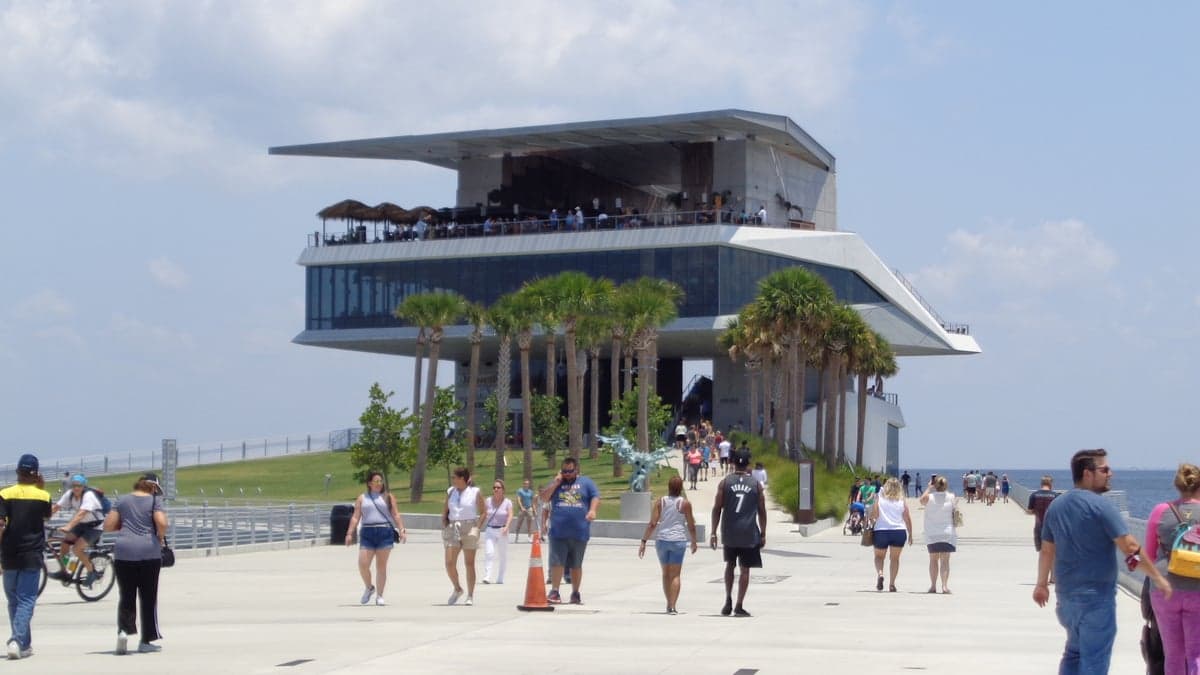
Photo: Wikipedia
Political ClimatePolitical Climate in St. Petersburg, FL
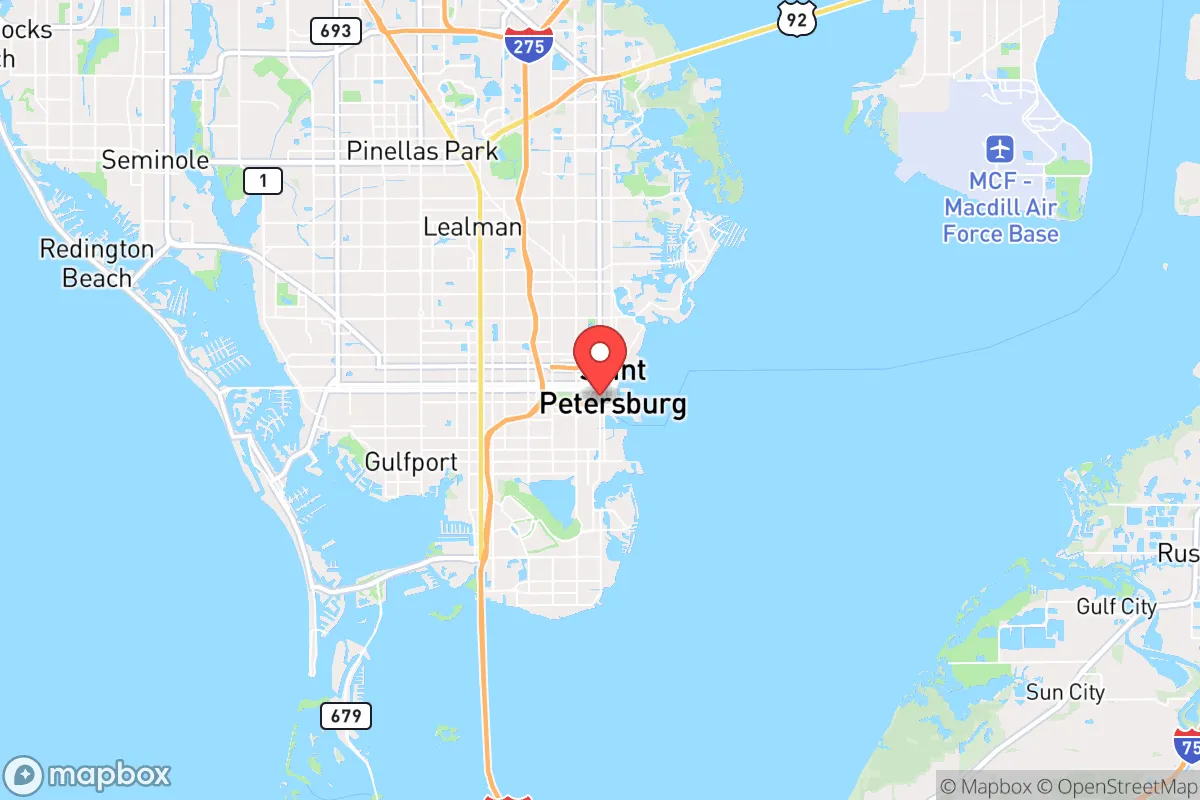
District shown is the primary district for this city’s centroid. Cities may span multiple districts.
Local Political AnalysisPolitical Analysis of St. Petersburg, FL
St. Petersburg, Florida, has drifted further left in recent years, and if you’ve lived here as long as I have, you’ve felt the shift. The city now carries a Cook PVI of D+5, meaning it votes about five points more Democratic than the national average—a far cry from the purple-leaning swing town it was just a decade ago. While Pinellas County as a whole still flirts with toss-up status, St. Pete proper has become a reliable blue stronghold, and the trend line is only getting steeper.
How it compares
Drive 20 minutes north to Clearwater or 30 minutes east to Brandon, and you’ll find yourself in much more conservative territory. Clearwater’s precincts routinely vote Republican by double digits, and the unincorporated areas of northern Pinellas feel like a different state entirely. Even within St. Pete, the contrast is stark: south of Central Avenue, you’ll see more Trump signs in yards and more pickup trucks with flags, while the downtown core and the Snell Isle/Shore Acres neighborhoods lean heavily progressive. The city council has shifted left in lockstep with the electorate, passing ordinances on everything from plastic straw bans to rent control studies—moves that would never fly in nearby Largo or Seminole. If you value local government staying out of your business, the contrast between St. Pete and its neighbors is something to watch closely.
What this means for residents
For a longtime resident, the biggest concern is how this political tilt affects daily life. Property taxes have crept up as the city funds new social programs and climate resilience projects—noble goals, but they come straight out of your pocket. The city’s push for “equity” in zoning has led to density increases in single-family neighborhoods, often without meaningful input from the people who actually live there. Meanwhile, the school board has embraced progressive curriculum changes that many parents find intrusive. If you’re a small business owner, you’ve probably noticed the new paid-leave mandates and stricter noise ordinances downtown. The government’s appetite for regulation seems to grow with every election cycle, and it’s getting harder to just live your life without tripping over a new rule or fee.
On the cultural side, St. Pete has become a haven for out-of-state transplants—many from blue states—who bring their politics with them. The local Democratic Party is now dominated by activists who push for things like defunding the police (which failed here, but only barely) and sanctuary city policies. The police department has lost officers to surrounding counties where the political climate is more supportive, and response times in some neighborhoods have ticked up as a result. The arts scene is vibrant, sure, but it comes with a heavy dose of progressive activism that can feel alienating if you don’t share the worldview.
Looking ahead, the trajectory is clear: as more young professionals and retirees from the Northeast and California move in, the city will only get bluer. The 2024 election saw St. Pete vote for Biden by a wider margin than 2020, and local races are following suit. If you’re considering a move here and you lean conservative, you’ll want to look at the northern or eastern parts of the county—or just accept that your vote won’t count for much in city elections. The old St. Pete, where a Republican could win a city council seat and neighbors respected each other’s differences, is fading fast. What’s replacing it is a one-party town with all the overreach that implies.

State Political ClimatePolitical Climate in Florida
State Political AnalysisPolitical Environment in the State
Florida has transformed from a classic swing state into a solidly Republican-leaning powerhouse over the past decade, with a partisan lean of roughly +3 to +5 points in statewide races as of 2024. The dominant coalition is a mix of conservative retirees, Hispanic voters (especially Cuban-Americans in Miami-Dade), and transplants from blue states seeking lower taxes and fewer restrictions. Over the last 20 years, the state has shifted rightward by about 10 points, driven by massive in-migration from the Northeast and Midwest, and a realignment of working-class voters who once leaned Democratic. This isn't your grandfather's Florida — it's a place where conservative policies are not just tolerated but actively championed at the state level.
Urban vs. rural divide
The political map of Florida is a study in contrasts. The major metros — Miami, Orlando, and Tampa — are the Democratic strongholds, but even these are shifting. Miami-Dade County, once a Democratic lock, flipped to Trump in 2020 and 2024, driven by a surge of conservative Cuban and Venezuelan voters who reject socialism. Meanwhile, Orlando (Orange County) and Tampa (Hillsborough County) remain blue-leaning but are surrounded by deep-red suburbs like Kissimmee and Lakeland that are growing fast. The rural Panhandle — places like Panama City and Pensacola — is as red as it gets, with Trump winning some counties by 40+ points. The I-4 corridor, stretching from Tampa to Daytona Beach, is the classic battleground, but even there, the trend is rightward. Volusia County, home to Daytona Beach, voted for Trump by 12 points in 2024, a shift from its purple status a decade ago. The divide isn't just urban vs. rural — it's coastal vs. inland, with the Atlantic coast (especially Palm Beach and Broward) still blue, but the Gulf Coast and interior trending redder every cycle.
Policy environment
Florida's policy environment is a conservative's dream, and it's been deliberately engineered that way. There is no state income tax, a huge draw for high-earners and retirees. Property taxes are moderate, and the state caps annual increases for homesteaded properties at 3% (the Save Our Homes amendment). The regulatory posture is light-touch — permitting for businesses is streamlined, and there's no state-level minimum wage above the federal floor (though a $15 minimum wage was passed by ballot initiative in 2020). Education policy is a flashpoint: Governor Ron DeSantis signed the Parental Rights in Education Act (HB 1557) in 2022, which restricts classroom instruction on sexual orientation and gender identity in early grades. School choice is robust, with vouchers and charter schools widely available. Healthcare is mixed — Florida did not expand Medicaid under the ACA, and the state has a competitive private insurance market. Election laws have been tightened: SB 90 (2021) added voter ID requirements, limited drop boxes, and restricted mail-in voting, making it harder to vote but also increasing confidence in election integrity among conservatives. The state also preempts local gun laws, ensuring uniform Second Amendment protections.
Trajectory & freedom
Florida is arguably the most freedom-oriented state in the country right now, and it's trending even more so. The 2023 legislative session was a landmark: HB 543 (constitutional carry) allows permitless carry of firearms, effective July 2023. SB 258 (the "Stop WOKE Act") restricts critical race theory in workplace training and schools, though parts were blocked by courts. On medical autonomy, SB 300 (2023) banned gender-affirming care for minors, a major win for parental rights advocates. Property rights were strengthened with HB 7 (2021), which limits homeowners' association fines and restrictions. Taxation is being cut further — the 2024 budget included a permanent reduction in the corporate income tax rate from 5.5% to 5.0%. The trajectory is clear: Florida is becoming more free, not less, with each legislative session expanding personal liberty in areas like gun rights, education choice, and medical freedom. The only caution is that the state's growth is bringing more people who may push for different policies — but so far, the political leadership is doubling down on freedom.
Civil unrest & political movements
Florida has seen its share of political flashpoints, but they've been relatively contained compared to other states. The 2020 Black Lives Matter protests in Miami and Orlando were large but mostly peaceful, with some property damage in downtown Miami. The state's response was firm — DeSantis declared a state of emergency and deployed the National Guard quickly. On the right, the "Don't Tread on Florida" movement is active, with grassroots groups pushing for school board elections and local government accountability. Immigration politics are front and center: SB 1718 (2023) is the toughest anti-illegal immigration law in the country, requiring E-Verify for employers and banning local "sanctuary" policies. This has caused some tension with agricultural and hospitality industries that rely on immigrant labor. Election integrity remains a hot topic — the 2020 and 2022 elections were widely seen as clean in Florida, but there are ongoing lawsuits over the state's new election laws. The most visible flashpoint for a new resident would be the culture war in schools, with heated school board meetings over library books and curriculum. It's not violent, but it's constant — and it's a sign that Floridians take their politics seriously.
Projection
Over the next 5-10 years, Florida is likely to become even more conservative, but with a twist. The in-migration from blue states (New York, California, Illinois) is bringing some moderate Democrats, but they're often fleeing high taxes and crime, not seeking to remake Florida in their old state's image. The Hispanic vote, especially in Miami-Dade, is trending rightward — by 2030, Florida could be a +10 Republican state in presidential elections. The biggest risk is overreach: if the state becomes too aggressive on social issues (e.g., a total abortion ban, which is currently at 6 weeks), it could alienate suburban women and moderate transplants. But the economic fundamentals — no income tax, pro-business climate, and a growing population — are so strong that the political lean is likely to hold. A new resident moving in now should expect to find a state that is more free, more prosperous, and more culturally conservative than the national average, with a government that actively protects those values.
For a conservative-leaning individual or family, Florida offers a rare combination: low taxes, strong Second Amendment protections, parental rights in education, and a government that respects personal liberty. The political climate is not just friendly — it's actively protective of the values that drive many people to relocate. You'll find like-minded neighbors in places like Naples or The Villages, and even in blue-leaning cities like St. Petersburg, the culture is more moderate than in comparable cities up north. The bottom line: if you're looking for a state where your freedoms are expanding, not contracting, Florida is the place to be. Just be ready for the heat — both the weather and the political debates.
* Values derived from national, state, county, city and local statistics and may differ in a specific area. Last updated: 2026-04-15T23:48:06.000Z
Narrative content on this page is AI-generated and may contain mistakes. Verify any details that matter before acting on them.
ReloMaps may earn a commission from affiliate links at no extra cost to you.

