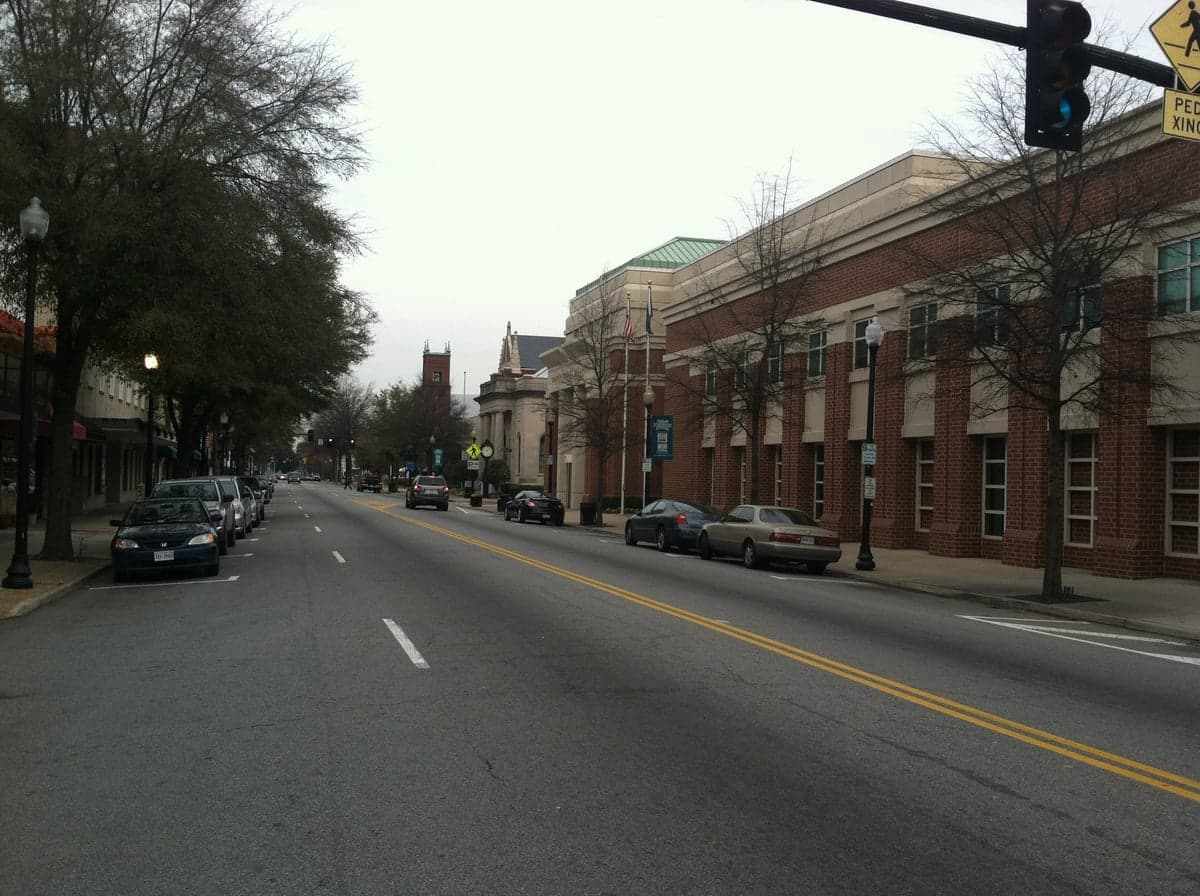
Photo: Wikipedia
Political ClimatePolitical Climate in Suffolk, VA
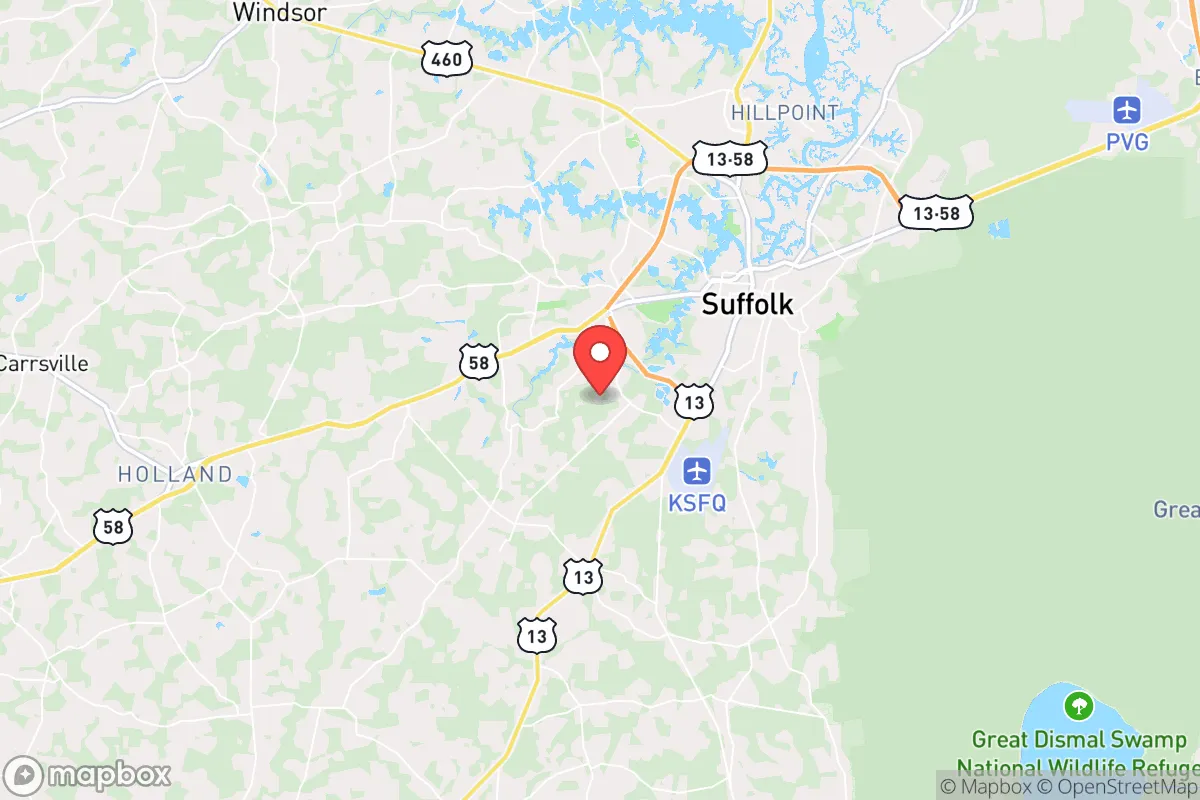
District shown is the primary district for this city’s centroid. Cities may span multiple districts.
Local Political AnalysisPolitical Analysis of Suffolk, VA
Suffolk, Virginia, sits right in the middle of the political map, literally and figuratively. The Cook Partisan Voting Index (PVI) rates it as EVEN, meaning it’s a perfect toss-up district that could swing either way in any given election. For a long time, this area was reliably conservative, a reflection of its deep agricultural roots and strong military ties, but the rapid growth from the Hampton Roads metro area has been pulling it toward the center, and lately, you can feel the tug toward the left. It’s not a deep-blue city by any stretch, but the days of it being a safe bet for conservative candidates are fading fast, and that shift is something folks who value limited government and personal freedoms are watching closely.
How it compares
Drive 20 minutes north to Portsmouth or Norfolk, and you’re in solidly Democratic territory—places where progressive policies on taxes, zoning, and public safety are the norm. Head west to Franklin or south to Gates County, North Carolina, and you’ll find the kind of deep-red, small-government conservatism that used to define Suffolk. The contrast is stark: Suffolk is the buffer zone. It’s where the rural, conservative values of the countryside meet the urban, progressive pressures of the coast. That tension shows up in local elections, where school board and city council races are often decided by a few hundred votes. The city’s PVI of EVEN means it’s a battleground, and every election cycle, you see more outside money and activist energy pouring in from both sides, trying to tip the scales.
What this means for residents
For a resident who values personal freedoms and wants to keep government out of their business, this political tug-of-war is a double-edged sword. On one hand, the city’s moderate streak has kept some of the more extreme progressive policies—like defunding the police or heavy-handed zoning restrictions—at bay. On the other hand, you can see the creeping influence of Hampton Roads’ liberal establishment in things like increased property tax assessments and new development regulations that make it harder to build a simple shed or run a small business from your home. The school board has become a flashpoint, with debates over curriculum transparency and parental rights heating up every year. If you’re the kind of person who believes the government should stay out of your wallet, your kids’ education, and your backyard, you’re going to feel like you’re constantly fighting to hold the line.
What really sets Suffolk apart culturally is its strong military and agricultural heritage. The city is home to the Planters Peanut Center and a huge number of veterans and active-duty personnel from nearby bases like Langley and Norfolk Naval Station. That gives it a practical, no-nonsense vibe that doesn’t have much patience for ideological experiments. But as new subdivisions pop up and more commuters move in from Norfolk and Virginia Beach, the character is slowly changing. The old-timers who remember when Suffolk was a quiet farming town are being outnumbered by newcomers who bring big-city expectations for government services and regulations. If the trend continues, Suffolk could easily tip into the progressive column within a decade, and that’s a real concern for anyone who moved here to escape the overreach they saw in the bigger cities.

State Political ClimatePolitical Climate in Virginia
State Political AnalysisPolitical Environment in the State
Virginia is a classic swing state that has shifted from reliably red to a competitive purple, with a strong blue tilt in recent cycles. The state voted for Joe Biden by 10 points in 2020, a stark contrast to its 2008 support for Barack Obama by just 6 points and its 2012 support for Mitt Romney by 3 points. The dominant coalition is now a mix of Northern Virginia’s tech and government workforce, Richmond’s growing urban core, and Hampton Roads’ military and port communities, while the rest of the state—particularly the Shenandoah Valley, Southside, and Southwest—remains deeply conservative. Over the past 20 years, the state has seen a steady leftward drift driven by massive population growth in the D.C. suburbs, which now account for over half of the state’s vote.
Urban vs. rural divide
The political map of Virginia is a tale of two states. The urban crescent—Arlington, Alexandria, Fairfax County, and Loudoun County—votes overwhelmingly Democratic, often by margins of 60-70%. These areas are home to federal employees, defense contractors, and tech workers who lean left on social issues and taxes. Richmond and its surrounding counties (Henrico, Chesterfield) are more moderate but trending blue, especially as younger professionals move in. Hampton Roads (Virginia Beach, Norfolk, Chesapeake) is a mixed bag: Virginia Beach is a purple city with a strong military and conservative base, while Norfolk and Portsmouth are solidly blue. The rural areas—places like Roanoke, Lynchburg, and the coal country of Southwest Virginia (Bristol, Wise County)—vote Republican by 30-40 points. The divide is stark: in 2024, Loudoun County voted +25 for Biden, while Lee County in the far southwest voted +60 for Trump. The key battlegrounds are the exurbs of Northern Virginia (Prince William, Stafford, Spotsylvania) and the growing suburbs of Richmond, where moderate voters decide the state’s overall lean.
Policy environment
Virginia’s policy environment is a mixed bag for conservatives. The state has a flat income tax rate of 5.75%, which is moderate compared to neighboring Maryland (up to 5.75% state plus local) but higher than North Carolina’s 4.75%. Property taxes are set locally and vary widely—Fairfax County’s rate is about 1.1% of assessed value, while rural counties like Pittsylvania are around 0.6%. The regulatory posture is business-friendly in name but increasingly burdensome in practice, especially for small businesses. Education policy has been a flashpoint: the state’s 2020 “Virginia is for Lovers” slogan rebrand aside, the real fight is over school choice and parental rights. Governor Glenn Youngkin’s 2022 executive order on “cell phone-free education” and his push for lab schools and charter schools have been popular with conservatives, but the Democrat-controlled Senate has blocked most of his agenda. Healthcare is dominated by the expansion of Medicaid under the 2018 “Virginia Healthcare and Insurance Exchange” law, which added 400,000 people to the rolls—a move that many conservatives opposed. Election laws are a sore spot: Virginia has no voter ID requirement (repealed in 2020), same-day voter registration, and no-excuse absentee voting, all of which have been criticized by conservatives as ripe for fraud. The state also has a Democratic trifecta in the legislature as of 2024, meaning Youngkin’s vetoes are the only check on progressive legislation.
Trajectory & freedom
Virginia is becoming less free by conservative metrics, especially on gun rights, parental rights, and taxation. The 2020 “Virginia Red Flag Law” allows courts to temporarily seize firearms from individuals deemed a threat, and the 2021 ban on “ghost guns” (unserialized firearms) has been upheld. In 2023, the legislature passed a law requiring a 3-day waiting period for all firearm purchases, which Youngkin signed. On parental rights, the 2022 “Model Policies” on transgender students—which required schools to notify parents of changes in a child’s gender identity—were blocked by a court order, and the Democrat-controlled Senate has refused to codify them. The 2021 “Virginia Clean Economy Act” mandates a 100% carbon-free electricity grid by 2050, which has driven up energy costs and forced the closure of coal plants in Southwest Virginia. On the positive side, Youngkin’s 2022 “Virginia is for Business” initiative cut some red tape for small businesses, and the state’s right-to-work law remains intact. But the overall trend is concerning: the state’s tax burden is rising, property rights are being eroded by environmental regulations, and the cultural shift in Northern Virginia is pulling the entire state leftward.
Civil unrest & political movements
Virginia has been a hotbed of political activism on both sides. The 2017 “Unite the Right” rally in Charlottesville and the subsequent violence made national headlines, leading to the removal of Confederate statues and a wave of left-wing protests. The 2020 Black Lives Matter protests in Richmond were among the largest in the country, with the Robert E. Lee statue becoming a focal point. On the right, the “Virginia Citizens Defense League” (VCDL) has organized massive pro-gun rallies at the state capitol, including the 2020 rally that drew 22,000 people. Immigration politics are tense: Northern Virginia has several “sanctuary cities” (Arlington, Alexandria, Fairfax County) that limit cooperation with ICE, while rural counties like Shenandoah have passed resolutions opposing sanctuary policies. Election integrity remains a flashpoint: the 2020 election saw widespread use of drop boxes and mail-in ballots, and the 2021 gubernatorial race was decided by just 2 points, with Youngkin winning on a platform of parental rights and election security. The state’s “Electoral College” system for state elections (the State Board of Elections certifies results) has been criticized by conservatives as opaque. A new resident would notice the political polarization in everyday life: bumper stickers, yard signs, and even neighborhood Facebook groups are sharply divided, especially in the exurbs.
Projection
Over the next 5-10 years, Virginia is likely to continue its leftward drift unless demographic trends reverse. The population of Northern Virginia is growing at 1.5% annually, while rural areas are shrinking. The 2020 census gave Virginia an 11th congressional district, which is likely to be a Democratic seat. The state’s in-migration is heavily skewed toward the D.C. suburbs, with Loudoun County adding 40,000 people between 2020 and 2024—most of them young professionals who vote blue. The 2025 gubernatorial election will be a bellwether: if a Democrat wins, expect a push for a state-level “Green New Deal” and stricter gun laws. If a Republican wins, the trend may slow but not reverse. The state’s electoral votes are likely to remain in the Democratic column for the foreseeable future, barring a major national shift. For someone moving in now, the practical takeaway is that Virginia is a purple state with a blue tilt, and the political environment will continue to be shaped by the D.C. suburbs. If you’re looking for a state that is trending conservative, Virginia is not it—but if you want a place where your vote matters and where you can fight for conservative values, the battleground is here.
Bottom line: Virginia offers a high quality of life, strong job market, and beautiful geography, but the political climate is increasingly hostile to conservative values. If you’re moving here, expect to pay higher taxes, navigate a complex regulatory environment, and deal with a culture war that is intensifying. The best bet for conservatives is to settle in the exurbs of Richmond or the Shenandoah Valley, where local governments are more aligned with your values, and to get involved in local politics to push back against the Northern Virginia machine. This is a state worth fighting for, but it’s not a safe haven.
* Values derived from national, state, county, city and local statistics and may differ in a specific area. Last updated: 2026-05-02T02:13:14.000Z
Narrative content on this page is AI-generated and may contain mistakes. Verify any details that matter before acting on them.
ReloMaps may earn a commission from affiliate links at no extra cost to you.

