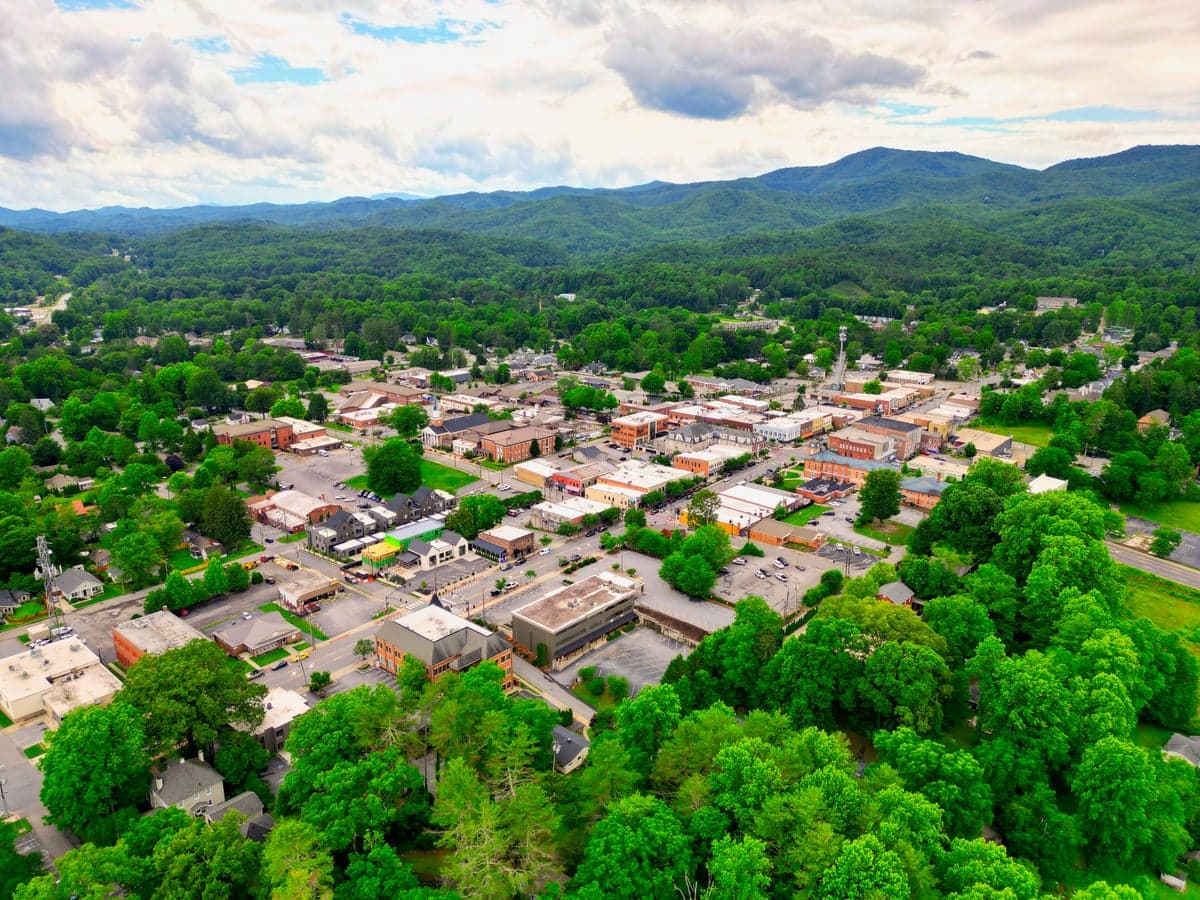
Photo: Wikipedia
Political ClimatePolitical Climate in Brevard, NC
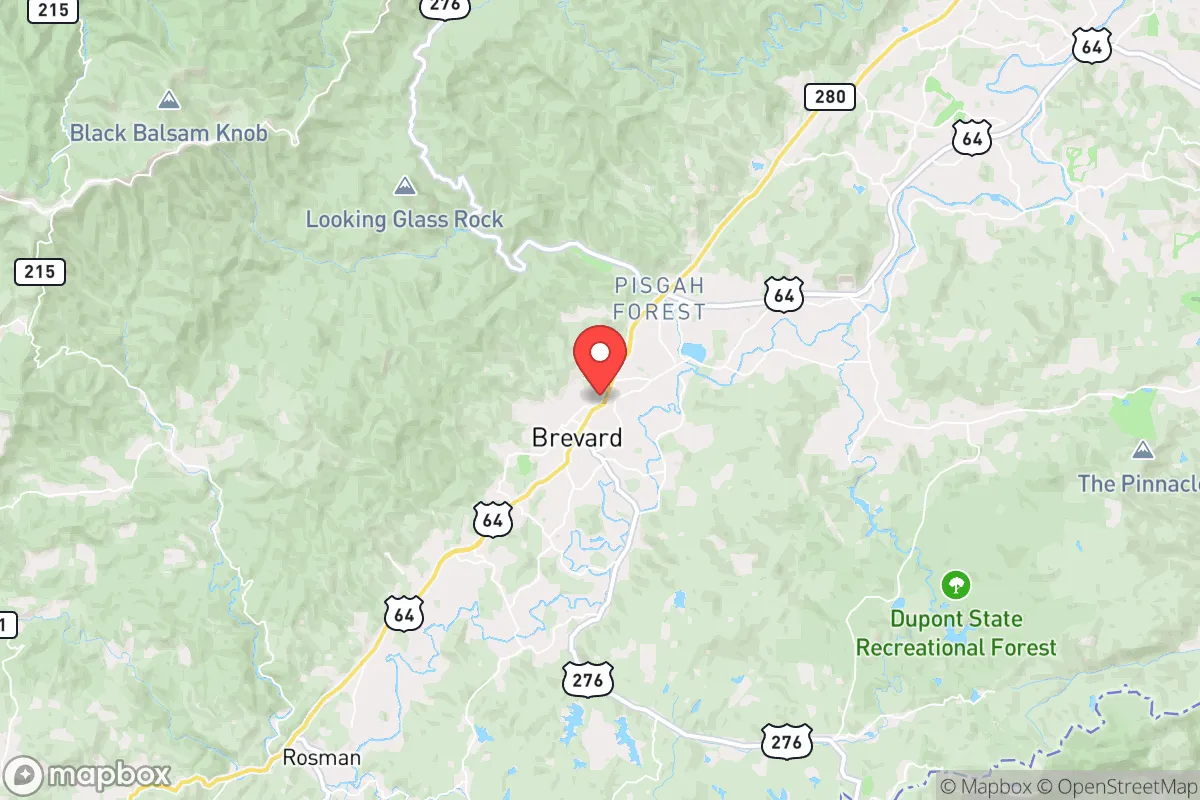
District shown is the primary district for this city’s centroid. Cities may span multiple districts.
Local Political AnalysisPolitical Analysis of Brevard, NC
Brevard, North Carolina, has long been a quiet outlier in the political landscape of the western part of the state. While the surrounding county of Transylvania has trended reliably Republican in recent presidential cycles—voting for Donald Trump by roughly 20 points in 2024—the town itself leans more moderate, with a noticeable Democratic presence concentrated among the arts community, retirees from out of state, and younger professionals drawn to the area’s natural beauty. Over the past decade, the local political climate has shifted subtly but steadily: the influx of remote workers and second-home owners from blue states has nudged Brevard’s precincts slightly leftward, even as the rural stretches of the county remain deeply conservative. It’s a place where you’ll find a “Coexist” bumper sticker on a Subaru next to a “Let’s Go Brandon” flag on a pickup truck, and most folks just get along.
How it compares
Compared to North Carolina as a whole—which carries a Cook PVI of R+1 and is one of the most closely divided states in the country—Brevard is a microcosm of that split, but with a local twist. The state’s political battleground is defined by the urban-rural divide: Charlotte, Raleigh, and Asheville are blue islands in a red sea, and Brevard plays a similar role on a smaller scale. While the rest of Transylvania County votes like neighboring conservative towns such as Rosman or Lake Toxaway, Brevard’s city limits often produce results closer to what you’d see in Asheville’s more moderate suburbs. In the 2024 gubernatorial race, for instance, Brevard precincts split nearly evenly between Josh Stein and Mark Robinson, while the county as a whole went heavily for the Republican. This makes Brevard a sort of political “purple zone” in a region that’s otherwise solid red, offering a contrast not just to the state but to the surrounding mountain communities.
What this means for residents
For conservative residents, Brevard’s moderate streak means they’re unlikely to feel outnumbered or marginalized in daily life—local government remains center-right, with a focus on fiscal conservatism and property rights, and the county commission has a Republican majority. However, they do have to share the town square with a vocal liberal minority that organizes around environmental issues, public arts funding, and social justice initiatives. For liberal residents, the upside is that Brevard is a welcoming enclave where progressive views are heard, especially on town council and in local nonprofits, but they’re still a minority in county-wide elections, meaning statewide policies on abortion, gun rights, and education funding often don’t align with their preferences. In practice, this creates a live-and-let-live atmosphere: you can have a heated debate about development at a coffee shop on Main Street, but it rarely spills over into hostility. The real tension surfaces around growth—conservatives worry about losing the area’s rural character, while liberals push for more affordable housing and environmental safeguards—but even that is handled with a civility that’s becoming rare elsewhere.
One cultural distinction that sets Brevard apart is the influence of the Brevard Music Center and the town’s identity as a hub for the arts, which draws a more cosmopolitan crowd than you’d find in, say, nearby Hendersonville or Waynesville. This gives the local political discourse a slightly more educated, less partisan flavor, with issues like climate change and public land management taking center stage over culture-war flashpoints. At the same time, the strong presence of the Pisgah National Forest and the local hunting and fishing culture means that Second Amendment rights are broadly respected across the political spectrum. Looking ahead, Brevard’s trajectory seems to be one of slow, steady moderation—newcomers will likely continue to nudge it leftward, but the surrounding county’s rural base will keep it from swinging too far. For anyone moving here, the takeaway is simple: you’ll find your tribe, but you’ll also have to coexist with the other side, and that’s just how Brevard likes it.

State Political ClimatePolitical Climate in North Carolina
State Political AnalysisPolitical Environment in the State
North Carolina is a classic swing state that has been trending rightward in presidential elections, with a Cook PVI of R+1, but it remains deeply competitive and politically divided. The state’s overall lean is shaped by a coalition of rural and suburban conservatives in the Piedmont and Coastal Plain, offset by rapidly growing, left-leaning urban centers like Charlotte, Raleigh-Durham, and Asheville. Over the past 10-20 years, North Carolina has shifted from a reliably red state in presidential races (voting Republican in every election from 1980 to 2012 except for 2008) to a true battleground, with margins under 4 points in 2020 and 2024. This trajectory reflects a classic urban-rural polarization, with in-migration to the Research Triangle and Charlotte metros slowly eroding the GOP’s historical dominance, while rural and exurban areas have hardened their Republican allegiance.
Urban vs. rural divide
The political map of North Carolina is a textbook case of the urban-rural split. The state’s three major metro areas—Charlotte (Mecklenburg County), Raleigh-Durham (Wake and Durham Counties), and Asheville (Buncombe County)—are solidly Democratic and growing fast. Mecklenburg County, home to Charlotte, voted for Joe Biden by 20 points in 2020, while Wake County (Raleigh) went for Biden by 17 points. These two counties alone account for over 2 million residents and are the engine of the state’s Democratic growth. In contrast, the rural eastern counties like Robeson, Columbus, and Bladen, as well as the western mountain counties like Mitchell and Yancey, are deeply Republican, often voting 60-70% for the GOP. The suburbs are the real battleground: counties like Union (southeast of Charlotte) and Cabarrus (northeast of Charlotte) have shifted from solid red to competitive, with Union County voting for Trump by only 12 points in 2020 after supporting him by 25 points in 2016. Meanwhile, the exurban and small-town areas like the Sandhills region (Moore County) and the Fayetteville area (Cumberland County) remain conservative but are seeing slow demographic change from military retirees and defense contractors.
Policy environment
North Carolina’s policy environment is a mix of conservative fiscal and social policies tempered by the state’s competitive politics. The state has a flat income tax rate of 4.5% (down from 5.25% in 2021) and a corporate tax rate of 2.5%, both among the lowest in the Southeast. There is no state-level property tax; local governments set rates, which average around 0.8% of assessed value. The regulatory posture is business-friendly, with a right-to-work law and limited union influence. On education, the state has a school choice program (the Opportunity Scholarship Program) that provides vouchers for private school tuition, expanded in 2023 to cover all income levels. Public school funding is a perennial political battleground, with the state Supreme Court’s Leandro ruling mandating adequate funding, but the Republican-controlled legislature has resisted full compliance. Healthcare policy is defined by the state’s refusal to expand Medicaid until 2023, when a bipartisan deal finally passed, expanding coverage to roughly 600,000 low-income adults. Election laws have been a flashpoint: the state requires voter ID (implemented in 2023 after years of litigation), has strict absentee ballot rules, and has undergone multiple redistricting cycles that have been challenged in court for partisan gerrymandering. The state also has a 72-hour early voting period and no-excuse absentee voting, though the latter was tightened in 2018.
Recent policy direction
Recent legislation in North Carolina points in a consistently conservative direction on most fronts, though with some bipartisan compromises. On gun and self-defense law, the state is a shall-issue concealed carry state with no permit required for open carry, and in 2023, the legislature passed a law allowing permitless concealed carry (effective 2024). Parental and education rights have been a major focus: the 2023 Parents’ Bill of Rights (HB 755) requires schools to notify parents of any changes in a child’s health or well-being, including gender identity or sexual orientation, and restricts instruction on gender identity and sexuality in K-4 classrooms. On speech and privacy, the state has no broad shield law for journalists, but it does have a strong public records law. Medical and bodily autonomy is sharply divided: abortion is legal up to 12 weeks (as of 2023’s HB 20), with a 72-hour waiting period and a requirement that the procedure be performed in a hospital after 12 weeks. The law also banned most abortions after 20 weeks. Property rights are generally strong, with no state-level rent control and a homestead exemption for property taxes. Taxation is trending downward: the flat income tax is scheduled to drop to 3.99% by 2027. Voting and ballot access have been tightened: the 2018 voter ID law was upheld by the state Supreme Court in 2023, and the state has reduced early voting days from 17 to 10 in some counties. Overall, the direction is toward lower taxes, expanded gun rights, and more parental control in schools, while abortion access has been restricted but not eliminated.
Civil unrest & political movements
North Carolina has seen its share of political flashpoints. The 2020 protests following George Floyd’s murder were significant in Charlotte and Raleigh, with some property damage and curfews, but they were smaller than in many other states. The state has a history of organized activism on both sides: the Moral Monday movement (led by the NAACP) has been a persistent force for progressive causes since 2013, while the conservative grassroots are active through groups like the North Carolina Republican Party and the John Locke Foundation. Immigration politics are relatively low-key compared to border states, but there is a sanctuary city debate: Charlotte and Durham have declared themselves “welcoming cities” with limited cooperation with ICE, while the state legislature has passed laws (like HB 318 in 2019) requiring sheriffs to honor ICE detainers. Election integrity controversies have been a major theme: the 2020 election saw Trump narrowly lose the state by 1.3 points, leading to a GOP-led audit that found no widespread fraud but resulted in tighter voting laws. The state’s 9th Congressional District election in 2018 was overturned due to absentee ballot fraud, a rare case of a federal election being voided. Secession or nullification rhetoric is minimal, but there is a strong states’ rights strain in the legislature. A new resident would notice the political polarization in yard signs, bumper stickers, and local news coverage, but the state is generally civil and safe, with no recent major unrest.
Projection
Over the next 5-10 years, North Carolina is likely to remain a competitive swing state, but the demographic trends favor the Democrats. The state is growing by about 100,000 people per year, with most of that growth in the Democratic-leaning metros of Charlotte, Raleigh-Durham, and Asheville. The Hispanic population is growing rapidly (now about 10% of the state) and leans Democratic, while the Black population (about 22%) is a reliable Democratic base. However, the GOP has a structural advantage through gerrymandering (the state legislature draws congressional maps) and the rural vote is not shrinking as fast as in some other states. The 2024 election will be a key test: if Trump wins the state again, it will confirm the R+1 lean; if a Democrat flips it, it could signal a longer-term shift. For a new resident moving in now, expect to see a state that is politically divided but functional, with a conservative legislature and a moderate Democratic governor (Roy Cooper, term-limited in 2024). The policy direction will likely continue to be conservative on taxes, guns, and education, with incremental restrictions on abortion and voting access. The biggest wildcard is the state Supreme Court, which flipped to a 5-2 Republican majority in 2022, potentially upholding more conservative laws.
For a new resident, the bottom line is that North Carolina offers a mix of conservative governance and urban progressive enclaves. If you’re conservative, you’ll find a state that generally aligns with your values on taxes, guns, and education, with a legislature that is actively pushing those priorities. If you’re liberal, you’ll find strong communities in Charlotte, Raleigh, and Asheville, but you’ll face a state government that is often at odds with your views, especially on abortion and voting rights. The state is not a culture-war battleground like Florida or Texas, but it is a place where politics is a constant, low-grade tension. Practical takeaways: expect lower taxes than the national average, a business-friendly environment, and a high quality of life in the metros, but be prepared for a state government that is reliably conservative and a political landscape that is genuinely competitive every two years.
* Values derived from national, state, county, city and local statistics and may differ in a specific area. Last updated: 2026-08-03T15:45:12.000Z
Narrative content on this page is AI-generated and may contain mistakes. Verify any details that matter before acting on them.
ReloMaps may earn a commission from affiliate links at no extra cost to you.

