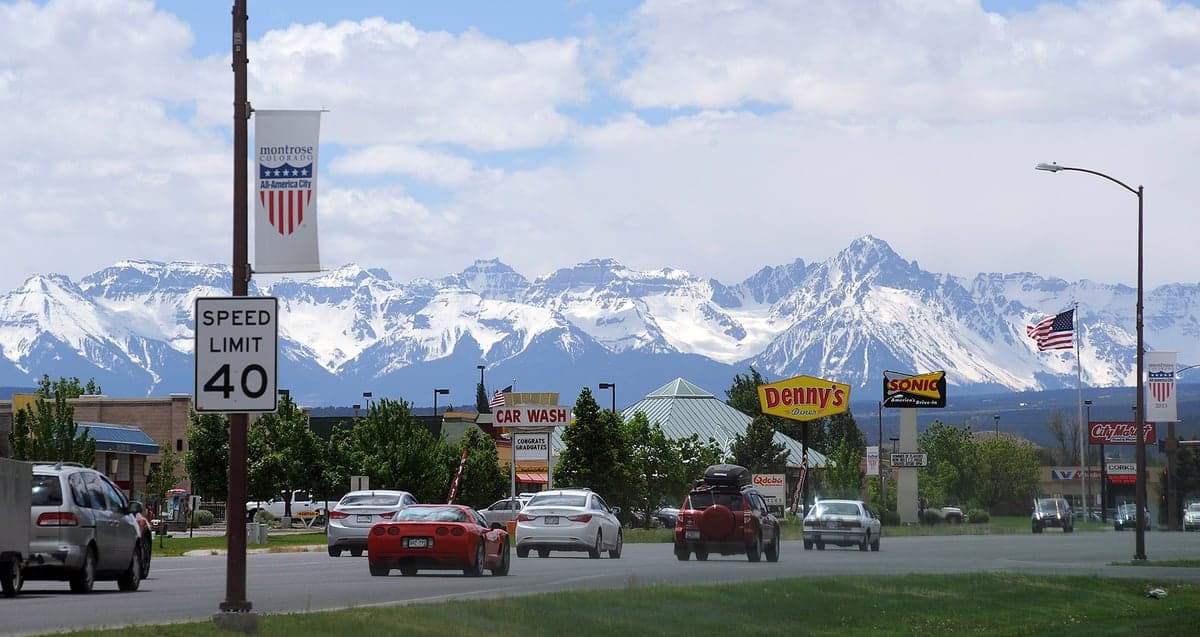
Photo: Wikipedia
Political ClimatePolitical Climate in Montrose, CO
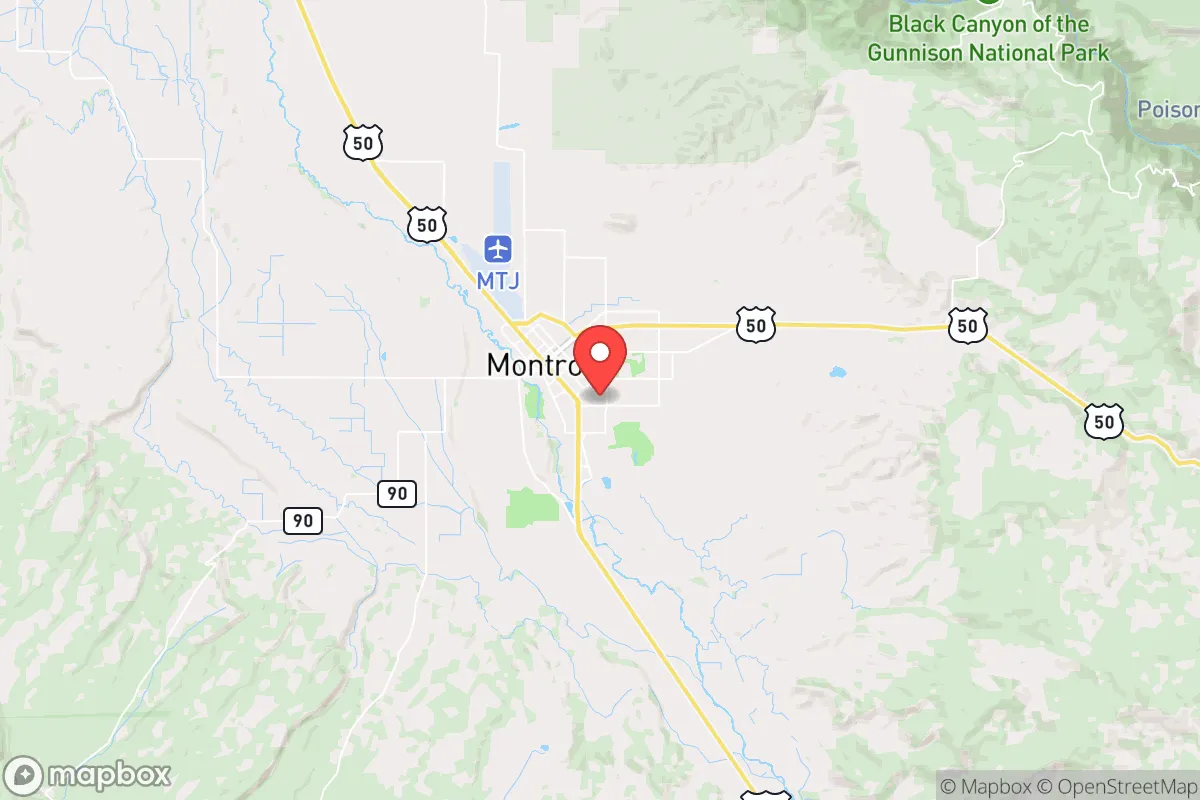
District shown is the primary district for this city’s centroid. Cities may span multiple districts.
Local Political AnalysisPolitical Analysis of Montrose, CO
Montrose, Colorado, sits in a reliably conservative pocket of the Western Slope, with a Cook PVI of R+5 that reflects a deeply rooted preference for limited government and personal responsibility. For decades, this town has been a place where folks expect to be left alone to run their businesses, raise their families, and enjoy the outdoors without a lot of bureaucratic interference. While the surrounding rural areas have historically leaned even further right, Montrose itself has held steady as a solidly Republican stronghold, though you can feel a subtle shift in the air as more people move in from the Front Range and out-of-state, bringing with them a more progressive set of priorities.
How it compares
Drive 60 miles east to Gunnison, and you'll find a college town that votes bluer every cycle, especially in city council races. Head north to Grand Junction, and while it's still conservative, the Mesa County seat has seen a noticeable uptick in progressive activism and local ballot measures that push for higher taxes and more regulations. Montrose, by contrast, has largely resisted that trend. The county commission and city council remain dominated by candidates who campaign on fiscal restraint, property rights, and Second Amendment protections. The contrast is sharpest when you look at Delta, just 15 miles west—Delta County is even more rural and votes R+10 or higher, but Montrose's larger population and growing service economy make it a bellwether for how the Western Slope's politics are evolving. So far, the old guard has held the line, but the newcomers are organizing.
What this means for residents
For a longtime resident, the most visible change is in local land-use debates. Where the county used to approve new subdivisions and commercial permits with a handshake and a nod, now you see more zoning fights, environmental impact studies, and affordable housing mandates that feel like government overreach. The school board, once a quiet affair, has become a battleground over curriculum transparency and parental rights. Property taxes remain low compared to the Front Range, but there's constant pressure from activist groups to raise mill levies for "community programs" that often come with strings attached. The real concern for many is that the cultural shift—more people demanding bike lanes, public transit expansions, and "inclusive" policies—will eventually translate into higher taxes and less freedom to use your land or run your business the way you see fit. The 2024 election cycle saw a surge in turnout among conservative voters who felt their way of life was being threatened, and that energy isn't fading.
One cultural distinction that still sets Montrose apart is the strong, informal network of local ranchers, small business owners, and outdoor recreationists who share a common distrust of federal land management. The Uncompahgre National Forest and BLM lands surround the town, and any talk of new wilderness designations or travel management plans gets met with fierce opposition from locals who see it as another layer of federal control. The gun culture here is still very much alive—open carry is common, and the local gun shows draw crowds from across the region. But the most telling sign of the times is the quiet anxiety you hear at coffee shops and hardware stores: people worry that the next wave of transplants will tip the balance, turning Montrose into another Durango or Telluride, where progressive policies have driven up costs and squeezed out the working class. For now, the town remains a place where conservative values still hold sway, but the fight to keep it that way is getting harder every year.

State Political ClimatePolitical Climate in Colorado
State Political AnalysisPolitical Environment in the State
Colorado has shifted from a classic purple swing state to a reliably blue stronghold over the past two decades, with Democrats now controlling the governorship, both U.S. Senate seats, and both chambers of the state legislature. The state voted for Hillary Clinton by 5 points in 2016, Joe Biden by 13 points in 2020, and Kamala Harris by roughly 11 points in 2024, reflecting a durable leftward tilt driven primarily by explosive growth in the Denver metro area and along the Front Range. For a conservative considering relocation, the state’s political trajectory is a cautionary tale of how rapid in-migration from blue states, combined with aggressive progressive policymaking, has transformed a once-balanced state into a laboratory for left-wing governance.
Urban vs. rural divide
The political map of Colorado is a stark story of two Colorados. The Denver-Boulder-Aurora corridor, home to over half the state’s population, is a Democratic stronghold where margins routinely exceed 20-30 points. Boulder County is the bluest, with Democrats winning by 40+ points in recent cycles. Denver County itself is similarly lopsided. The I-25 corridor from Colorado Springs to Fort Collins is more mixed: Colorado Springs (El Paso County) remains a conservative redoubt, voting Republican by about 10-12 points in 2024, while Fort Collins (Larimer County) has flipped blue, now voting Democratic by 8-10 points. The Western Slope and Eastern Plains are deeply red—rural counties like Moffat, Rio Blanco, and Kit Carson routinely vote 70-80% Republican. But these areas have shrinking populations, while the Front Range suburbs—places like Aurora, Lakewood, and Thornton—are growing and trending left. The 2022 gubernatorial race saw Republican Heidi Ganahl win only 28 of 64 counties, all rural, while Democrat Jared Polis swept the urban and suburban counties that hold the votes.
Policy environment
Colorado’s policy environment has become aggressively progressive, especially since Democrats took full control in 2019. The state income tax rate was cut from 4.63% to 4.4% under the Taxpayer’s Bill of Rights (TABOR) framework, but property taxes have risen sharply—up 40% in some areas since 2020—due to a 2022 law that removed Gallagher Amendment protections. The regulatory climate is hostile to energy: Colorado imposed a 2030 target for a 50% reduction in oil and gas emissions and a 2040 net-zero goal, effectively strangling the state’s traditional energy sector. Education policy has shifted left with the 2019 adoption of comprehensive sex education standards and a 2023 law requiring school districts to adopt policies on transgender student participation in sports. Healthcare is dominated by the state-run Connect for Health Colorado exchange, and a 2022 law created a public option insurance plan. Election laws have been loosened: Colorado was one of the first states to implement universal mail-in voting (2013) and same-day voter registration, and it now has no voter ID requirement at the polls. Gun rights have been heavily restricted: a 2013 magazine ban (15-round limit), a 2023 law raising the purchase age to 21, and a 2024 law requiring a 3-day waiting period and allowing local governments to ban firearms in public buildings.
Trajectory & freedom
Colorado is clearly becoming less free, especially for conservatives. The 2023 legislative session alone passed over a dozen bills expanding government control: the “Family Leave and Medical Leave Insurance” (FAMLI) program imposes a mandatory payroll tax for paid leave; a 2023 law bans “conversion therapy” for minors; and a 2024 law prohibits local governments from enforcing “sanctuary” policies for federal immigration enforcement. On parental rights, a 2023 law requires schools to notify parents of changes to a student’s gender identity or sexual orientation—but only if the student consents, effectively undermining parental authority. Property rights have eroded: a 2022 law allows local governments to impose rent control on mobile home parks, and a 2024 law expands the state’s ability to seize land for affordable housing projects. The 2020 “Red Flag” law (Extreme Risk Protection Order) allows courts to temporarily confiscate firearms without a criminal conviction or due process hearing. The 2023 “Assault Weapons” ban failed narrowly, but a 2024 law banned “ghost guns” and required serial numbers on all firearm frames. The state’s tax burden has increased despite TABOR: the 2021 “Proposition FF” raised taxes on high-income earners to fund free school meals, and a 2023 law imposed a new fee on oil and gas extraction. The trajectory is clear: more mandates, higher costs, and less individual autonomy.
Civil unrest & political movements
Colorado has seen significant political activism from both sides. The 2020 George Floyd protests in Denver turned violent, with property damage exceeding $2 million and the city paying $14 million in settlements. The 2021 “Colorado Springs Planned Parenthood shooting” (2015) remains a flashpoint for gun control debates. On the right, the “Colorado Republican Party” has fractured between establishment and MAGA factions, with the 2022 state convention devolving into chaos. The “Colorado Project” (a conservative grassroots group) has organized against school board policies, particularly in Douglas County and El Paso County. Immigration politics are heated: Denver became a “sanctuary city” in 2017, and the state’s 2023 “Immigrant Legal Defense Fund” allocated $2 million for legal services for undocumented immigrants. The 2023 “Colorado Border Crisis” saw Denver busing migrants to other cities, sparking a lawsuit from Texas. Election integrity remains a concern: Colorado’s universal mail-in system has been criticized for lax signature verification, and the 2020 election saw a lawsuit over ballot drop box security. The “Colorado Election Integrity Project” has documented over 1,000 alleged irregularities, though courts have dismissed most claims. Visible flashpoints include the “Denver Homeless Encampment” crisis, where the city’s 2023 “Right to Rest” ordinance decriminalized camping on public property, leading to widespread encampments and public health complaints.
Projection
Over the next 5-10 years, Colorado will likely continue its leftward drift. Demographic trends are unfavorable for conservatives: the state’s population growth is concentrated in the Denver metro area and along the Front Range, where new arrivals from California, Texas, and the Northeast tend to vote Democratic. The 2020 census showed Colorado’s Hispanic population grew by 30%, a demographic that leans Democratic by 20+ points. The state’s economy is diversifying away from energy toward tech and renewable energy, which attracts a younger, more liberal workforce. The 2024 election saw Democrats hold all statewide offices, and the state legislature’s Democratic supermajority is likely to expand in 2026. Expect more gun control (a full assault weapons ban is likely), a state-run public option for healthcare, and further erosion of parental rights. The 2023 “Colorado Water Plan” will likely lead to more state control over water rights, a major concern for rural landowners. The only countervailing trend is the growth of conservative enclaves like El Paso County and Weld County, but these areas lack the population to flip the state. A conservative moving to Colorado now should expect to live in a state where their vote is increasingly irrelevant, their taxes are rising, and their freedoms are being curtailed by a permanent Democratic majority.
For a conservative considering relocation, Colorado offers beautiful scenery and a strong economy, but the political climate is hostile to traditional values and personal liberty. The state’s trajectory is toward more government control, higher taxes, and less individual freedom. If you’re looking for a place where your vote matters and your rights are respected, Colorado is not that place. The best you can hope for is to find a conservative enclave like Colorado Springs or a rural county, but even there, state-level policies will constrain your life. The bottom line: Colorado is a blue state that is getting bluer, and anyone moving here should be prepared for a political environment that is actively hostile to conservative principles.
* Values derived from national, state, county, city and local statistics and may differ in a specific area. Last updated: 2026-05-01T10:32:10.000Z
Narrative content on this page is AI-generated and may contain mistakes. Verify any details that matter before acting on them.
ReloMaps may earn a commission from affiliate links at no extra cost to you.

