Photo: Wikipedia
Political ClimatePolitical Climate in North Fort Myers, FL
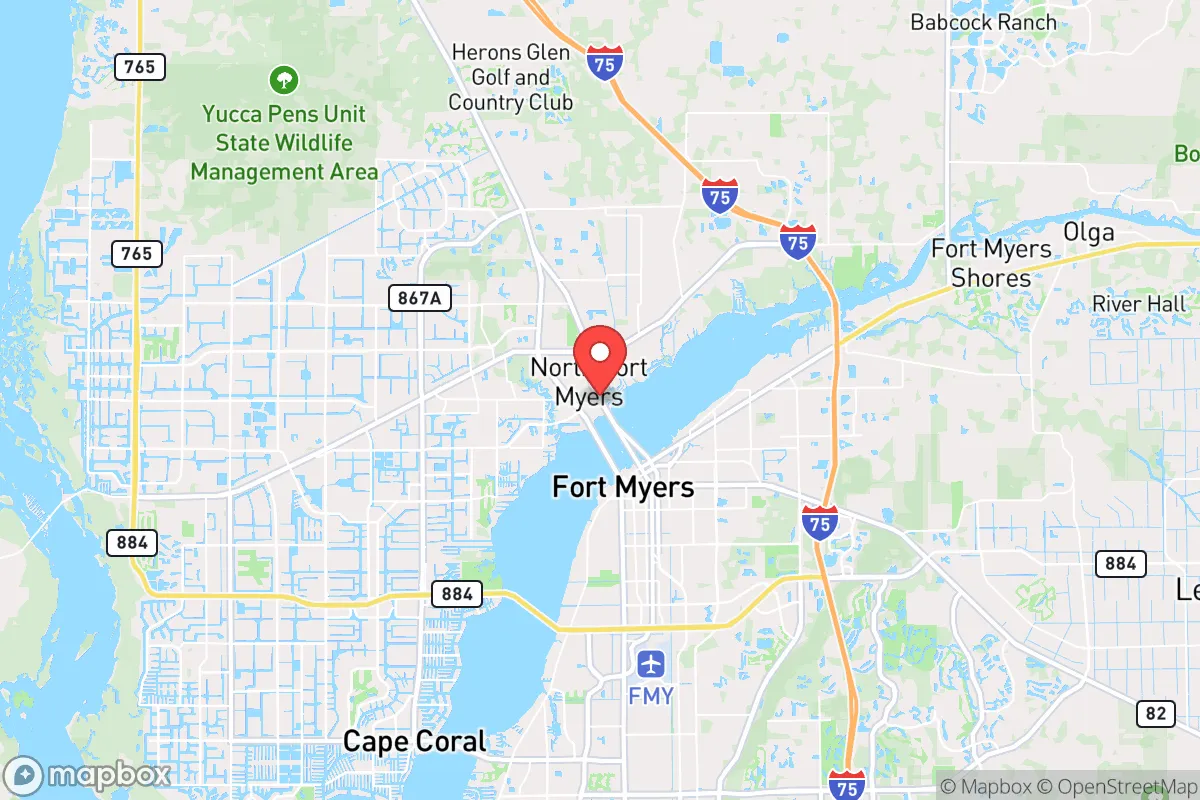
District shown is the primary district for this city’s centroid. Cities may span multiple districts.
Local Political AnalysisPolitical Analysis of North Fort Myers, FL
North Fort Myers has long been a reliably conservative stronghold, and that hasn't changed much even as the rest of the state has seen some shifts. The area sits at a Cook PVI of R+11, which is a solid six points more Republican than the state of Florida as a whole, which sits at R+5. That means when you're voting in North Fort Myers, your ballot carries a lot more weight in a primary than it might in a swingier part of the state, and the local political culture reflects that—people here tend to value limited government, personal responsibility, and a healthy skepticism of overreach from Tallahassee or Washington.
How it compares
Compared to the rest of Florida, North Fort Myers feels like a different world politically. Drive south into Cape Coral or Fort Myers proper, and you'll start to see more purple-leaning precincts, especially as younger transplants and retirees from blue states move in. But here in North Fort Myers, the Republican registration advantage is deep and durable. The surrounding Lee County as a whole is R+9, so North Fort Myers is actually a bit redder than its own county average. That's a stark contrast to places like Miami-Dade or Orange County, which lean Democratic, or even the Tampa Bay area, which has trended left in recent cycles. The difference isn't just numbers—it's a cultural thing. You don't see as many "We're all in this together" government messaging on billboards here; instead, it's more "Keep government out of my backyard."
What this means for residents
For folks living here, the political climate translates into a few tangible things. Property taxes and regulations tend to be lighter than in more progressive parts of the state, and local officials are generally more responsive to concerns about zoning, gun rights, and school curriculum. You won't find the same kind of push for mask mandates or vaccine passports that you'd see in, say, Broward County. The downside? If you're hoping for big government-funded infrastructure projects or rapid transit expansions, don't hold your breath—the local ethos is more "let the private sector handle it." That said, the trade-off is a sense of personal freedom that feels increasingly rare in other parts of Florida. People here are generally left alone to live their lives, as long as they're not hurting anyone else.
One thing that's worth keeping an eye on is the slow creep of development from the south. As more people move into Lee County from high-tax states like New York and California, there's a risk that some of those progressive voting habits follow them. So far, North Fort Myers has held the line, but the 2024 and 2026 elections will be telling. If you're someone who values limited government and local control, this is still one of the best spots in Southwest Florida to plant roots—just be aware that the political winds are shifting statewide, and it's going to take active participation to keep things from drifting toward the kind of overreach you see in places like Orlando or Miami Beach.

State Political ClimatePolitical Climate in Florida
State Political AnalysisPolitical Environment in the State
Florida has transformed from a quintessential swing state into a solidly Republican-leaning powerhouse, carrying a Cook PVI of R+5 and delivering decisive wins for Donald Trump in both 2016 and 2020. The dominant coalition today is a blend of conservative retirees, Hispanic voters (especially Cuban-Americans and Venezuelans), and transplants from blue states fleeing high taxes and lockdown policies. Over the past 10-20 years, the state has shifted rightward by roughly 8 points, driven by massive in-migration from the Northeast and Midwest and a growing rejection of progressive governance in places like California and New York.
Urban vs. rural divide
The political map of Florida is starkly divided. The major metros of Miami-Dade County, Orlando (Orange County), and Tampa (Hillsborough County) lean Democratic, but even these are shifting. Miami-Dade, once a Democratic stronghold, flipped to Trump in 2020 by a narrow margin, driven by Cuban-American and Nicaraguan voters who reject socialism and left-wing policies. Meanwhile, the I-4 corridor — including Lakeland and Ocala — is deeply Republican, as are the Panhandle counties like Santa Rosa and Okaloosa. The rural north and central regions, from Gainesville’s outskirts to the Everglades, vote overwhelmingly red. The suburbs of Jacksonville (Duval County) and Fort Myers (Lee County) have also trended right, with Lee County voting +18 R in 2024. The only blue holdouts are college towns like Tallahassee and Gainesville proper, plus a few coastal enclaves like St. Petersburg and Key West.
Policy environment
Florida’s policy environment is a model of limited government. There is no state income tax — a huge draw for movers — and property taxes are capped by the Save Our Homes amendment, which limits annual increases to 3% for homesteaded properties. The regulatory posture is business-friendly, with right-to-work laws and minimal red tape. Education policy has been a flashpoint: Governor Ron DeSantis signed the Parental Rights in Education Act (HB 1557, often called the “Don’t Say Gay” law) in 2022, which prohibits classroom instruction on sexual orientation and gender identity in grades K-3, and later expanded it to all grades. School choice is robust, with the Family Empowerment Scholarship program allowing state funds to follow students to private or charter schools. Healthcare is mixed — Florida did not expand Medicaid under Obamacare, keeping costs lower for taxpayers, but the state has a high uninsured rate. Election laws were tightened after 2020: SB 90 (2021) added voter ID requirements, limited drop boxes, and restricted third-party ballot collection, all aimed at election integrity. The state also preempted local gun laws, ensuring uniform Second Amendment protections statewide.
Trajectory & freedom
Florida is unequivocally becoming more free for conservatives, especially compared to blue states. The Second Amendment Preservation Act (2024) prohibits state enforcement of any future federal gun bans, a direct nullification-style move. The Live Free or Die ethos is real: during COVID, Florida was among the first states to reopen schools, businesses, and beaches, and it banned vaccine passports (SB 2006, 2021). Parental rights expanded with the Parental Bill of Rights (HB 241, 2021), which affirms parents’ authority over their children’s medical and educational decisions. Medical autonomy was bolstered by a ban on mask mandates in schools (2021) and a law prohibiting employers from requiring COVID vaccines (SB 252, 2023). Property rights were strengthened by the Private Property Rights Protection Act (2021), which limits eminent domain abuse. The only area of concern is the state’s heavy reliance on tourism and real estate taxes, which could pressure future lawmakers to raise other levies — but so far, the trajectory is toward more personal liberty, not less.
Civil unrest & political movements
Florida has seen relatively little civil unrest compared to states like Oregon or Minnesota. The 2020 Black Lives Matter protests in Miami, Orlando, and Tampa were mostly peaceful, with some isolated looting. The state’s response was firm: DeSantis declared a state of emergency and deployed the National Guard to protect property. Organized activist movements are active but polarized. On the left, groups like Dream Defenders and Florida Rising push for criminal justice reform and voting access, but they have little legislative success. On the right, the Florida Parental Rights Alliance and Moms for Liberty have been highly effective, winning school board races and pushing for curriculum transparency. Immigration politics are front and center: Florida passed SB 1718 (2023), the toughest anti-illegal immigration law in the country, requiring E-Verify for employers and banning local sanctuary policies. The law was a direct response to Biden’s border crisis and has made Florida a hostile environment for illegal immigration. Election integrity remains a hot topic — the state’s 2020 audit found no widespread fraud, but Republicans have continued to tighten laws, and Democrats have sued repeatedly. A new resident will notice a palpable sense of order: no homeless encampments in most cities, few visible protests, and a general cultural expectation of lawfulness.
Projection
Over the next 5-10 years, Florida will likely become even more Republican. In-migration from blue states — roughly 1,000 people per day — is overwhelmingly conservative or libertarian-leaning. The Hispanic vote, especially in Miami-Dade and Orlando, is trending right as younger Cuban-Americans and Puerto Ricans reject socialism. The state’s demographic future is bright: a growing tax base, a booming economy, and a cultural identity that prizes freedom. However, there are risks. Climate change and rising insurance costs could slow growth in coastal areas like Miami Beach and Fort Lauderdale. The influx of left-leaning transplants from New York and California could eventually dilute the conservative majority, especially if they cluster in Orlando and Tampa. But for now, the state’s political trajectory is firmly rightward, with no signs of a blue wave. A mover in 2026 should expect to find a state that values individual liberty, low taxes, and parental rights — and that is willing to fight federal overreach.
For a conservative individual or family, Florida offers a rare combination: a growing economy, no state income tax, strong Second Amendment protections, and a government that actively pushes back against progressive overreach. The political climate is stable and increasingly red, with a culture that rewards self-reliance and punishes government dependency. If you’re looking for a place where your values are reflected in state law and where your children’s education isn’t dictated by federal bureaucrats, Florida is the clear choice. Just be prepared for the humidity — and the fact that everyone else is moving here too.
* Values derived from national, state, county, city and local statistics and may differ in a specific area. Last updated: 2026-05-14T01:43:14.000Z
Narrative content on this page is AI-generated and may contain mistakes. Verify any details that matter before acting on them.
ReloMaps may earn a commission from affiliate links at no extra cost to you.

