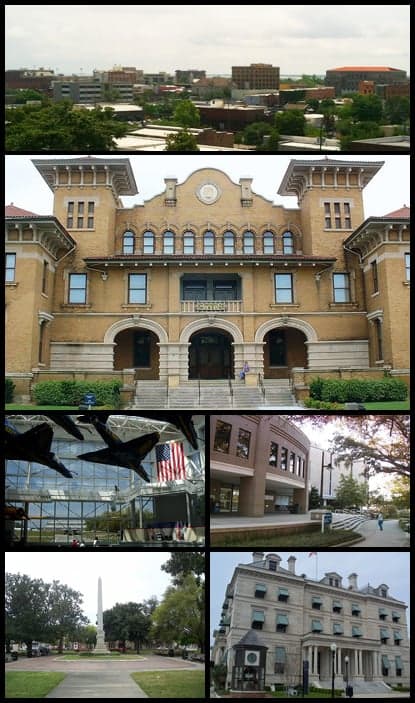
Photo: Wikipedia
Political ClimatePolitical Climate in Pensacola, FL
District shown is the primary district for this city’s centroid. Cities may span multiple districts.
Inherited from parent state — no local data available.
Local Political AnalysisPolitical Analysis of Pensacola, FL
Pensacola has long been a solidly conservative stronghold, and that hasn't changed much. The area's Cook Partisan Voting Index (PVI) of R+18 tells you everything you need to know about the baseline—this is deep-red territory, and it's been that way for generations. You'll find a lot of folks here who remember when the city was even more reliably Republican, but the political lean hasn't shifted leftward in any meaningful way. If anything, the surrounding rural areas in Escambia and Santa Rosa counties have only doubled down on conservative values, while the city itself has stayed the course, resisting the kind of progressive drift you see in places like Tallahassee or even parts of Jacksonville.
How it compares
Drive just a few miles east to Gulf Breeze or south to Navarre, and you're in even more conservative territory—those areas are reliably Republican by wider margins than Pensacola itself. Head west across the state line into Alabama, and places like Mobile feel similar politically, though Pensacola has a slightly more moderate streak thanks to its military and university populations. The real contrast comes if you go northeast to Tallahassee, where the state capital's mix of government workers and college students creates a much more liberal environment. Here in Pensacola, you don't see that kind of ideological split. The local politics are dominated by fiscal conservatism, a strong Second Amendment culture, and a general skepticism of government overreach into personal freedoms—whether that's business regulations, property rights, or health mandates. The few progressive voices that pop up tend to get drowned out in local elections, and the city council and county commission have stayed firmly in conservative hands.
What this means for residents
For someone moving here, the political climate means you can expect a government that mostly stays out of your way. Taxes are low, zoning is relatively relaxed, and there's little appetite for the kind of social engineering you see in more progressive cities. The downside is that if you're hoping for rapid shifts toward progressive policies—like expanded public transit, rent control, or aggressive climate initiatives—you'll be disappointed. The local leadership prioritizes public safety, infrastructure maintenance, and keeping the economy open over experimental social programs. There's a strong sense of personal responsibility here, and most residents prefer that the government focus on core services rather than meddling in how people live their lives. The military presence at NAS Pensacola reinforces that mindset, with a population that values order, discipline, and limited government interference.
One thing that sets Pensacola apart from some other conservative areas is its cultural openness—it's a beach town with a laid-back vibe, and you'll find a mix of retirees, military families, and young professionals who all share a common respect for individual liberty. The local politics reflect that: conservative on principle, but not dogmatic. There's a wariness of any shift toward progressive ideology, especially when it comes to school curriculum, property rights, or health mandates. The long-term trajectory looks stable—Pensacola isn't going to flip blue anytime soon, but it's also not becoming a hotbed of hardline activism. It's a place where you can live your life without the government breathing down your neck, and that's exactly how most folks here want to keep it.

State Political ClimatePolitical Climate in Florida
State Political AnalysisPolitical Environment in the State
Florida is a solidly Republican state that has shifted rightward over the past decade, driven by a powerful coalition of conservative retirees, suburban families, and Hispanic voters in the southern part of the state. The GOP now holds a supermajority in both legislative chambers, and the governor’s mansion has been in Republican hands since 1999. The state’s political trajectory has been unmistakably conservative since the 2010s, with a decisive 2022 midterm that saw Governor Ron DeSantis win by nearly 20 points and Republicans flipping Miami-Dade County—a longtime Democratic stronghold—for the first time in two decades. This isn’t your grandfather’s swing state anymore; Florida is now the nation’s most consequential red state laboratory.
Urban vs. rural divide
The political map of Florida is a tale of three regions. The rural Panhandle, from Pensacola to Tallahassee, is deeply conservative, with counties like Okaloosa and Santa Rosa routinely delivering 70-80% of the vote to Republicans. Central Florida’s I-4 corridor, stretching from Tampa through Orlando to Daytona Beach, remains the state’s primary battleground, but even here the GOP has made gains—Volusia County, once a swing county, now leans reliably red. The biggest story is South Florida: Miami-Dade County, which voted for Hillary Clinton by 30 points in 2016, flipped to Trump by 11 points in 2020 and then backed DeSantis by 15 points in 2022. This shift is driven by Cuban-American, Venezuelan-American, and Nicaraguan-American voters who see the Democratic Party as drifting toward socialism. Meanwhile, the urban cores of Miami, Orlando, and Tampa remain blue, but their suburbs—places like Weston, Coral Gables, and Lake Nona—are trending red as families flee high taxes and progressive policies in other states.
Policy environment
Florida’s policy environment is a deliberate counterweight to states like California and New York. There is no state income tax, a major draw for high-earners and retirees. The regulatory climate is business-friendly, with a right-to-work law and minimal red tape for new construction and small businesses. On education, the state has aggressively expanded school choice: the Family Empowerment Scholarship and the Florida Tax Credit Scholarship now serve over 400,000 students, and the 2023 expansion of the Universal School Choice program made Florida the first state to offer education savings accounts to every K-12 student regardless of income. Higher education has seen a conservative overhaul, with the 2023 “Stop WOKE Act” restricting critical race theory in classrooms and the elimination of diversity, equity, and inclusion (DEI) programs at public universities. Election integrity is a priority: Florida passed SB 90 in 2021, which tightened voter ID requirements, limited drop boxes, and banned ballot harvesting. The state also enacted a 15-week abortion ban in 2022, later tightened to six weeks in 2023, with exceptions for rape, incest, and the life of the mother. On healthcare, Florida did not expand Medicaid under the Affordable Care Act, and it has resisted vaccine mandates and lockdowns more aggressively than almost any other state.
Trajectory & freedom
By any measure, Florida has become more free over the past five years, especially for conservatives who felt constrained by pandemic-era restrictions elsewhere. The state was among the first to reopen schools and businesses in 2020, and Governor DeSantis signed a law banning vaccine passports in 2021. The “Parental Rights in Education” bill (HB 1557), signed in 2022, prohibits classroom instruction on sexual orientation and gender identity in grades K-3, and was later expanded to all grades. Gun rights expanded with the 2023 permitless carry law, allowing law-abiding adults to carry concealed firearms without a license. Property rights were strengthened by the 2023 “Live Local Act,” which preempts local rent control ordinances and streamlines affordable housing development. The state has also cracked down on “nuisance” lawsuits and HOA overreach. However, there are limits: the state’s stand-your-ground law remains intact, but local governments in blue cities like Miami Beach and Orlando have tried to impose their own gun restrictions, only to be overruled by state preemption. The biggest threat to freedom in Florida is not state government but local municipalities—places like Gainesville and Tallahassee have attempted to pass sanctuary city policies, only to be blocked by state law.
Civil unrest & political movements
Florida has seen its share of political flashpoints, but they tend to be more controlled than in other states. The 2020 Black Lives Matter protests in Miami, Orlando, and Jacksonville were large but largely peaceful, with property damage limited to a few downtown blocks. The state’s response was swift: DeSantis signed the “Combating Public Disorder Act” in 2021, which enhanced penalties for rioting, blocking roads, and defacing monuments. Immigration politics are a constant undercurrent, especially in South Florida, where the arrival of tens of thousands of migrants from Cuba, Haiti, and Venezuela has fueled a backlash against federal border policy. Governor DeSantis has made national headlines for flying migrants to Martha’s Vineyard and signing a law (SB 1718) that requires businesses with 25+ employees to use E-Verify and prohibits local governments from issuing IDs to undocumented immigrants. Election integrity remains a hot-button issue: the 2020 election in Florida was widely seen as clean, but the 2022 midterms saw allegations of voter roll purges and mail-in ballot irregularities in Broward County, though no major fraud was proven. The most visible political movement is the “Florida Blue” resistance, a loose coalition of progressive activists in Miami, Orlando, and Tallahassee that organizes against the state’s conservative agenda, but they remain a minority voice.
Projection
Over the next 5-10 years, Florida is likely to become even more conservative, not less. The state is gaining roughly 1,000 new residents per day, and the vast majority are coming from high-tax, high-regulation states like New York, California, and Illinois. These newcomers are not liberals fleeing progressive policies; they are conservatives and moderates who want lower taxes, safer streets, and more personal freedom. The Hispanic vote, which now makes up over 20% of the electorate, is trending Republican, especially among Cuban-Americans in Miami-Dade and Puerto Ricans in Central Florida. The Democratic Party’s base is shrinking to the urban cores and college towns—places like Gainesville, Tallahassee, and parts of Orlando—while the suburbs and exurbs are solidifying as red. The biggest wildcard is climate change: rising sea levels and stronger hurricanes could eventually drive coastal residents inland, potentially shifting the political balance toward the interior, which is already deeply conservative. For now, the trajectory is clear: Florida will remain a national leader in conservative governance, with continued expansion of school choice, tax cuts, and deregulation.
For a conservative-leaning individual or family considering a move to Florida, the bottom line is this: you will find a state that respects your right to live as you see fit, keep more of your money, and raise your children without government interference. The schools are increasingly choice-driven, the taxes are low, and the political culture is unapologetically red. Just be aware that the cost of living in desirable areas—especially along the coasts—has risen sharply, and you’ll need to navigate a patchwork of local ordinances in blue cities like Miami Beach, Orlando, and Tallahassee. But if you’re looking for a state that values freedom over bureaucracy, Florida is the gold standard.
* Values derived from national, state, county, city and local statistics and may differ in a specific area. Last updated: 2026-04-19T06:57:09.000Z
Narrative content on this page is AI-generated and may contain mistakes. Verify any details that matter before acting on them.
ReloMaps may earn a commission from affiliate links at no extra cost to you.

