Photo: Wikipedia
Political ClimatePolitical Climate in Seguin, TX
District shown is the primary district for this city’s centroid. Cities may span multiple districts.
Local Political AnalysisPolitical Analysis of Seguin, TX
Seguin has long been a solidly conservative community, and that hasn't changed much, though you can feel the winds shifting a bit at the edges. The Cook PVI here is R+7, which is a good three points more Republican than the state of Texas as a whole, which sits at R+4. That might not sound like a huge gap, but in practical terms, it means local elections are usually decided in the Republican primary, and the general election is often a formality. The real story, though, is how the area is holding the line compared to some of its neighbors, and what that means for folks who value keeping government out of their personal lives.
How it compares
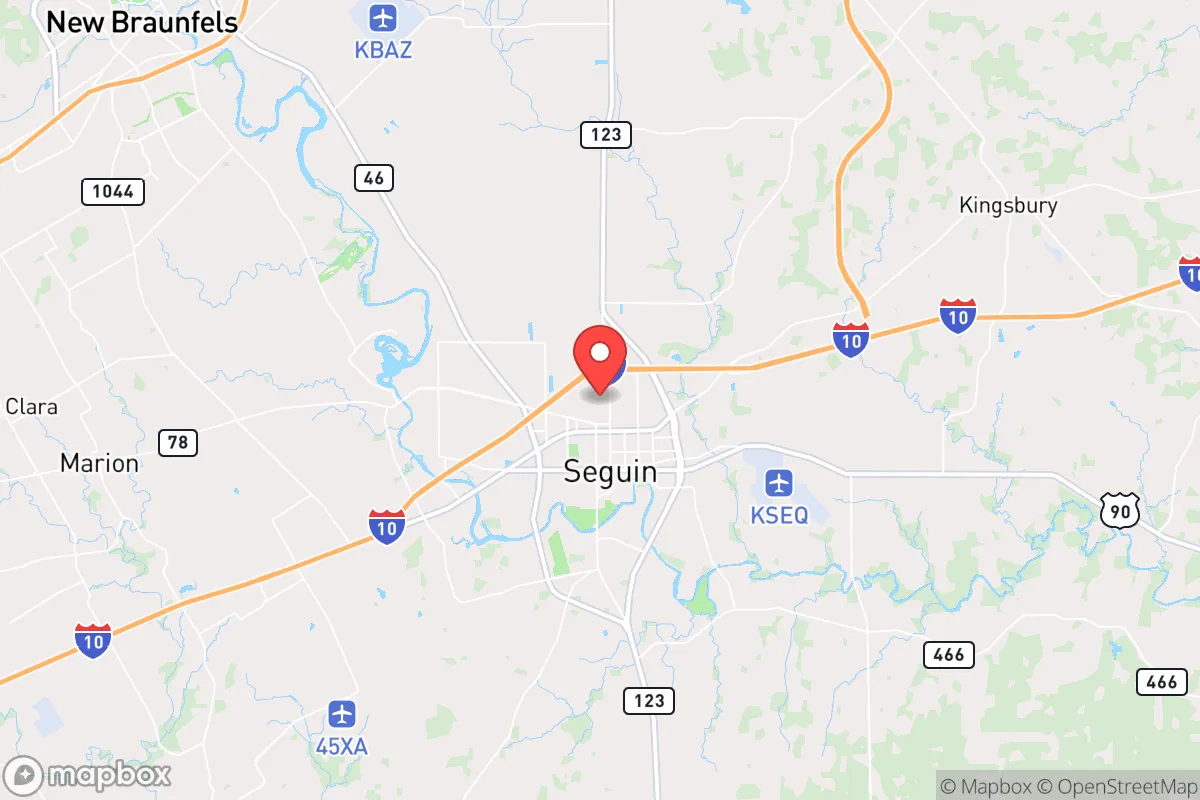
When you look at the map, Seguin is a bit of a conservative anchor in a region that's getting more complicated. Drive north up I-35 to San Marcos or Austin, and you're in a completely different world—those areas have shifted hard left, with San Marcos being a deep blue college town. Even New Braunfels, just to the west, has seen its politics get a little more purple as it grows, though it's still reliably red. Seguin, by contrast, has stayed more consistent. The surrounding Guadalupe County is one of the more reliably Republican counties in the state, and Seguin itself hasn't seen the same influx of out-of-state transplants that have diluted the conservative vote in places like Kyle or Buda. The R+7 rating here isn't just a number; it reflects a community that still largely believes in limited government, low taxes, and the Second Amendment. Compared to the state's R+4, Seguin is a place where conservative values aren't just holding on—they're still the default setting.
What this means for residents
For someone who values personal freedom and worries about government overreach, Seguin is a pretty good place to be right now. You don't see the same push for progressive social policies or heavy-handed regulations that you'd find in the bigger cities. The local school board, city council, and county commissioners are still dominated by folks who prioritize fiscal restraint and local control. That said, you can't be complacent. There's always pressure from the state and federal level to impose mandates or chip away at property rights, and as the area grows, you'll see more people moving in who might not share those values. The key is that the political culture here still pushes back against that kind of thing. If you're concerned about things like mask mandates, business closures, or overzealous zoning, Seguin's political climate is a lot more resistant to that than what you'd find in, say, San Antonio or Austin.
One cultural distinction worth noting is that Seguin has a strong sense of local identity that's tied to its history and its rural roots. You don't get the sense that people here are trying to reinvent the town into something it's not. The policy debates tend to be about practical matters—roads, water, schools—rather than ideological battles over social issues. That's not to say there aren't disagreements, but the overall direction is still toward preserving the kind of community where you can live your life without a lot of interference. The long-term outlook depends on how well the area can manage growth without losing that character. If the conservative majority stays engaged and active, Seguin will likely remain a place where personal freedoms are respected and government stays in its lane. If not, you could see it start to drift toward the more progressive model of its neighbors, which would be a real shame for anyone who moved here to get away from that.

State Political ClimatePolitical Climate in Texas
State Political AnalysisPolitical Environment in the State
Texas has been a reliably Republican state for decades, with a Cook PVI of R+4 reflecting its consistent lean. The dominant coalition is a mix of suburban conservatives, rural voters, and a growing number of fiscally-minded transplants, but the last 10-20 years have seen a slow but steady shift toward competitiveness. The GOP still holds every statewide office and both legislative chambers, but the margins have tightened—Trump won the state by 9 points in 2016 and only 5.5 in 2020, while Democratic gains in the suburbs of Houston, Dallas, and San Antonio have made once-safe seats competitive. For a conservative considering relocation, the key question is whether the state’s traditional freedom-friendly posture can hold against the demographic and cultural changes rolling in from the coasts.
Urban vs. rural divide
The political map of Texas is a study in contrasts. The big metros—Houston, Dallas-Fort Worth, San Antonio, and Austin—are the engines of Democratic growth, with Harris County (Houston) and Dallas County now reliably blue in presidential races. Austin, in particular, has become a progressive stronghold, with Travis County voting 71% for Biden in 2020. Meanwhile, the rural and exurban areas—places like Lubbock, Midland, and Tyler—vote Republican by massive margins, often 70-80%. The real battleground is the suburbs: Collin County (north of Dallas) and Fort Bend County (southwest of Houston) have flipped from red to purple, with Collin going from 57% Romney in 2012 to 51% Trump in 2020. The Rio Grande Valley, once a Democratic stronghold, has been shifting right, with counties like Zapata flipping to Trump in 2020. For a conservative, the safest bets are the smaller cities and exurbs—places like Katy, Frisco, and New Braunfels—where the politics still lean heavily red.
Policy environment
Texas’s policy environment is defined by its low-tax, low-regulation posture. There is no state income tax, and property taxes are high (around 1.6-2.5% of assessed value) but offset by the lack of income tax. The regulatory climate is business-friendly, with no state-level minimum wage above the federal $7.25 and right-to-work laws that limit union power. On education, the state has expanded school choice through charter schools and the Texas Education Agency’s oversight, but a full voucher program has stalled in the legislature. Healthcare policy is largely free-market, with no state Medicaid expansion under the ACA, leaving many low-income residents uninsured. Election laws have tightened since 2021’s SB 1, which added voter ID requirements, limited drive-through voting, and banned 24-hour polling places. For a conservative, the policy environment is broadly appealing, but the property tax burden and lack of school choice are persistent frustrations.
Trajectory & freedom
Texas has been on a trajectory of expanding personal freedom in some areas while contracting it in others. On the plus side, the state passed constitutional carry (permitless carry) in 2021 under HB 1927, allowing most adults to carry a handgun without a license. Parental rights were strengthened with the 2023 passage of the “Parental Bill of Rights” (HB 900), which requires schools to get parental consent for certain health services and restricts library materials deemed sexually explicit. On medical autonomy, Texas banned nearly all abortions in 2021 with SB 8, the heartbeat bill, and has resisted COVID-19 vaccine mandates. However, the state has also expanded government power in ways that concern liberty-minded residents: the 2023 TikTok ban on government devices, the use of state police to arrest migrants under Operation Lone Star, and the expansion of the Texas Department of Public Safety’s surveillance powers. The net direction is mixed—more freedom on guns and family issues, but more state intervention on border enforcement and technology.
Civil unrest & political movements
Texas has seen its share of political flashpoints. The 2020 Black Lives Matter protests in Austin and Houston were large and sometimes violent, leading to property damage and a lasting tension between local progressive city councils and the state GOP. The “Defund the Police” movement gained traction in Austin, where the city council cut the police budget by $150 million in 2020, only to restore it after a backlash. Immigration politics are a constant flashpoint: Operation Lone Star, launched in 2021, has deployed thousands of state troopers and National Guard to the border, leading to clashes with the Biden administration and lawsuits over the state’s busing of migrants to northern cities. Election integrity remains a hot-button issue, with the 2020 election sparking calls for audits in counties like Harris and Tarrant. Secession rhetoric, while fringe, has a vocal minority in groups like the Texas Nationalist Movement. For a new resident, the most visible sign of political tension is the stark contrast between the blue cities and the red state government—a dynamic that plays out in fights over local control, mask mandates, and property rights.
Projection
Over the next 5-10 years, Texas is likely to become more competitive but not flip blue. The key demographic drivers are the influx of Californians and other out-of-state transplants, who tend to be more moderate or left-leaning, and the continued growth of the Hispanic population, which is shifting rightward. The suburbs will be the decisive battleground: places like Fort Bend County and Williamson County (north of Austin) are trending purple, while rural areas are solidifying red. The state legislature will likely remain under GOP control, but the margins will shrink, making it harder to pass conservative priorities like school vouchers or further tax cuts. The biggest wildcard is the border crisis: if federal policy remains unchanged, Texas will continue to assert state authority, which could galvanize both conservative and progressive movements. For a conservative moving in now, expect a decade of political trench warfare, but the state’s structural advantages—no income tax, a growing economy, and a culture of self-reliance—will keep it a red-leaning haven.
For a new resident, the bottom line is that Texas offers a strong foundation for conservative values—low taxes, gun rights, and parental control—but it’s not immune to the national trends. The cities are increasingly progressive, and the state government is fighting a rear-guard action to preserve its freedom-friendly policies. If you’re moving here, pick your location carefully: the exurbs and smaller cities offer the most aligned political environment, while the big metros will feel like a different country. The state is still a net positive for liberty, but it’s not the Texas of 20 years ago—and it won’t be the same in 20 more.
* Values derived from national, state, county, city and local statistics and may differ in a specific area. Last updated: 2026-05-11T22:05:42.000Z
Narrative content on this page is AI-generated and may contain mistakes. Verify any details that matter before acting on them.
ReloMaps may earn a commission from affiliate links at no extra cost to you.

