Photo: Wikipedia
Political ClimatePolitical Climate in Gonzales County
Showing district-level results — no local-only data available.
Local Political AnalysisPolitical Analysis of Gonzales County
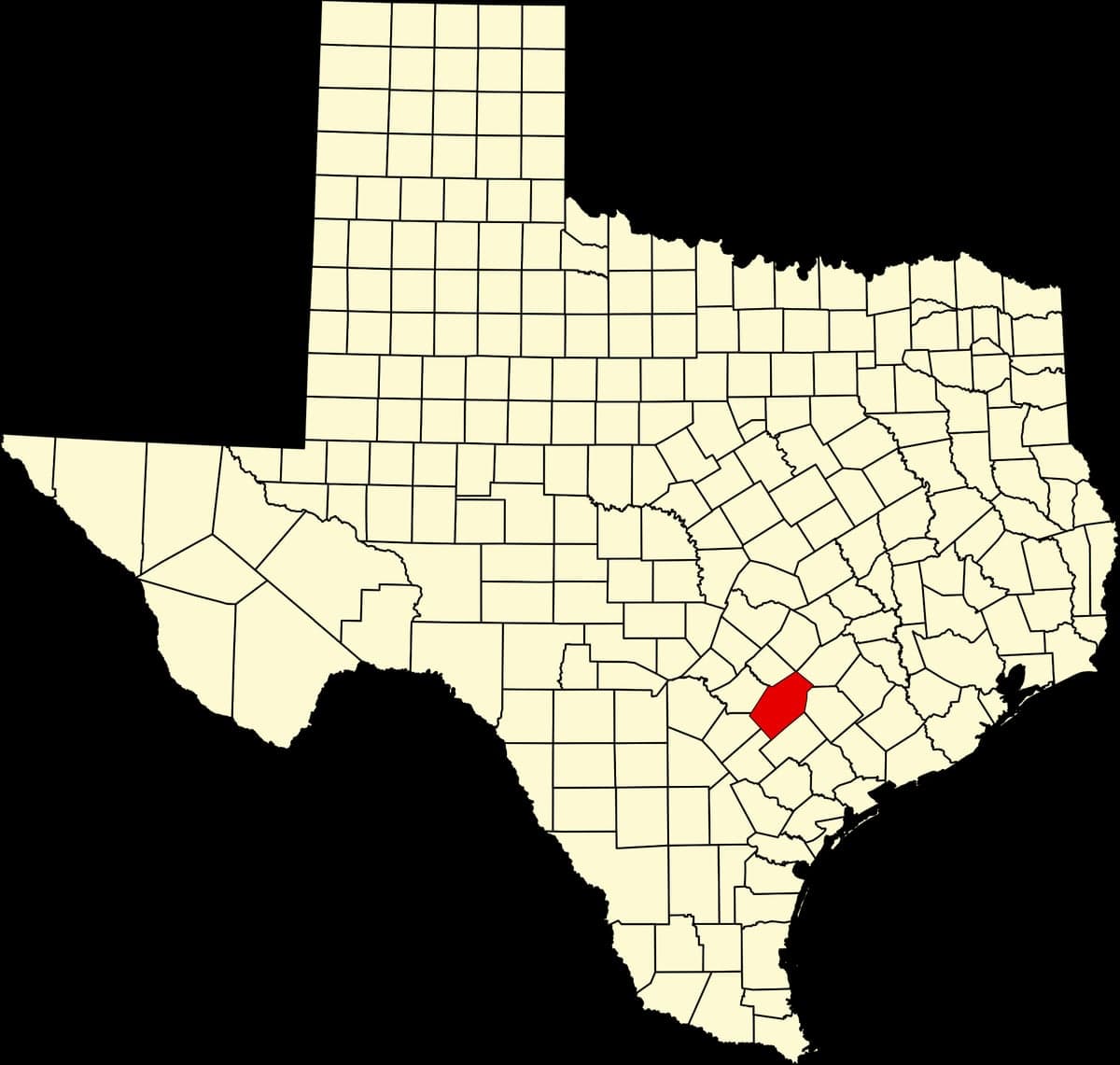
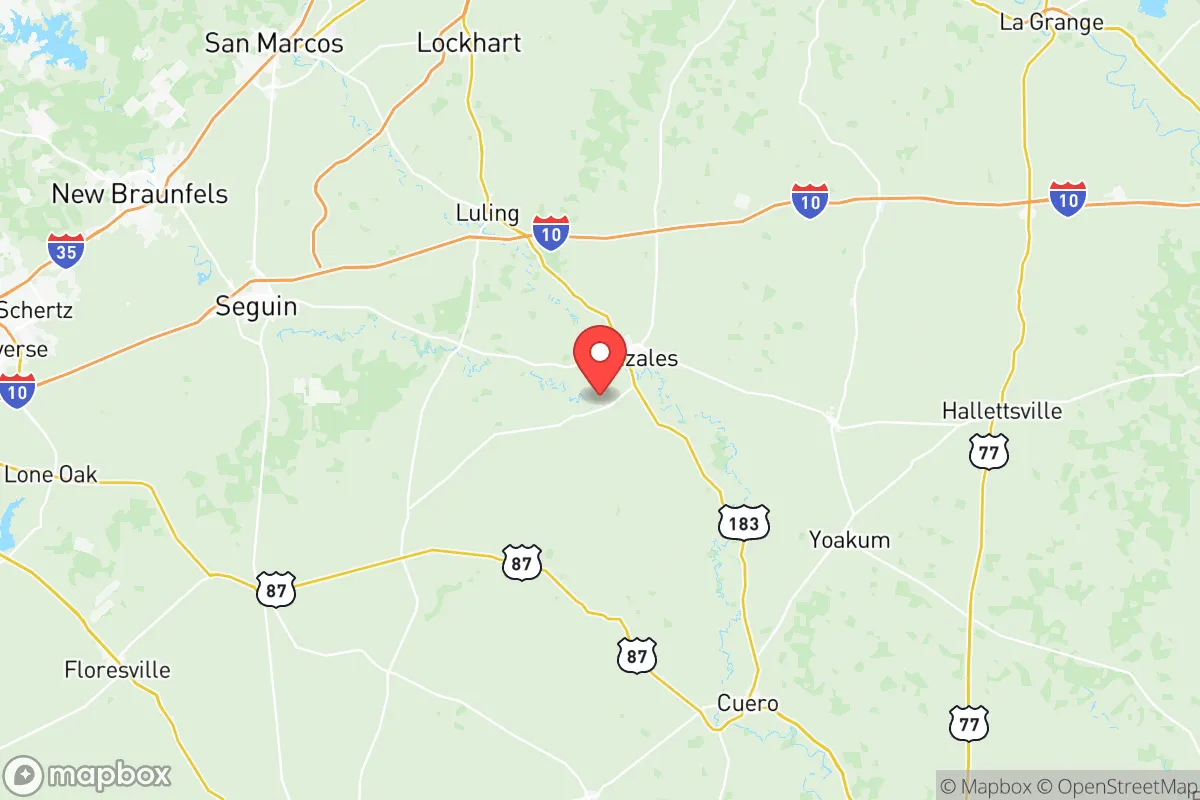
Gonzales County, Texas, is a reliably Republican area with a Cook Partisan Voting Index of R+7, meaning it votes about seven points more conservative than the nation as a whole. This isn't a purple county; it's a solid red one, though the shade varies noticeably from one end to the other. The county seat, Gonzales, is the political and cultural anchor, and while it's still conservative, it's the most moderate part of the county. Out in the smaller communities like Waelder, Smiley, and Nixon, the Republican lean is much more pronounced, often by double-digit margins in statewide races.
How it compares
Comparing Gonzales County to Texas as a whole is tricky because the state's Cook PVI is technically unknown, but we can use real election results. In the 2024 presidential race, Donald Trump carried Gonzales County with roughly 78% of the vote, while he won Texas statewide with about 56%. That's a massive 22-point gap, showing Gonzales is significantly more conservative than the state average. The county's R+7 PVI reflects this, but the actual voting behavior is even more lopsided. The biggest contrast is with urban Texas: places like Travis County (Austin) or Harris County (Houston) are deep blue, while Gonzales is deep red. The county's trajectory is also worth noting. It's not becoming more liberal; if anything, the rural precincts are getting redder as the small towns depopulate and the remaining voters trend older and more conservative. The one exception is the city of Gonzales itself, where a small but growing Hispanic population and a few younger families moving in from San Antonio have kept the Democratic vote share in the 25-30% range, compared to 15-18% in the outlying areas.
What this means for residents
For conservative residents, Gonzales County is a comfortable place politically. Local offices—county commissioner, sheriff, school board—are almost entirely held by Republicans, and policy reflects that. You'll see strong support for Second Amendment rights, low property taxes, and a general resistance to state or federal mandates. For liberal residents, it's a different story. You're in a clear minority, and you'll likely feel it in casual conversation and local governance. There's no active Democratic Party infrastructure in the county, so if you want to get involved, you're mostly on your own. That said, people are generally polite and neighborly regardless of politics; you won't face hostility, but you will be out of step with the majority. The practical impact is most visible in things like school curriculum debates (which lean traditional) and local zoning (which is minimal to nonexistent).
The cultural distinction that sets Gonzales County apart from much of Texas is its deep, almost defiant, sense of local identity. This is the "Come and Take It" county, home to the first shot of the Texas Revolution. That history isn't just a museum exhibit; it's woven into the local psyche. You'll see the cannon flag everywhere, and there's a real pride in self-reliance and skepticism of outside authority, whether that's from Austin or Washington. This makes the county's politics less about national party labels and more about a lived, local conservatism that values tradition, land, and community above all else. It's a place where the political climate is less about arguing over cable news and more about how the county fair is run or whether the school needs a new roof. For anyone moving here, understanding that local-first mindset is more important than knowing the PVI.

State Political ClimatePolitical Climate in Texas
State Political AnalysisPolitical Environment in the State
Texas has been a reliably Republican state for over three decades, but the margin has been tightening in every election cycle since 2012. In 2024, Donald Trump carried the state by roughly 9 points, down from 11 points in 2020 and 16 points in 2016. The dominant coalition remains a mix of rural and suburban conservatives, evangelical Christians, and business-oriented fiscal conservatives, but explosive growth in the urban crescent from Dallas-Fort Worth down through Austin to San Antonio and Houston is steadily shifting the electorate. A new resident moving in today will find a state where Republicans still hold every statewide office and both legislative chambers, but where the political conversation is increasingly shaped by the tension between a deeply conservative rural base and fast-growing, diversifying metro areas.
Urban vs. rural divide
The political map of Texas is a study in contrasts. The state's three largest metros — Houston, Dallas-Fort Worth, and San Antonio — are all trending bluer, with Harris County (Houston) and Dallas County now reliably Democratic in presidential races. Austin and El Paso are deep blue strongholds, with Travis County delivering margins of 50+ points for Democrats. Meanwhile, the vast rural and exurban expanse — places like the Panhandle around Lubbock, East Texas timber country, and the Rio Grande Valley — votes overwhelmingly Republican. The Valley itself is a fascinating microcosm: historically Democratic, it swung hard toward Trump in 2020 and 2024, with counties like Starr and Zapata flipping red for the first time in generations. The suburbs are the real battleground: Collin County (north of Dallas) and Fort Bend County (southwest of Houston) have shifted from solid red to competitive, while Tarrant County (Fort Worth) flipped blue in 2020 before snapping back slightly in 2024. A relocator moving to the outer ring of any major city will experience a very different political environment than someone settling in a small town like Fredericksburg or Waco.
Policy environment
Texas has no state income tax, which is the single biggest policy draw for conservative and libertarian-leaning relocators. Property taxes are high to compensate — the average effective rate is around 1.6%, among the highest in the nation — but the state offers a homestead exemption and a 10% cap on annual appraisal increases for homeowners. The regulatory posture is famously business-friendly: no state-level occupational licensing for many trades, weak unions (Texas is a right-to-work state), and minimal zoning in most cities. Education policy is a flashpoint: the state funds public schools through a Robin Hood system that redistributes property tax revenue from wealthy districts to poor ones, and the 2023 school voucher bill (SB 1) passed after years of resistance, allowing families to use public funds for private or homeschool expenses. Healthcare is a mixed bag: Texas has the highest uninsured rate in the country (roughly 17% as of 2025) because it has not expanded Medicaid under the ACA. Abortion is effectively banned after six weeks under the 2021 Heartbeat Act (SB 8) and the 2023 trigger law (HB 1280), with no exceptions for rape or incest. Election laws have been tightened: SB 1 (2021) added ID requirements for mail ballots, banned drive-through and 24-hour voting, and gave partisan poll watchers more access.
Recent policy direction
The last five years have seen a sharp rightward shift in state policy, even as the electorate has grown more competitive. On gun and self-defense law, Texas became a permitless carry state in 2021 (HB 1927), allowing anyone 21 or older who can legally possess a firearm to carry it openly or concealed without a license. On parental and education rights, the 2023 school voucher law (SB 1) and the 2021 "critical race theory" law (HB 3979) restrict how race and current events can be taught in public schools, while a 2023 law (SB 12) bans drag performances in public or where minors might see them. On speech and privacy, the state passed a law in 2023 (HB 20) that prohibits social media platforms from moderating content based on viewpoint, though it is currently tied up in court. On medical and bodily autonomy, the near-total abortion ban is the headline, but the state has also restricted gender-affirming care for minors (SB 14, 2023) and banned transition-related care for transgender youth. On property rights, Texas remains a strong property-rights state with no state-level rent control and limited eminent domain, though the 2023 law (SB 2038) restricted local governments from regulating short-term rentals. On taxation, the 2023 session saw a $18 billion property tax cut package (SB 2 and SB 3) that increased the homestead exemption and compressed school tax rates. On voting and ballot access, the 2021 law (SB 1) remains the baseline, but the state has also purged voter rolls aggressively, removing over a million names since 2020.
Civil unrest & political movements
Texas has a long history of political activism on both sides. The 2020 protests in Austin and Houston over George Floyd's death were among the largest in the country, and the city of Austin responded by cutting its police budget by a third, though much of that funding was later restored. On the right, the "constitutional sheriff" movement has gained traction in rural counties, with sheriffs in places like Montgomery County and Smith County publicly refusing to enforce certain state or federal gun laws. Immigration is the most visible flashpoint: Governor Abbott's Operation Lone Star, launched in 2021, has deployed thousands of National Guard troops and state troopers to the border, bused migrants to Democratic-led cities, and installed razor wire and buoys in the Rio Grande. The state has also passed a law (SB 4, 2023) that allows state and local police to arrest people suspected of entering the U.S. illegally, though it is blocked by court order. Secession rhetoric flares up periodically — the Texas Nationalist Movement has some grassroots support — but it remains a fringe position with no serious political momentum. Election integrity controversies have been persistent: the 2020 and 2022 cycles saw lawsuits over mail ballot drop boxes, drive-through voting, and voter ID, and the state's 2021 law was passed in direct response to Democratic-led expansions in Harris County.
Projection
Over the next five to ten years, Texas is likely to become more competitive at the statewide level, but not necessarily blue. The key demographic driver is the continued influx of domestic migrants — roughly 1,000 people move to Texas every day — who tend to be younger, more diverse, and more moderate than the existing population. The suburbs of Dallas, Houston, and San Antonio will continue to shift left, but the exurbs and smaller cities like Kyle, Buda, and New Braunfels are growing fast and leaning red. The Rio Grande Valley's rightward drift could accelerate if Democrats fail to reconnect with working-class Hispanic voters. The state legislature will likely remain under Republican control through at least 2030 due to gerrymandering, but the margin in the Texas House could narrow to a handful of seats. A new resident moving in now should expect a decade of political gridlock on major issues — no income tax will remain sacrosanct, but property tax relief will be a perennial fight, and the cultural battles over education, abortion, and LGBTQ rights will intensify as the electorate becomes more evenly split.
For a new resident, the bottom line is that Texas offers a low-tax, low-regulation environment that appeals strongly to conservatives and libertarians, but the political climate is increasingly polarized and unpredictable. If you lean right, you'll find a state government that largely reflects your values, especially on guns, taxes, and parental rights. If you lean left, you'll find strong communities in the major cities and a growing political counterweight, but you'll also face state laws that restrict abortion, voting access, and local control. The practical takeaway: choose your county carefully. The political experience of living in Austin versus Lubbock is as different as living in two different states, and the gap is only widening.
* Values derived from national, state, county, city and local statistics and may differ in a specific area. Last updated: 2026-10-17T00:16:39.000Z
Narrative content on this page is AI-generated and may contain mistakes. Verify any details that matter before acting on them.
ReloMaps may earn a commission from affiliate links at no extra cost to you.

