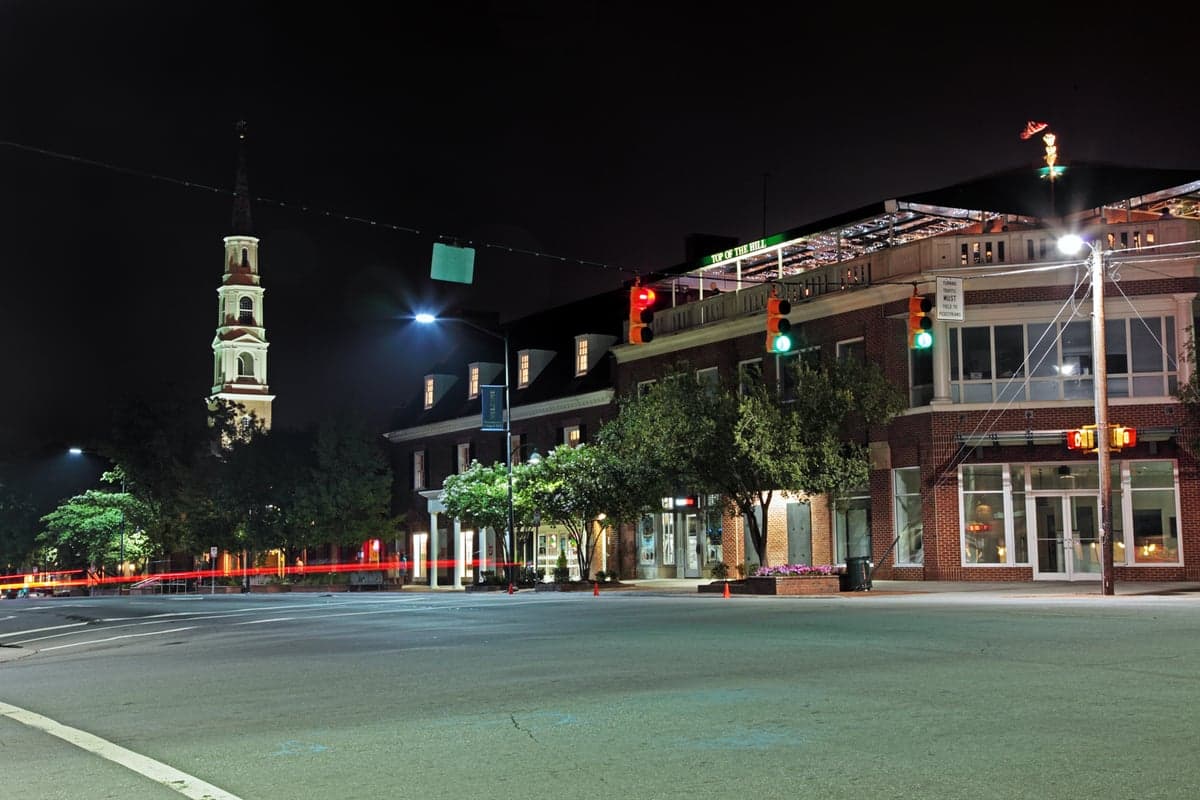
Photo: Wikipedia
Political ClimatePolitical Climate in Chapel Hill, NC
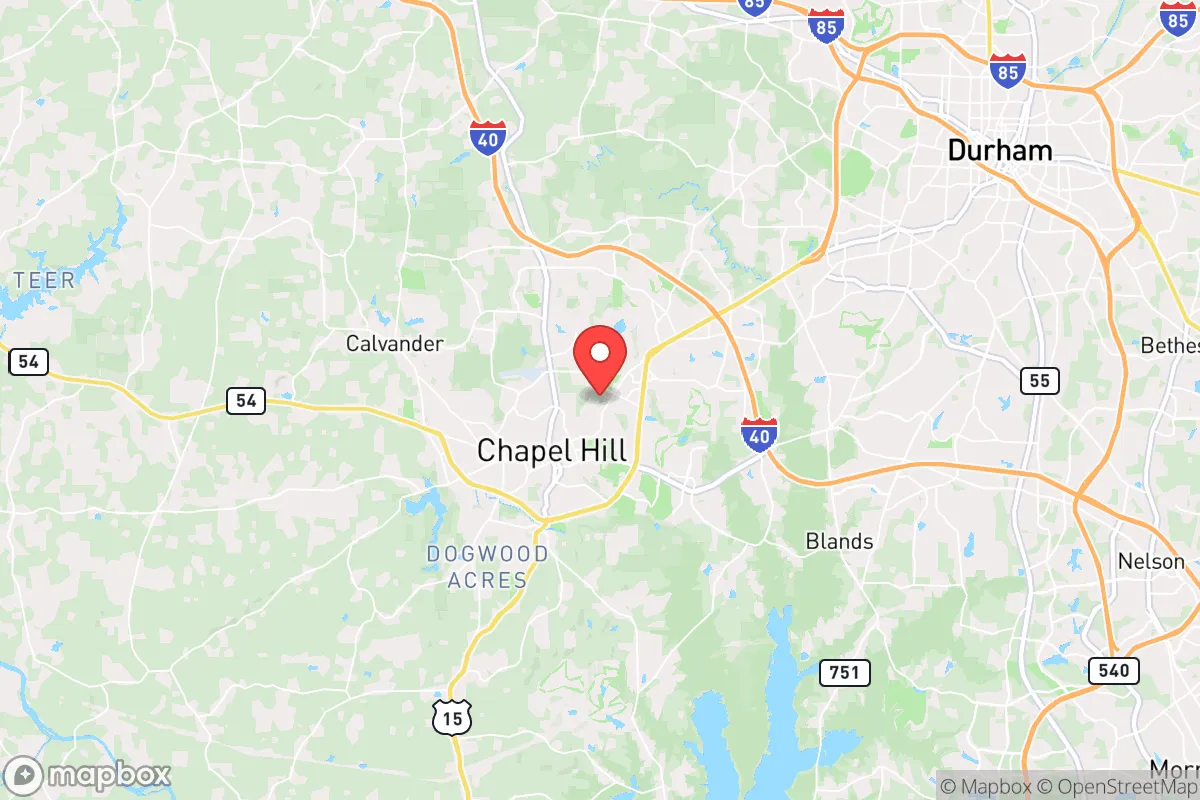
District shown is the primary district for this city’s centroid. Cities may span multiple districts.
Local Political AnalysisPolitical Analysis of Chapel Hill, NC
Chapel Hill is about as blue as it gets in North Carolina, with a Cook PVI of D+23 that puts it in the top tier of liberal strongholds nationwide. That number isn't just a statistic—it reflects a decades-long march leftward that has accelerated noticeably since the early 2000s. If you're looking for a place where traditional values and personal freedoms still carry weight, you'll find Chapel Hill increasingly inhospitable to that way of thinking. The trajectory here is one of steady, deliberate progressive consolidation, and it shows no signs of reversing.
How it compares
Drive 15 minutes in almost any direction and you'll hit towns that feel like a different country. Carrboro, right next door, is even further left—often called the "Paris of the Piedmont" for its activist culture. But head south to Pittsboro or east to Hillsborough, and you'll find more moderate, even conservative-leaning communities. Durham, 20 minutes east, is another deep-blue city, but its politics are more chaotic and less polished than Chapel Hill's. The real contrast comes in Raleigh (30 minutes east) and Cary (25 minutes southeast), where you'll find a healthier mix of viewpoints and a government that hasn't fully surrendered to progressive orthodoxy. Chapel Hill stands out because its liberalism isn't just electoral—it's cultural, enforced through zoning, school policies, and a local media that treats dissent as ignorance.
What this means for residents
For a conservative or even a moderate, daily life here means navigating a system that assumes you agree with its premises. Property taxes are high—the town's tax rate is about 50 cents per $100 of valuation, and Orange County adds another 80 cents or so—because the local government funds a long list of social programs and sustainability initiatives. Zoning rules are strict, making it nearly impossible to build a traditional single-family home without jumping through hoops designed to force density and "equity" outcomes. School policies in the Chapel Hill-Carrboro district lean heavily into DEI and critical theory, with less emphasis on academic rigor than you'd expect given the high property values. If you value freedom of speech, be warned: the town council has considered resolutions that effectively chill public comment on controversial topics. The police department is under constant pressure to defund or redefine its role, even as property crime ticks up in student-heavy neighborhoods. What this adds up to is a place where your personal choices—from how you heat your home to what you teach your kids—are increasingly subject to government approval.
The cultural distinctions here are telling. Chapel Hill was one of the first towns in the state to remove Confederate monuments and rename schools, and it regularly passes symbolic resolutions on national issues that have no local relevance. The University of North Carolina dominates the economy and the mindset, meaning the town's politics are shaped more by academic fashion than by the practical concerns of families and small business owners. Longtime residents will tell you that Chapel Hill in the 1990s was a charming college town with a live-and-let-live attitude. Today, it's a place where conformity to progressive norms is expected, and those who push back find themselves on the outside looking in. If you're considering a move here, understand that you're not just buying a house—you're buying into a political project that shows no signs of moderating.

State Political ClimatePolitical Climate in North Carolina
State Political AnalysisPolitical Environment in the State
North Carolina has long been a classic swing state, but over the past decade it has settled into a reliably right-of-center posture, voting Republican in nine of the last eleven presidential elections while maintaining a deeply competitive state legislature. The dominant coalition is a mix of rural and suburban conservatives, military retirees, and a growing number of fiscally conservative transplants from the Northeast and Midwest. However, the state’s trajectory is not static — the urban crescent from Charlotte through the Triad to the Research Triangle is rapidly shifting left, powered by tech migration and university growth, while the eastern and western rural counties remain staunchly red. The 2024 election saw Donald Trump carry the state by roughly 3 points, a narrower margin than 2020’s 1.3 points, signaling that the political ground is shifting under everyone’s feet.
Urban vs. rural divide
The political map of North Carolina is a tale of two landscapes. The urban crescent — Charlotte, Raleigh, Durham, Chapel Hill, and Greensboro — votes overwhelmingly Democratic, with Mecklenburg and Wake Counties alone delivering nearly a quarter of the state’s total votes. Durham County, home to Duke University and a massive progressive activist base, routinely votes 80%+ Democratic. Meanwhile, the rural east — places like Robeson County, Duplin County, and the Sandhills — and the mountain west — Buncombe County (Asheville) is a notable blue island, but surrounding counties like Henderson and Haywood are deep red — create a stark contrast. The real battleground is the fast-growing exurbs: Johnston County (south of Raleigh) flipped from Obama to Trump and stayed there, while Union County (southeast of Charlotte) is now one of the most reliably Republican counties in the state. The 2022 redistricting cemented a 10-4 Republican U.S. House delegation, but the state Supreme Court flipped back to a 5-2 Republican majority in 2024 after a brief 4-3 Democratic control, showing how tight the margins are.
Policy environment
North Carolina’s policy environment is broadly conservative but with notable exceptions. The state has a flat income tax rate of 4.5% (down from 7% in 2013), with a scheduled phase-down to 3.99% by 2027. There is no state property tax, and the sales tax is capped at 7.5% in most counties. The regulatory climate is business-friendly — the state is a right-to-work state with no state-level minimum wage above the federal $7.25. Education policy is a flashpoint: the state has a robust school choice program, including Opportunity Scholarships (vouchers) that were expanded in 2023 to all income levels, and a growing charter school sector. However, the state also saw a massive influx of federal COVID-era education dollars that many conservatives felt were mismanaged. Healthcare is mixed — the state did not expand Medicaid until 2023, a decade after the ACA, and only after a Republican-led compromise that included work requirements and a hospital assessment. Election laws are moderately restrictive: voter ID is required (passed in 2018, fully implemented in 2023), same-day registration is not available during early voting, and absentee ballot witness requirements remain in place. The 2024 election saw no major controversies, but the state’s election integrity laws remain a point of contention.
Trajectory & freedom
On balance, North Carolina has been moving in a more freedom-oriented direction over the past decade, but the trend is uneven. The most significant expansion of personal liberty came in 2023 with the repeal of the pistol purchase permit system (the “Pistol Purchase Permit” law, which had required a sheriff’s approval for handgun purchases) — a major win for Second Amendment advocates. The state also passed a Parents’ Bill of Rights in 2023, requiring schools to notify parents about instructional materials involving gender identity and sexuality, and giving parents the right to opt their children out. On the economic freedom front, the state eliminated the corporate income tax entirely as of 2025, and the flat tax phase-down continues. However, there have been concerning encroachments: the 2020 COVID lockdowns were among the most aggressive in the South, with Governor Roy Cooper (a Democrat) issuing a stay-at-home order that lasted 10 weeks and kept many small businesses shuttered. More recently, the state’s medical marijuana program remains stalled in the legislature, and there is no recreational cannabis — a freedom that many neighboring states are embracing. Property rights saw a win with the 2024 passage of a law limiting county-level zoning restrictions on accessory dwelling units, but the state still has no statewide preemption on rent control (though it’s rarely used).
Civil unrest & political movements
North Carolina has seen its share of political flashpoints. The 2020 protests in Charlotte and Raleigh following George Floyd’s death were large but largely peaceful, though there were instances of property damage and looting in Charlotte’s South End. The state has an active “Moms for Liberty” chapter network, particularly in Wake County and Mecklenburg County, which has been vocal on school board issues. Immigration politics are relatively quiet compared to border states — North Carolina has no sanctuary cities, and the 2015 HB 318 law prohibits local governments from adopting sanctuary policies. However, the 2024 election saw a surge in rhetoric around immigration, with the state’s growing Hispanic population (now about 10% of the total) becoming a political target. The “Confederate monument” debate flared in 2020-2021, with the state’s 2015 law protecting monuments being partially repealed in 2021, allowing local governments to remove them — several were taken down in Durham and Chapel Hill. Election integrity remains a live issue: the 2020 election saw a 117,000-vote margin for Trump, but the 2024 margin was closer, and the state’s voter ID law was challenged in court (upheld in 2024). There is no serious secession or nullification movement, but the “State Sovereignty” resolution introduced in 2023 (which passed the House but died in the Senate) reflected a growing frustration with federal overreach.
Projection
Over the next 5-10 years, North Carolina is likely to become more competitive, not less. The in-migration from blue states — particularly New York, New Jersey, and California — is concentrated in the urban crescent and exurbs, and these newcomers tend to bring their voting habits with them. The state’s population grew by 9.5% from 2010 to 2020, and the trend is accelerating. However, the rural counties are also growing (albeit slower), and the Republican legislature has shown a willingness to use redistricting and voter ID laws to maintain a structural advantage. The wild card is the state’s growing Hispanic and Asian populations — both groups lean Democratic but are not monolithic. The 2024 election results suggest that the GOP’s margin in the state is shrinking, and a Democratic presidential candidate could plausibly win North Carolina by 2028 or 2032. For a conservative moving in now, the state will likely remain a red-leaning purple state for the next decade, but the cultural and political center of gravity is shifting toward the urban areas. The legislature will remain Republican-controlled through at least 2030 due to gerrymandering, but the governor’s mansion is likely to flip back and forth.
For a new resident, the bottom line is this: North Carolina offers a relatively low-tax, business-friendly environment with strong gun rights and parental control over education, but the political winds are shifting. If you’re moving to Raleigh or Charlotte, you’ll find a growing progressive presence that feels increasingly like a blue city in a red state. If you’re heading to Wilmington, Fayetteville, or the mountains, you’ll find a more traditional Southern conservative culture. The state’s trajectory is toward a more competitive, polarized future — but for now, it remains one of the better options in the Southeast for those who value personal freedom and limited government. Just keep an eye on the school board meetings and the state supreme court races; that’s where the real action is.
* Values derived from national, state, county, city and local statistics and may differ in a specific area. Last updated: 2026-04-29T23:22:12.000Z
Narrative content on this page is AI-generated and may contain mistakes. Verify any details that matter before acting on them.
ReloMaps may earn a commission from affiliate links at no extra cost to you.

