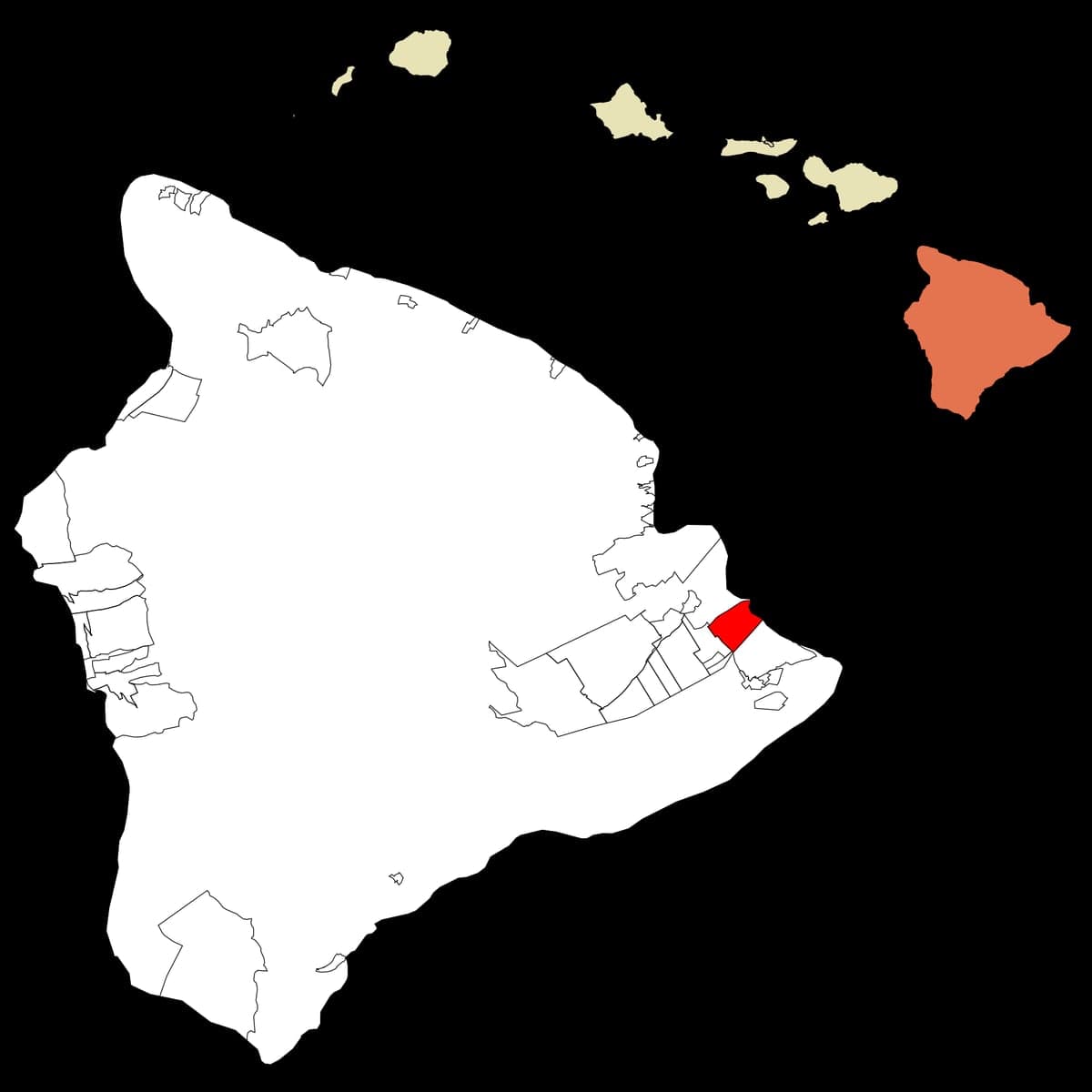
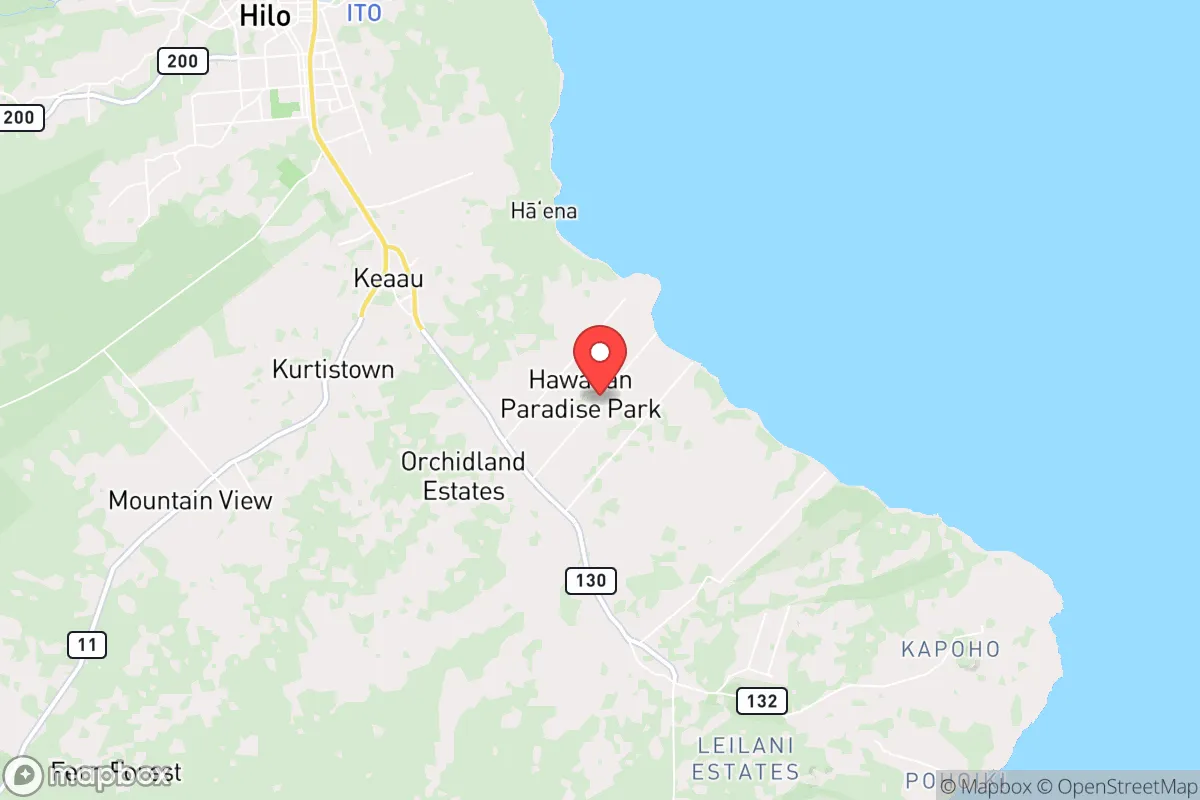
Photo: Wikipedia
Political ClimatePolitical Climate in Hawaiian Paradise Park, HI
District shown is the primary district for this city’s centroid. Cities may span multiple districts.
Local Political AnalysisPolitical Analysis of Hawaiian Paradise Park, HI
Hawaiian Paradise Park, on the Big Island’s Puna district, leans heavily Democratic, with a Cook PVI of D+12, meaning it votes about 12 points more Democratic than the national average. That’s a stark shift from even 15 years ago, when the area was a mix of libertarian-leaning homesteaders, off-gridders, and working-class families who valued self-reliance and minimal government interference. Now, you’re seeing a steady influx of mainland transplants, many from blue states, who bring progressive voting habits and a preference for more regulation—especially around land use, building codes, and environmental rules. The local precincts consistently go for Democratic candidates by wide margins, and the trend is only accelerating as new subdivisions fill up with folks who see government as a solution, not a problem.
How it compares
Drive 20 minutes north to Pahoa, and you’ll find an even more progressive vibe—think co-ops, community gardens, and a vocal activist scene that pushes for stricter county oversight on everything from septic systems to short-term rentals. Head west to Volcano Village, and it’s similar, with a heavy environmentalist tilt. But if you go south to the more rural, agricultural areas around Kurtistown or Mountain View, you’ll still find pockets of old-school Hawaii—folks who want to be left alone, who hunt and fish for food, and who view the county’s building department as an adversary, not an ally. The contrast is sharp: in Hawaiian Paradise Park, you’re more likely to hear neighbors arguing for more public transit and affordable housing mandates; in those outlying areas, the talk is about property rights and keeping the government out of your backyard. The D+12 rating masks a real internal divide—the park itself is the progressive hub, while the surrounding unincorporated areas are more mixed, with a libertarian streak that’s been here since the 1970s homesteading days.
What this means for residents
For someone who values personal freedom, the political drift here is concerning. The county council has been pushing stricter building codes, mandatory cesspool upgrades, and tighter short-term rental regulations—all sold as environmental protection, but they hit property owners hard, especially those on fixed incomes. The local school board has also shifted left, with more emphasis on equity initiatives and less on core academics. If you’re the type who wants to build a simple ohana dwelling without a dozen permits, or run a small farm stand without a business license, you’ll find the regulatory creep frustrating. The upside? The community is still diverse enough that you can find like-minded neighbors—there are active groups pushing back against overreach, like the Puna Property Rights Association. But the long-term trajectory is clear: as more people move in from high-tax, high-regulation states, the political center of gravity moves further from the old “live and let live” ethos. If you’re considering a move here, look closely at the county’s proposed land-use plan—it’s a roadmap for more control, not less.
Culturally, Hawaiian Paradise Park has a unique blend: it’s one of the few places in Hawaii where you’ll find a strong contingent of off-grid homesteaders living alongside tech workers who work remotely for mainland companies. That mix creates tension—the homesteaders want minimal government, while the newcomers often push for more services, which inevitably means more taxes and rules. The local farmers market is a good barometer: you’ll see organic kombucha stands next to guys selling wild pig meat they shot themselves. That diversity is what makes the area interesting, but politically, the scales are tipping. The county’s recent push to ban certain pesticides and restrict rainwater catchment systems—both sold as environmental wins—are red flags for anyone who values autonomy. If you’re looking for a place where you can truly be left alone, the window is closing. The next five years will likely bring more zoning changes and fee hikes, so buy now if you want a say in how things go, or be prepared to fight for your rights at the county council meetings.

State Political ClimatePolitical Climate in Hawaii
State Political AnalysisPolitical Environment in the State
Hawaii has been a one-party Democratic stronghold for decades, but don’t let the blue veneer fool you—the state’s political climate is far more complex than a simple partisan label. The dominant coalition is a mix of labor unions, native Hawaiian sovereignty advocates, and a progressive urban core, but there’s a quiet, growing conservative undercurrent, especially on the outer islands. Over the last 10-20 years, the state has drifted steadily leftward on social issues and government expansion, but a counter-movement centered on property rights, parental control, and fiscal sanity is slowly gaining traction, particularly in places like Kailua-Kona and Hilo.
Urban vs. rural divide
The political map of Hawaii is a tale of two islands—and a few distinct pockets. Honolulu on Oahu is the engine of the state’s progressive tilt, with its dense urban core, university influence, and heavy union presence driving Democratic margins of 70% or more in most elections. The rest of Oahu, especially the Leeward side (like Waianae), is more mixed, with a strong military and veteran presence that leans conservative on national security but votes Democratic locally due to union ties. The Big Island is where the real divide shows: Kailua-Kona and the North Kohala coast are increasingly conservative, fueled by mainland transplants and a ranching culture, while Hilo remains a progressive stronghold with a strong native Hawaiian activist scene. Maui’s Kihei and Lahaina areas are reliably liberal, but Upcountry Maui (Kula, Makawao) has a libertarian-leaning ranching community that votes Republican more often than not. Kauai is a wildcard—its rural character and strong agricultural base produce a mix of environmental progressivism and property-rights conservatism, with Hanalei leaning left and Waimea leaning right.
Policy environment
Hawaii’s policy environment is a mixed bag for a conservative-leaning newcomer. The tax structure is punishing: the state has one of the highest combined state and local tax burdens in the nation, with a progressive income tax that tops out at 11% and a general excise tax (GET) of 4% that applies to nearly everything, including rent and groceries. Property taxes are relatively low (around 0.3% of assessed value), but the state’s regulatory posture is heavy-handed, especially on housing and land use. The Hawaii Land Use Commission controls zoning statewide, making it nearly impossible to build new homes or start a business without years of permitting. Education policy is dominated by a single statewide school district, the Hawaii Department of Education, which has been criticized for low test scores and a top-down approach that leaves parents with little say. School choice is virtually nonexistent—no charter schools of note, and private schools are expensive. Healthcare is heavily regulated, with the state’s Prepaid Health Care Act mandating employer-provided insurance, which drives up costs for small businesses. Election laws are relatively open, with same-day registration and no voter ID requirement, which has led to concerns about election integrity among conservatives, though no major scandals have surfaced.
Trajectory & freedom
Hawaii is becoming less free by nearly any measure, and the trend is accelerating. The state has some of the strictest gun laws in the nation—a 2022 law (Act 207) bans the open carry of firearms and requires a permit for concealed carry that is nearly impossible to obtain, effectively gutting the Second Amendment. Parental rights took a hit with Act 2 (2023), which codified abortion access and removed parental notification requirements for minors seeking the procedure. Medical autonomy is severely restricted: the state’s vaccine mandate for healthcare workers and school employees remains in place, and a 2021 law (Act 39) gave the governor broad emergency powers that were used to enforce lockdowns and mask mandates longer than most states. Property rights are under constant assault from the Land Use Commission and county planning departments, which routinely deny building permits and impose costly impact fees. On the plus side, Hawaii has no statewide income tax on military pensions, and a 2023 law (Act 4) began phasing out the GET on food and medical services, but the overall trajectory is toward more government control, not less.
Civil unrest & political movements
Hawaii has a long history of civil unrest, but it’s not the kind you see on the mainland. The most visible flashpoint is the Mauna Kea telescope protest, which in 2019 saw thousands of native Hawaiian activists and their allies block construction of the Thirty Meter Telescope. This movement is a potent mix of environmentalism, indigenous sovereignty, and anti-government sentiment that cuts across party lines—many conservatives sympathize with the property-rights angle, while progressives back the environmental cause. The sovereignty movement is a persistent force, with groups like the Kingdom of Hawaii and Ka Lahui Hawaii pushing for secession or at least federal recognition. Immigration politics are muted compared to the mainland, but the state’s sanctuary policies (no local cooperation with ICE) have drawn criticism from conservatives, especially in Kapolei and Ewa Beach, where military families are concentrated. Election integrity is a growing concern: the state’s move to all-mail voting in 2020 (Act 136) was controversial, and while no widespread fraud has been proven, the lack of voter ID and signature verification standards has many conservatives uneasy. The Hawaii Republican Party is small but active, with a strong grassroots presence in Hawaii Kai and Mililani, but it struggles to gain traction in a state where union endorsements and family political dynasties (like the Abercrombies and the Ige family) dominate.
Projection
Over the next 5-10 years, Hawaii is likely to become more progressive on social issues and more restrictive on economic freedom. Demographic trends are not kind to conservatives: the state’s native Hawaiian and Asian populations are growing, and both groups tend to vote Democratic, while the white military and retiree population that leans Republican is shrinking due to high cost of living and base realignments. In-migration from the mainland is accelerating, but it’s mostly wealthy retirees and remote workers from California and New York who bring their progressive politics with them. The Hawaii Housing Affordability Crisis will likely force some policy changes—maybe a loosening of land-use restrictions—but don’t expect a libertarian revolution. The most realistic scenario is a slow drift toward a more regulated, higher-tax state that prioritizes environmentalism and native Hawaiian rights over economic growth. Someone moving in now should expect to see more green energy mandates, more restrictions on short-term rentals (already happening in Honolulu and Maui), and a continued erosion of Second Amendment rights.
Bottom line for a new resident: If you’re moving to Hawaii for the weather and the lifestyle, be prepared to accept a government that is deeply involved in your daily life—from what you can build on your property to how you educate your kids. The state is beautiful, but it is not a freedom-friendly destination. If you value low taxes, school choice, gun rights, and minimal regulation, you’ll find yourself swimming against a strong current. The best bet for a conservative-leaning family is the Big Island’s Kona side or Upcountry Maui, where the politics are more libertarian and the community is smaller. But even there, the state government in Honolulu will be a constant presence. Hawaii is a place you move to for the aloha spirit, not for the political climate—and that spirit, while real, comes with a heavy dose of government oversight.
* Values derived from national, state, county, city and local statistics and may differ in a specific area. Last updated: 2026-04-24T14:29:44.000Z
Narrative content on this page is AI-generated and may contain mistakes. Verify any details that matter before acting on them.
ReloMaps may earn a commission from affiliate links at no extra cost to you.

