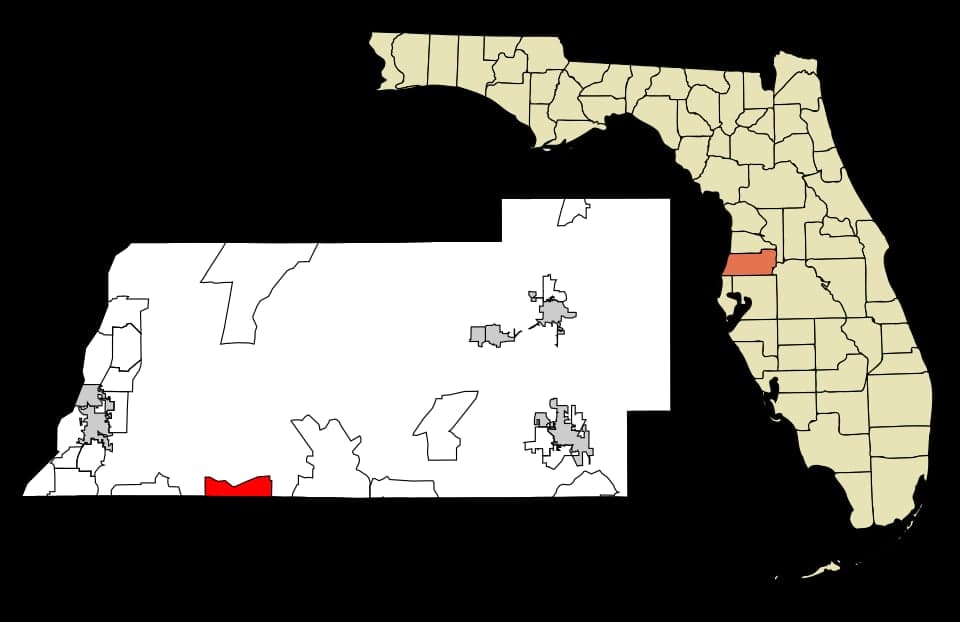
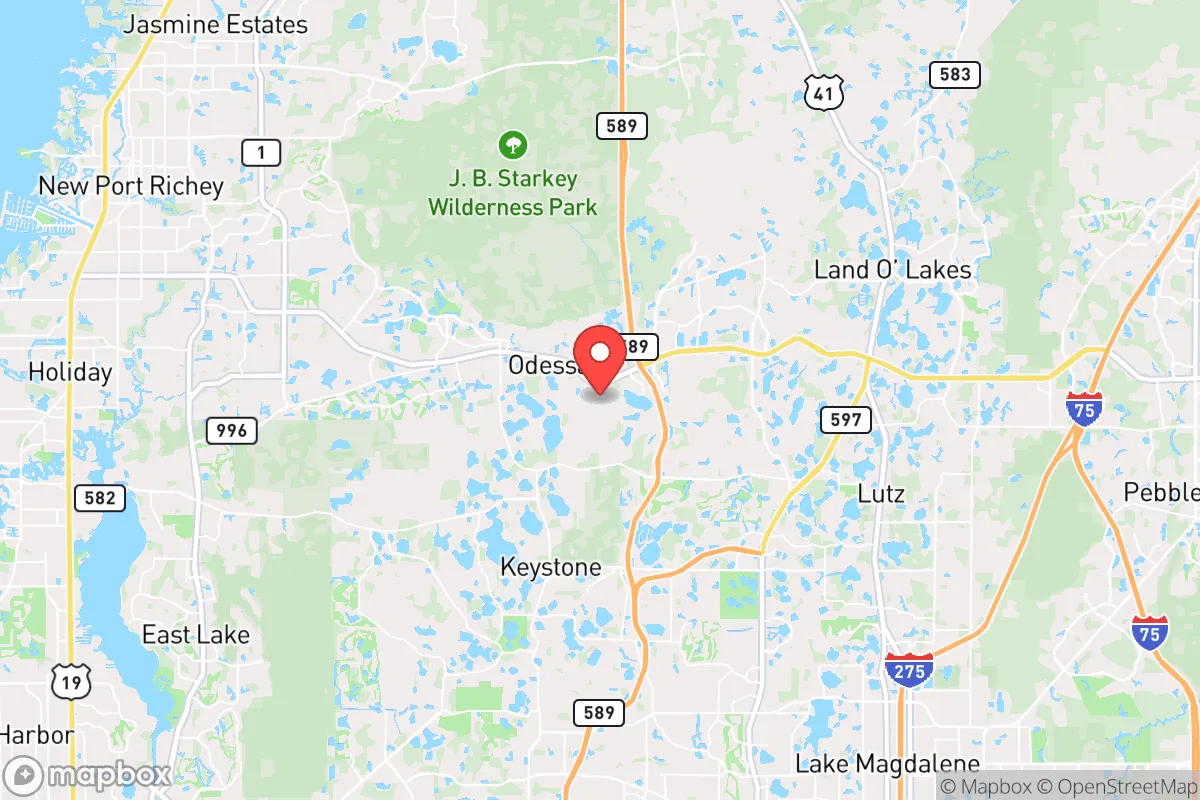
Photo: Wikipedia
Political ClimatePolitical Climate in Odessa, FL
District shown is the primary district for this city’s centroid. Cities may span multiple districts.
Local Political AnalysisPolitical Analysis of Odessa, FL
Odessa, Florida, is a reliably conservative community with a political climate that leans heavily Republican, reflected in its Cook Partisan Voting Index (PVI) of R+17. This means the area votes about 17 points more Republican than the national average, a tilt that has been consistent for years and shows no signs of shifting dramatically. Nestled in Pasco County, Odessa sits in a region that has long been a GOP stronghold, though its character is distinct from the more purple or blue-leaning areas just a few miles south in Tampa or St. Petersburg.
How it compares
Compared to Florida as a whole, Odessa is significantly more conservative. While Florida is often considered a swing state with a near-even partisan split—recent statewide elections have been decided by margins of 1-3 points—Odessa’s R+17 rating places it firmly in the deep-red category. For context, nearby cities like Tampa (Hillsborough County) lean Democratic, with a PVI around D+7, while St. Petersburg is even more liberal. In contrast, Odessa’s neighbors to the north, such as Land O’ Lakes and Wesley Chapel, share a similar conservative bent, though Wesley Chapel has seen some Democratic inroads as new residents arrive from more diverse areas. The political divide is stark: drive 20 minutes south from Odessa into Tampa, and you’ll encounter a very different set of yard signs and local priorities.
What this means for residents
For conservative residents, Odessa offers a comfortable environment where their views align with the majority. Local elections, school board decisions, and county commission policies tend to reflect conservative values, such as lower taxes, support for law enforcement, and a focus on property rights. Republican voters here rarely feel out of step with their neighbors. For liberal residents, the reality is more nuanced. While you won’t face hostility in daily life—Odessa is a polite, family-oriented area—you may find fewer like-minded peers in local civic groups or social circles. Political discussions at community events or school functions often lean right, so progressive residents might seek connection in nearby Tampa or through online networks. The area’s trajectory suggests this dynamic will persist: Pasco County’s growth is attracting families from other red states, reinforcing the conservative tilt, though some influx from blue areas could gradually shift the needle over the next decade.
Culturally, Odessa stands apart from Florida’s coastal hotspots. There’s no beachfront nightlife or urban arts scene here; instead, the vibe is suburban and rural, with a strong emphasis on outdoor recreation, like fishing on the Anclote River or hiking at Starkey Wilderness Park. Policy-wise, the county leans toward limited government—zoning is less restrictive than in Tampa, and there’s a palpable skepticism of state-level mandates, whether on COVID restrictions or environmental regulations. For newcomers, the key takeaway is that Odessa’s political climate is stable and predictable: it’s a place where conservative values are the norm, and while diversity of thought exists, it’s not the loudest voice in the room.

State Political ClimatePolitical Climate in Florida
State Political AnalysisPolitical Environment in the State
Florida has transformed from a quintessential swing state into a solidly Republican-leaning powerhouse over the past decade, driven by a massive influx of conservative-leaning migrants from the Northeast and Midwest. The state now consistently votes +3 to +5 points to the right of the national popular vote in presidential elections, with Republicans holding a trifecta in state government since 1999. This shift is not a fluke—it’s the result of a deliberate policy agenda that has made Florida a laboratory for conservative governance, while still maintaining enough purple patches to keep things interesting for both sides.
Urban vs. rural divide
The political map of Florida is a study in stark contrasts. The major metros—Miami-Dade, Broward (Fort Lauderdale), and Orange County (Orlando)—are Democratic strongholds, with Miami-Dade alone delivering over 500,000 votes for Joe Biden in 2020. But the real story is the suburban and exurban shift. Counties like St. Johns (St. Augustine), Collier (Naples), and Lee (Fort Myers) have moved sharply right, with St. Johns now voting +30 points Republican. The I-4 corridor, stretching from Tampa through Lakeland to Daytona Beach, remains the ultimate battleground, but even here, Polk County (Lakeland) has trended red as retirees and families from blue states settle in. Rural North Florida—places like Liberty County and Suwannee County—vote 80%+ Republican, while the Panhandle’s Escambia County (Pensacola) is reliably red but with a blue-leaning university district. The urban-rural divide is so pronounced that a drive from downtown Miami to the Everglades feels like crossing into a different country politically.
Policy environment
Florida’s policy environment is defined by low taxes and light regulation, with no state income tax and a 6% corporate income tax that applies only to C-corporations. The state’s Stand Your Ground law (2005) and constitutional carry (2023) make it one of the most gun-friendly states in the nation. Education policy is a flashpoint: the Parental Rights in Education Act (HB 1557, 2022) restricts classroom instruction on sexual orientation and gender identity in early grades, while the School Choice program (HB 1, 2023) expanded vouchers to nearly all families, making Florida a national leader in education alternatives. Healthcare is a mixed bag—the state did not expand Medicaid under the ACA, leaving roughly 800,000 residents in the coverage gap, but it has robust telehealth laws and a competitive insurance market. Election laws tightened after 2020 with SB 90 (2021), which limited drop boxes and added ID requirements for mail-in ballots, though early voting remains generous at 8-14 days depending on the county.
Recent policy direction
The last three years have seen an aggressive conservative legislative agenda. On guns, HB 543 (2023) eliminated the need for a concealed carry permit, allowing any legal gun owner to carry openly or concealed without a license. On parental rights, HB 1 (2023) also banned gender-affirming care for minors and restricted transgender athletes in school sports. Property rights were bolstered by SB 250 (2023), which limited homeowners’ association fines and made it harder for HOAs to foreclose on homes. On speech, HB 7 (2022) prohibited workplace training that promotes certain concepts about race and sex, while SB 258 (2023) required public universities to survey for “intellectual diversity” and allowed students to record classroom lectures. Privacy and surveillance saw a shift with HB 3 (2023), which banned TikTok on government devices and restricted Chinese-owned apps. Medical autonomy took a hit with the 15-week abortion ban (HB 5, 2022), which was later upheld by the state Supreme Court, though a 2024 ballot initiative to enshrine abortion rights is pending. Voting access remains a partisan wedge—SB 7050 (2024) further restricted third-party voter registration groups and added new felony penalties for registration errors.
Civil unrest & political movements
Florida has seen its share of political flashpoints. The Parkland school shooting in 2018 sparked the March for Our Lives movement, with massive student-led protests in Tallahassee and Miami. In 2020, George Floyd protests erupted in major cities, with curfews in Miami and Orlando, but the state avoided the prolonged unrest seen in Portland or Seattle. Immigration politics are front and center—Governor Ron DeSantis’s SB 1718 (2023) made it a felony to transport undocumented immigrants into the state and required hospitals to ask about immigration status, leading to a sharp drop in the undocumented population in counties like Miami-Dade. The state also bused migrants to Martha’s Vineyard and Sacramento as a political statement. Election integrity controversies have been persistent, with the state creating an Office of Election Crimes and Security (2022) that has prosecuted dozens of cases of alleged voter fraud, though most have been minor. Secession rhetoric is rare, but there is a strong “Free Florida” movement among libertarian-leaning conservatives who want to break from federal overreach. A new resident in The Villages or Naples will see Trump flags and DeSantis signs year-round, while in St. Petersburg or Gainesville, they’ll find “DeSantis is a Fascist” bumper stickers. The divide is visible and real.
Projection
Over the next 5-10 years, Florida is likely to become even more Republican, but with a twist. The in-migration from blue states—roughly 1,000 new residents per day—is overwhelmingly conservative-leaning, as people move for low taxes, gun rights, and school choice. However, the same migrants bring their cultural preferences, which could moderate the state’s hard edge on issues like marijuana legalization (a 2024 ballot initiative is expected to pass) and abortion (the 2024 amendment may also pass). The Hispanic vote, particularly in Miami-Dade, is shifting right—Cuban-Americans and Venezuelan-Americans are increasingly Republican, while Puerto Ricans in Orlando remain Democratic. Expect the state to remain a Republican trifecta through 2030, but with narrower margins in the legislature as suburban districts become more competitive. The biggest wildcard is climate change—rising sea levels and stronger hurricanes could reshape coastal politics, especially in Miami Beach and Fort Lauderdale, where adaptation costs are already driving local tax debates. A family moving to Jacksonville or Tampa today should expect a state that is firmly conservative on fiscal and cultural issues, but with enough local variation to find their tribe.
For a new resident, the bottom line is this: Florida offers a low-tax, high-freedom environment for conservatives, with a strong economy and warm weather. Liberals will find vibrant blue cities like Miami, Orlando, and Tampa where they can live comfortably, but they’ll face a state government that is actively hostile to many of their priorities. The key is choosing your county wisely—Alachua County (Gainesville) is a blue island in a red sea, while Collier County (Naples) is deep red. Either way, you’ll pay no state income tax, enjoy year-round sunshine, and live in a state that is unapologetically charting its own course.
* Values derived from national, state, county, city and local statistics and may differ in a specific area. Last updated: 2026-10-18T23:59:33.000Z
Narrative content on this page is AI-generated and may contain mistakes. Verify any details that matter before acting on them.
ReloMaps may earn a commission from affiliate links at no extra cost to you.

