Photo: Wikipedia
Political ClimatePolitical Climate in Doral, FL
District shown is the primary district for this city’s centroid. Cities may span multiple districts.
Local Political AnalysisPolitical Analysis of Doral, FL
Doral, Florida, sits in a reliably conservative pocket of Miami-Dade County, with a Cook Partisan Voting Index of R+16 that reflects its strong Republican lean. This isn't a new trend—the area has long been a bastion for fiscally conservative, pro-business values, driven largely by its large Venezuelan and Cuban-American communities who fled socialist regimes and have little patience for progressive experiments. Over the past decade, you've seen the local GOP machinery stay solid, but there's been a creeping unease as Miami-Dade County as a whole has flirted with more progressive policies, especially on taxes and zoning. The trajectory here is one of cautious vigilance: Doral's conservative core is holding, but the surrounding county's leftward drift means residents are constantly fighting to keep local government focused on freedom, not overreach.
How it compares
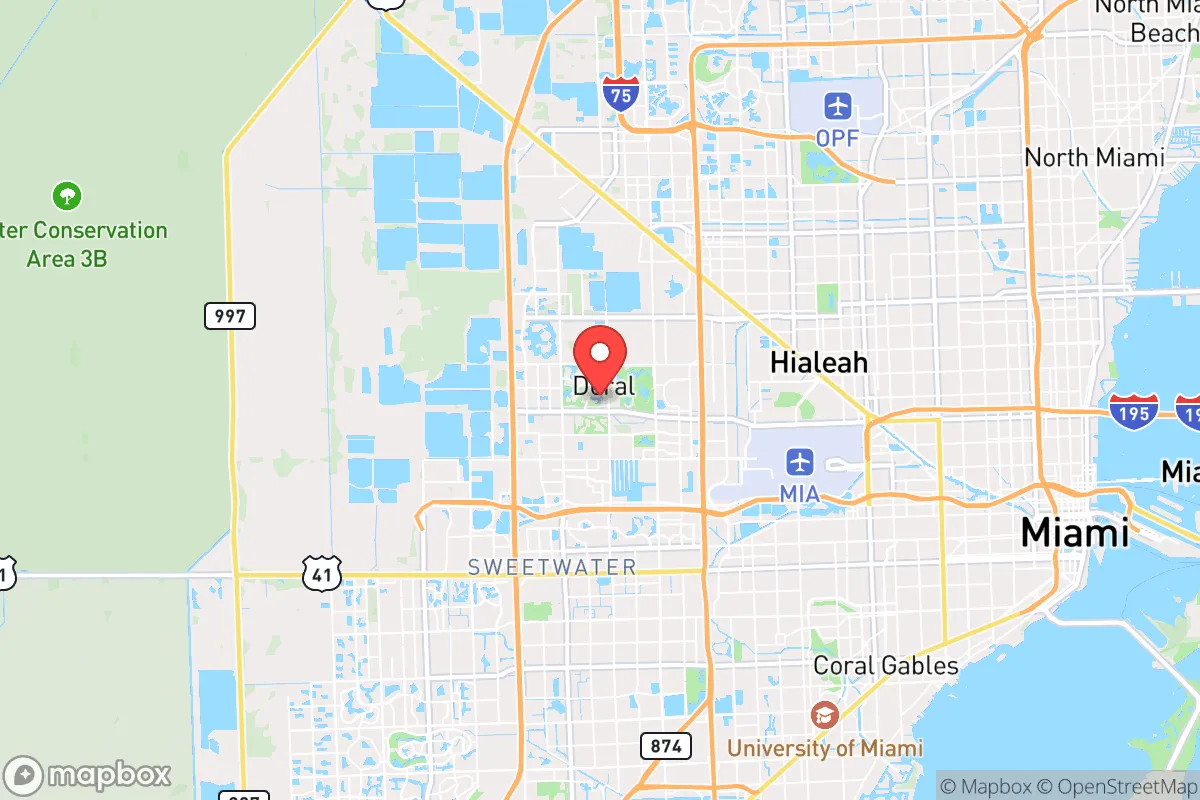
Drive ten miles east to Miami proper, and you're in a different world—Miami's city council has pushed rent control studies and sanctuary city policies that would make a Doral resident's blood boil. Head north to Hialeah, and you'll find a similar Cuban-American conservative vibe, but Hialeah's politics are more machine-driven and less transparent than Doral's. The real contrast is with Broward County to the north: places like Weston or Parkland lean Republican, but Fort Lauderdale and Hollywood are deep blue, with aggressive mask mandates and business shutdowns during COVID that Doral largely avoided. Doral itself has kept property taxes relatively low and resisted county-level attempts to impose strict short-term rental bans, which is a big deal for the many homeowners who rely on Airbnb income. The R+16 rating isn't just a number—it means Doral's congressional representation consistently votes for lower taxes, Second Amendment protections, and school choice, while nearby districts like Florida's 27th (Miami Beach) are represented by Democrats who back the Green New Deal and Medicare for All.
What this means for residents
For the average Doral family, this political climate means you can run a small business without drowning in red tape, and your kids' schools aren't being used as social engineering labs. The city council has pushed back hard against county-level mandates on everything from plastic straw bans to vaccine passports, which is a relief if you believe government should stay out of your personal health decisions. Property values have held steady because investors know Doral isn't going to suddenly impose rent control or exclusionary zoning. That said, you need to stay engaged: the 2024 election saw a slight uptick in progressive turnout in some precincts near the downtown Doral area, and there's chatter about bringing "equity" audits into city contracts. If you're not paying attention, you could wake up to a city that starts taxing your home sale to fund affordable housing projects you never voted for.
Culturally, Doral stands out for its fierce embrace of American exceptionalism—you'll see more American flags per block than in most of South Florida, and the annual 4th of July parade is a bigger deal than any local election. The city's large Venezuelan community means there's a visceral understanding of what happens when government overreaches: they've lived it. That's why you'll find strong support for school choice (many families use vouchers for private Catholic or Christian schools) and a general distrust of any policy that sounds like "for the greater good." The long-term worry here is that as Miami-Dade County's population diversifies and younger, more liberal transplants move in from New York and California, Doral could face pressure to adopt county-wide progressive policies on housing and policing. For now, the city's conservative DNA is intact, but it's a constant battle to keep it that way—and that's exactly how the old-timers like it.

State Political ClimatePolitical Climate in Florida
State Political AnalysisPolitical Environment in the State
Florida has transformed from a classic swing state into a solidly Republican-leaning powerhouse over the past two decades, with a registered Republican voter advantage of over 700,000 as of 2026 and a 2024 presidential margin of roughly +13 points for the GOP. The dominant coalition is a blend of conservative retirees, Hispanic voters (especially in Miami-Dade and the I-4 corridor), and rural transplants from other red states, all pushing the state rightward. This isn’t a purple state anymore—it’s a red state with a few stubborn blue pockets, and the trajectory has been unmistakably conservative since the 2018 gubernatorial race cemented Ron DeSantis as a national figure.
Urban vs. rural divide
The political map of Florida is a study in stark contrasts. The major metros—Miami-Dade, Broward, and Palm Beach counties in the southeast, plus Orange County (Orlando) and Leon County (Tallahassee)—are the Democratic strongholds, but even these are shifting. Miami-Dade County, once a Democratic bastion, flipped to Trump in 2020 and again in 2024, driven by Cuban-American and Venezuelan voters who are deeply skeptical of socialism and left-wing economic policies. Meanwhile, the rural Panhandle—places like Panama City, Pensacola, and the sprawling counties of the Big Bend region—vote 70-80% Republican, with a culture that feels more like Alabama than Miami. The I-4 corridor, running from Tampa through Lakeland to Daytona Beach, is the traditional swing zone, but even there, Hillsborough County (Tampa) is trending redder as suburban voters flee Democratic governance. The urban-rural split is sharp: you can drive 20 minutes from downtown Orlando into rural Osceola County and feel like you’ve crossed a political border. The suburbs of Jacksonville and Fort Myers are now reliably red, while the core cities remain blue but shrinking in influence.
Policy environment
Florida’s policy environment is a conservative’s dream, deliberately engineered to attract families and businesses from high-tax states. There is no state income tax, a constitutional cap on property tax increases (the Save Our Homes amendment), and a business-friendly regulatory climate that has drawn corporate relocations from California and New York. Education policy is a flashpoint: the state’s Parental Rights in Education law (HB 1557, passed in 2022) restricts classroom instruction on sexual orientation and gender identity in grades K-3, and the 2023 expansion (HB 1069) extended those restrictions through grade 8. School choice is robust, with the Family Empowerment Scholarship program giving parents taxpayer-funded options for private or homeschool. Healthcare policy leans toward personal responsibility: Florida did not expand Medicaid under the ACA, and the state has a strong medical malpractice tort reform environment. Election laws have been tightened with SB 90 (2021), requiring voter ID, limiting drop boxes, and restricting mail-in ballot requests to one election cycle. Gun laws are among the most permissive in the nation: permitless carry (constitutional carry) was signed into law in 2023, and there are no state-level red flag laws, no waiting periods, and no magazine capacity limits. The state also preempts local governments from enacting stricter gun ordinances, so a move to Miami or Tallahassee doesn’t change your Second Amendment rights.
Trajectory & freedom
Florida is unequivocally becoming more free for conservative-leaning residents, especially in terms of parental rights, gun rights, and economic liberty. The 2023 passage of the Live Healthy Act expanded healthcare access through deregulation, but the biggest freedom gains have been in education and speech. The Stop WOKE Act (HB 7, 2022) prohibits workplace and school training that promotes certain concepts about race and sex, though parts of it were blocked by federal courts. The state has also cracked down on social media platforms with SB 7072 (2021), which bans them from deplatforming political candidates—a law currently tied up in litigation. On medical freedom, Florida banned vaccine passports in 2021 (SB 2006) and prohibited mask mandates in schools during the pandemic. The trajectory is clear: the legislature is actively rolling back what it sees as overreach from local governments and federal mandates. However, there are concerns about government overreach from the right—the state’s preemption of local ordinances on everything from short-term rentals to plastic straws means local control is limited. A new resident should expect a state that prioritizes individual liberty in most areas but isn’t afraid to use state power to enforce conservative norms.
Civil unrest & political movements
Florida has seen its share of political flashpoints, but they’ve been less about violent unrest and more about organized activism. The 2020 Black Lives Matter protests in Miami, Orlando, and Jacksonville were large but largely peaceful, with some property damage in downtown Miami. The state’s response was aggressive: DeSantis created the Office of Election Crimes and Security in 2022, which has prosecuted a handful of cases of alleged voter fraud. Immigration politics are a major driver of activism, with the 2023 SB 1718 law requiring businesses with 25+ employees to use E-Verify and making it a felony to transport undocumented immigrants into the state. This has sparked protests from immigrant rights groups, especially in Miami and Immokalee. The “Don’t Say Gay” law (HB 1557) drew national protests and boycotts, but within Florida, it energized conservative parents who felt schools were overstepping. There’s a growing secessionist sentiment in the Panhandle—the “State of Jefferson” movement has some traction in rural counties like Liberty and Calhoun, though it’s more symbolic than serious. Election integrity remains a hot-button issue, with the 2020 and 2022 cycles seeing intense scrutiny of mail-in ballots and drop boxes, though no widespread fraud has been proven. A new resident will notice the political polarization in everyday life—bumper stickers, yard signs, and local news coverage are heavily partisan, but the state’s culture is generally live-and-let-live outside of the most heated debates.
Projection
Over the next 5-10 years, Florida will likely become even more conservative, driven by two powerful demographic forces: continued in-migration from blue states and the naturalization of Hispanic voters who lean Republican. The state is projected to gain 2-3 million new residents by 2035, mostly from New York, California, and Illinois, and these transplants tend to be moderate-to-conservative on fiscal issues and crime, even if they’re socially liberal. The Republican supermajority in the legislature is unlikely to be broken, and the governorship will remain red for the foreseeable future. However, there are risks: climate change and rising insurance costs could slow migration from coastal areas, and the state’s housing affordability crisis (especially in Miami and Tampa) could push younger voters leftward. The biggest wildcard is the Hispanic vote—if Democrats ever figure out how to appeal to Cuban and Venezuelan voters on economic issues, the state could swing back to purple. But for now, the trajectory is toward a deeper shade of red, with more school choice, more gun rights, and more preemption of local progressive policies. A new resident moving in 2026 should expect to find a state that is aggressively conservative on cultural issues but still diverse and dynamic, with a political climate that rewards individual initiative and punishes government overreach.
For a conservative family or individual considering relocation, Florida offers a rare combination of low taxes, strong parental rights, and permissive gun laws that is increasingly hard to find in the United States. The trade-offs are real: you’ll deal with intense summer heat, hurricane risks, and a housing market that has priced out many locals. But politically, you’re moving into a state that has deliberately built a bulwark against progressive policies, and that bulwark is only getting stronger. If you value personal freedom over government mandates, Florida is one of the safest bets in the country for the next decade.
* Values derived from national, state, county, city and local statistics and may differ in a specific area. Last updated: 2026-04-30T05:16:42.000Z
Narrative content on this page is AI-generated and may contain mistakes. Verify any details that matter before acting on them.
ReloMaps may earn a commission from affiliate links at no extra cost to you.

