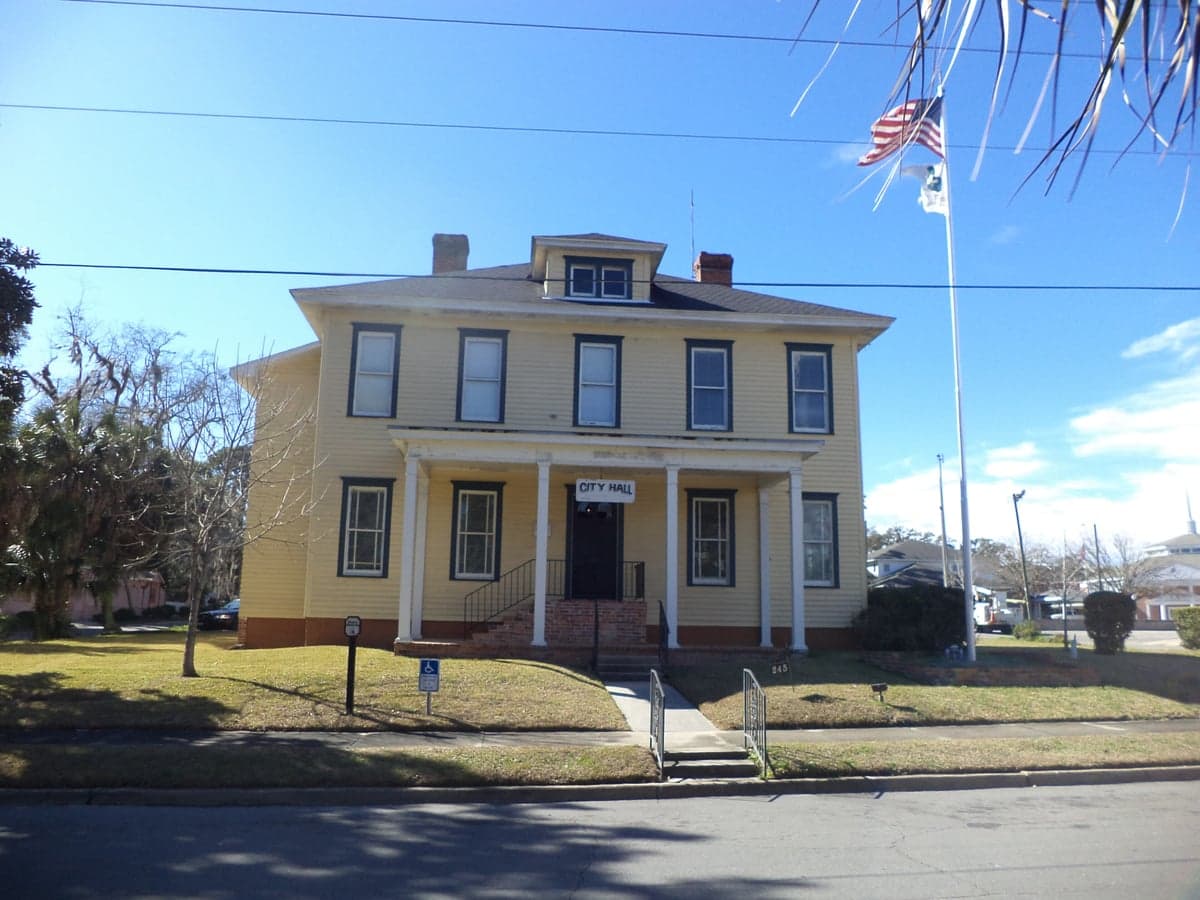
Photo: Wikipedia
Political ClimatePolitical Climate in Monticello, FL
District shown is the primary district for this city’s centroid. Cities may span multiple districts.
Local Political AnalysisPolitical Analysis of Monticello, FL
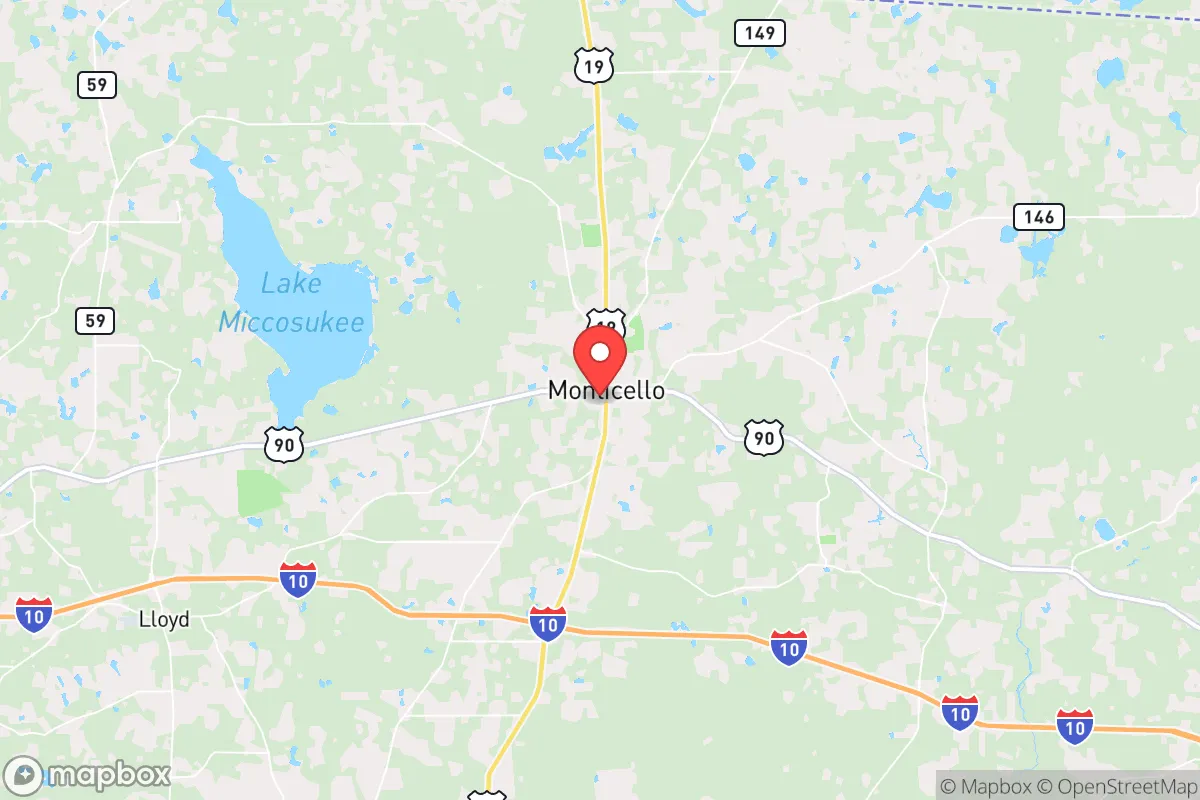
Monticello sits in the heart of Jefferson County, and if you look at the numbers, it’s about as reliably conservative as any small town in North Florida. The Cook PVI here is R+8, meaning the area votes eight points more Republican than the national average. That’s a solid three points redder than the state of Florida as a whole, which sits at R+5. Over the past decade, that gap has held steady—Monticello hasn’t drifted left the way some rural towns have, and I think that’s because folks here still remember when government kept its nose out of local business. The trajectory is stable, but you can feel the pressure from Tallahassee creeping south, and that’s got a lot of us watching closely.
How it compares
Statewide, Florida’s R+5 PVI reflects a mix of booming metro areas like Miami and Orlando that lean blue, plus a massive retiree and transplant population that’s made the state more purple over the years. Monticello, by contrast, is insulated from that. We’re a two-hour drive from Jacksonville and about 45 minutes east of Tallahassee, and that distance matters. Tallahassee itself is a blue dot in a red county—Leon County votes reliably Democratic—and you can see the cultural divide as soon as you cross the county line. In Monticello, you don’t hear talk of rent control or sanctuary city policies. The local commission stays focused on keeping taxes low and property rights intact. Compared to the state average, Monticello is a stronghold of traditional values, and the voting patterns reflect that. Even as Florida’s overall PVI has shifted from R+3 to R+5 in recent cycles, Jefferson County has barely budged.
What this means for residents
For someone moving here, the political climate translates directly into daily life. You won’t see the kind of government overreach that’s become common in bigger Florida cities—no mask mandates that last for months, no heavy-handed zoning that tells you what you can do with your own land. Property taxes are low, and the county commission generally takes a hands-off approach to business regulation. That’s a big deal if you value personal freedom and don’t want some bureaucrat in Tallahassee or Washington telling you how to run your household or your farm. The downside? If you’re hoping for progressive policies like expanded public transit or aggressive environmental regulations, you’ll be disappointed. But for most of us, that’s a feature, not a bug. The school board and sheriff’s office are both conservative, and there’s a strong sense of community self-reliance. I’ve seen neighboring counties like Gadsden (which leans more Democratic) struggle with higher crime and slower economic growth, and I think the political stability here is a big reason Monticello stays quiet and safe.
One cultural distinction worth noting: Monticello has a deep-rooted agricultural economy—peanuts, cotton, timber—and that shapes the local mindset. People here are skeptical of distant authority and prefer local solutions. You won’t find the same kind of partisan bickering you see in state politics; instead, it’s more about practical, common-sense governance. That said, I do worry about the long term. As Florida’s population keeps growing and the state legislature pushes more mandates from above, places like Monticello will have to fight to keep their independence. For now, though, if you’re looking for a place where your rights aren’t treated as negotiable, this is still one of the best spots in the state.

State Political ClimatePolitical Climate in Florida
State Political AnalysisPolitical Environment in the State
Florida is a solidly Republican state with a Cook PVI of R+5, meaning it leans about five points more conservative than the national average in presidential elections. Over the past 20 years, the state has shifted from a classic swing state—where George W. Bush won by just 537 votes in 2000 and Barack Obama carried it in 2008 and 2012—to a reliably red stronghold. Donald Trump won Florida by 3.4 points in 2020 and by a wider margin in 2024, driven by a massive influx of conservative-leaning transplants from blue states and a growing Hispanic electorate that has moved rightward, especially in Miami-Dade County. The dominant coalition is a mix of suburban and exurban families, retirees, and small-business owners who prioritize low taxes, parental rights, and public safety.
Urban vs. rural divide
The political map of Florida is starkly divided. The major urban centers—Miami, Orlando, Tampa, and Jacksonville—tend to vote Democratic, but even these cities have seen notable rightward shifts. Miami-Dade County, once a Democratic stronghold, flipped to Trump in 2020 and again in 2024, driven by Cuban-American and Venezuelan-American voters who are deeply skeptical of socialism and progressive policies. Meanwhile, the rural Panhandle—places like Panama City, Pensacola, and Tallahassee's surrounding counties—votes overwhelmingly Republican, often by 30-40 point margins. The real battleground is the suburban and exurban corridor stretching from Jacksonville down through Gainesville and Ocala to Orlando's outer rings. These areas, filled with families fleeing high-tax states like New York and California, have turned once-purple counties like St. Johns (St. Augustine) and Sumter (The Villages) into deep red territory. The I-4 corridor, which runs from Tampa to Daytona Beach, remains the state's political fulcrum, but even here, the trend is toward the right as new arrivals bring their conservative values with them.
Policy environment
Florida's policy environment is a model of limited government and personal freedom. There is no state income tax, a major draw for relocating families and entrepreneurs. The regulatory posture is business-friendly, with right-to-work laws and minimal red tape compared to states like New York or California. On education, Governor Ron DeSantis signed the Parental Rights in Education Act (HB 1557) in 2022, which prohibits classroom instruction on sexual orientation and gender identity in grades K-3, and the Florida Parental Rights Act (HB 5) in 2024, which strengthens parents' authority over their children's medical decisions. School choice is robust, with the Family Empowerment Scholarship program allowing state funds to follow students to private or charter schools. Healthcare policy emphasizes transparency and competition, with the Florida Health Care Transparency Act requiring hospitals to post prices. Election integrity is a priority: the state passed SB 90 in 2021, which requires voter ID, limits drop boxes, and bans ballot harvesting. Florida also has a "stand your ground" self-defense law and a constitutional carry law (permitless concealed carry) signed in 2023, reinforcing Second Amendment rights.
Trajectory & freedom
Florida is becoming more free, not less, and that's the main reason people are moving here in droves. Recent legislation has expanded personal liberty across multiple fronts. The Second Amendment Preservation Act (2023) prohibits state and local law enforcement from enforcing federal gun laws that violate the state constitution. The Florida Freedom Act (2024) bans vaccine mandates and mask mandates by private employers and government entities. On medical autonomy, the Medical Freedom Act (2023) prohibits discrimination based on vaccination status and bans the use of vaccine passports. Property rights were strengthened by SB 250 (2023), which limits homeowners' association authority to impose fines and restricts their ability to foreclose on homes for unpaid fees. The Florida Parental Rights Act (2024) gives parents the final say on their child's medical care, including gender transition procedures. The only area where freedom has arguably contracted is on abortion: the state passed a 15-week ban in 2022 (HB 5) and a six-week ban in 2023 (HB 7), with exceptions for rape, incest, and the mother's life. For conservatives who value life, this is a positive development; for those who prioritize abortion access, it's a restriction. Overall, the trajectory is toward more individual liberty, less government overreach, and a culture that rewards self-reliance.
Civil unrest & political movements
Florida has seen relatively little civil unrest compared to states like Oregon or Minnesota. The 2020 Black Lives Matter protests were smaller and less destructive here, partly because Governor DeSantis quickly deployed the Florida National Guard and state law enforcement to protect property. Organized activist movements on the left are concentrated in college towns like Gainesville (home to the University of Florida) and Tallahassee (Florida State University), where groups like the Dream Defenders have pushed for criminal justice reform. On the right, the Florida Republican Assembly and local Moms for Liberty chapters have been highly effective in school board elections, particularly in Brevard County (Cocoa Beach area) and Lee County (Fort Myers). Immigration politics are a major flashpoint: Governor DeSantis has bused migrants to Martha's Vineyard and signed SB 1718 (2023), which requires businesses with 25+ employees to use E-Verify, bans local governments from issuing ID cards to undocumented immigrants, and makes it a felony to transport illegal aliens into the state. There is no sanctuary city policy anywhere in Florida—the state preempted that in 2019 with SB 168. Election integrity controversies have been minimal compared to states like Georgia or Arizona, but the 2020 recount in Palm Beach County and ongoing litigation over mail-in ballot deadlines keep the issue alive. A new resident would notice a palpable sense of order: people generally feel safe, and political disagreements rarely spill into the streets.
Projection
Over the next 5-10 years, Florida will likely become even more conservative. The in-migration pattern is self-reinforcing: people moving from blue states are disproportionately conservative-leaning families and retirees who want lower taxes, better schools, and less government interference. The Hispanic vote, especially in Miami-Dade and Osceola County (Kissimmee), will continue to shift right as younger generations reject the socialism their parents fled. The Democratic Party's strength is increasingly confined to a few urban cores and the I-4 corridor's most densely populated areas. Climate change and hurricane risk may slow growth in coastal areas like Miami Beach and Fort Myers Beach, but inland cities like Ocala, Gainesville, and Lakeland are booming. The biggest wild card is the state's insurance crisis: property insurance premiums have skyrocketed, and if the market collapses, it could trigger an exodus. But the political response—tort reform and deregulation—is likely to keep Florida on a free-market path. Someone moving in now should expect to find a state that is more culturally conservative, more economically dynamic, and more politically stable than most of the country.
For a new resident, the bottom line is this: Florida offers a political environment that respects your freedom to live your life as you see fit, as long as you don't harm others. You won't face a state income tax, vaccine mandates, or government overreach into your children's education. The schools are increasingly choice-friendly, the gun laws are among the most protective in the nation, and the culture rewards hard work and self-reliance. If you're moving from a high-tax, high-regulation state, you'll feel the difference immediately. Just be prepared for hot summers, hurricane season, and a political landscape that is unapologetically red—and getting redder.
* Values derived from national, state, county, city and local statistics and may differ in a specific area. Last updated: 2026-05-14T17:59:23.000Z
Narrative content on this page is AI-generated and may contain mistakes. Verify any details that matter before acting on them.
ReloMaps may earn a commission from affiliate links at no extra cost to you.

