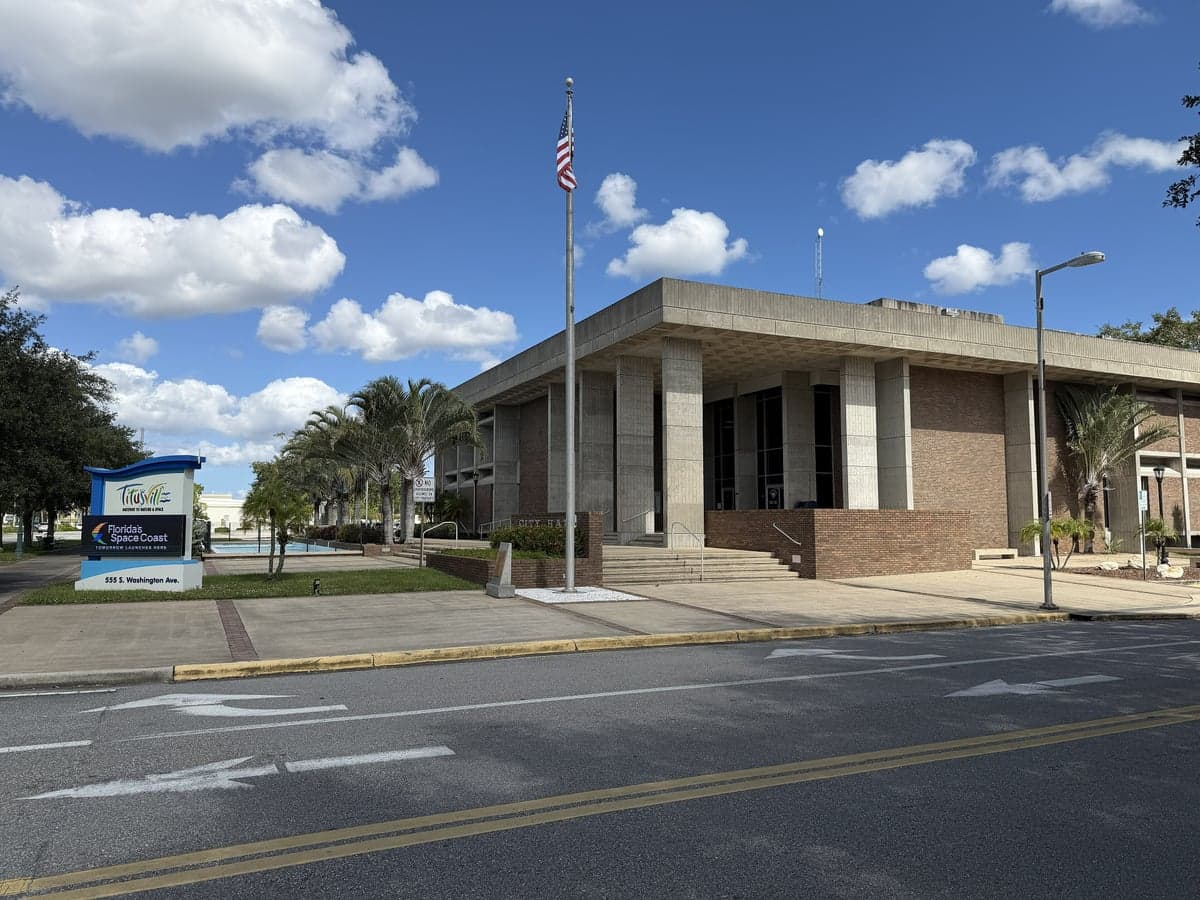
Photo: Wikipedia
Political ClimatePolitical Climate in Titusville, FL
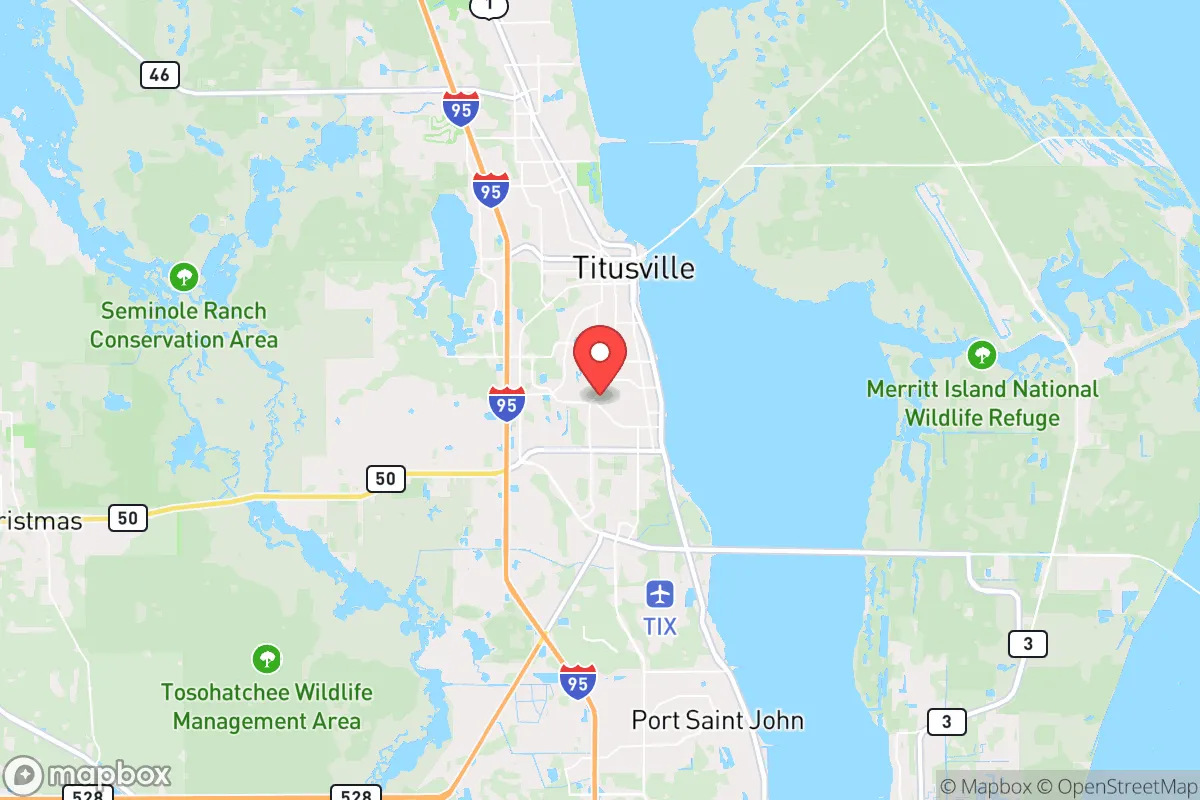
District shown is the primary district for this city’s centroid. Cities may span multiple districts.
Local Political AnalysisPolitical Analysis of Titusville, FL
Titusville leans solidly Republican, with a Cook Partisan Voting Index of R+11, meaning the area votes about 11 points more conservative than the national average. This isn't a new development—Brevard County has been reliably red for decades, but the tilt has deepened since the 2010s as new residents from more liberal parts of Florida have largely settled closer to the coast or in the Orlando suburbs, leaving Titusville’s political character more stable than some of its neighbors. The city itself has a slightly more moderate feel than the surrounding unincorporated areas, but overall, if you’re looking at the voting patterns, Titusville is a place where Republican candidates consistently win by comfortable margins.
How it compares
Compared to the state of Florida as a whole—which is a classic purple battleground with no fixed Cook PVI—Titusville is noticeably more conservative. Florida as a state swings between parties depending on the cycle; in 2020, it voted for Trump by about 3 points, and in 2022, Governor Ron DeSantis won by nearly 20 points. Titusville, by contrast, has been reliably red in both presidential and state-level races. The contrast is even sharper when you look at nearby cities: Melbourne and Palm Bay, about 20 miles south, are more politically mixed, with Melbourne Beach and Indialantic leaning Democratic in local elections. Head west toward Orlando, and you’re in a blue stronghold. So Titusville sits as a conservative anchor in a region that’s otherwise a patchwork of purple and blue pockets. The Space Coast’s economy—heavily tied to NASA and defense contractors—tends to reinforce a pro-business, pro-military mindset that aligns with the area’s voting patterns.
What this means for residents
For conservative residents, Titusville feels like a comfortable fit. Local government tends to be business-friendly, and you’ll find that city council meetings and county commission decisions generally reflect a limited-government philosophy. Gun rights are broadly supported, and property taxes are relatively low compared to the state average. For liberal residents, the political climate can feel isolating, but it’s not hostile. There’s a small but active Democratic club in the area, and the city itself is more tolerant than the rural pockets to the north. You won’t see the kind of overt political tension you might in a swing county—most people just get along. The biggest practical difference is in policy: school board decisions tend to lean conservative, and social issues like mask mandates or book bans have been less contentious here than in, say, Brevard’s coastal towns. If you’re a liberal, you’ll likely find your social circle through work at Kennedy Space Center or local nonprofits, not through local politics.
Culturally, Titusville has a distinct identity that softens some of the political edges. The city’s identity is wrapped up in space exploration and the natural beauty of the Indian River Lagoon, which creates a shared civic pride that transcends party lines. You’ll see Trump signs and NASA bumper stickers on the same truck—that’s the local flavor. The biggest policy distinction from the rest of Florida is the area’s strong support for environmental conservation, particularly around the lagoon and the Merritt Island National Wildlife Refuge. That’s a rare point of bipartisan agreement. Looking ahead, as the Space Coast continues to grow with commercial space ventures, Titusville might see a slow influx of younger, more diverse workers, which could nudge the political needle slightly left over the next decade. But for now, it remains a reliably red community where the pace of life is slow, the politics are predictable, and the biggest local debates are about development and traffic, not culture wars.

State Political ClimatePolitical Climate in Florida
State Political AnalysisPolitical Environment in the State
Florida has transformed from a quintessential swing state into a solidly Republican-leaning powerhouse over the past decade, with the GOP now holding a supermajority in both legislative chambers and every statewide elected office. The state’s political trajectory has been a steady rightward march since 2010, driven by a massive influx of conservative-leaning domestic migrants from the Northeast and Midwest, combined with a growing Hispanic electorate that has shifted toward the GOP in places like Miami-Dade County. In 2024, Donald Trump carried Florida by over 13 points, a stark contrast to the nail-biters of 2000 and 2012, cementing the state’s new status as a reliably red anchor in the Sun Belt.
Urban vs. rural divide
The political map of Florida is a study in stark contrasts. The major metropolitan areas of Miami-Dade, Orlando (Orange County), and Tampa (Hillsborough County) still lean Democratic, but their margins have shrunk dramatically. Miami-Dade, once a Democratic fortress, flipped to Trump in 2020 and again in 2024, driven by Cuban-American and Venezuelan voters who prioritize anti-socialist rhetoric and economic freedom. Meanwhile, the sprawling suburban counties around these cities—Palm Beach, Broward, and Pinellas—remain blue but are bleeding support. The real engine of Republican dominance is the vast rural and exurban expanse: the Panhandle (think Pensacola and Panama City), North Florida (Jacksonville’s Duval County is now reliably red), and the I-4 corridor’s outer suburbs like The Villages and Ocala (Marion County). These areas vote 65-70% Republican, and their population growth—especially among retirees and remote workers—has outpaced the coastal cities. The result is a state where Democrats win the urban cores but lose everywhere else by widening margins.
Policy environment
Florida’s policy environment is defined by a low-tax, low-regulation posture that appeals directly to conservative relocators. There is no state income tax, a major draw for high-earners and retirees. Property taxes are capped by the Save Our Homes amendment, which limits annual increases to 3% for homesteaded properties. The regulatory climate is business-friendly, with a right-to-work law and minimal labor union influence. Education policy has shifted sharply rightward: Governor Ron DeSantis signed the Parental Rights in Education Act (the “Don’t Say Gay” law) in 2022, banning classroom instruction on sexual orientation and gender identity through third grade, and later expanded it to all grades. The state also banned DEI programs at public universities and restricted how race-related topics can be taught. Healthcare policy is a mixed bag: Florida did not expand Medicaid under the ACA, leaving roughly 800,000 low-income adults uninsured, but the state has a robust private insurance market. Election laws have tightened significantly—voter ID is required, drop boxes are restricted, and mail-in ballot requests must be renewed every two years. The state also passed a 15-week abortion ban in 2023, later tightened to six weeks, with no exceptions for rape or incest.
Recent policy direction
The last three years have seen a legislative blitz that touches nearly every liberty a relocator might care about. On gun and self-defense law, Florida became a permitless carry state in 2023, allowing anyone 21 or older to carry a concealed firearm without a license or training. Parental and education rights have been supercharged: the “Don’t Say Gay” expansion, a ban on transgender girls in women’s sports, and a law requiring schools to notify parents if a child requests a name or pronoun change. Speech and privacy saw the creation of a state-level “Office of Election Crimes and Security” to prosecute voter fraud, and a law requiring social media platforms to host political candidates equally. Medical and bodily autonomy is sharply restricted: the six-week abortion ban is among the strictest in the nation, and the state banned gender-affirming care for minors in 2023. Property rights are strong, with no state-level rent control and a “live local” law that preempts local governments from imposing short-term rental restrictions. Taxation remains a selling point: no income tax, a 6% sales tax (with local options up to 8.5%), and a homestead exemption that shields up to $50,000 of home value from property taxes. Voting and ballot access has been tightened: the 2021 SB 90 law limited drop boxes, banned third-party ballot collection, and added stricter signature verification. The overall direction is unmistakably toward a smaller state footprint on economic matters and a larger one on social and cultural issues.
Civil unrest & political movements
Florida has seen its share of political flashpoints, but they tend to be more organized and less chaotic than in states like Oregon or California. The Black Lives Matter protests in 2020 were large in Miami, Orlando, and Tampa, but they were met with a swift legislative response: the 2021 “Combating Public Disorder” law enhanced penalties for rioting and protected monuments. Immigration politics are a constant undercurrent, especially in South Florida, where the state has bused migrants to Democratic-led states like Massachusetts and California as a protest against federal border policy. There is no sanctuary city movement of note—Florida law explicitly bans sanctuary policies and requires local law enforcement to cooperate with ICE. Election integrity controversies have been a recurring theme: the 2020 and 2022 cycles saw high-profile audits in Palm Beach and Broward counties, and the state’s new election police unit has made a handful of arrests for voter fraud, though critics call it a political stunt. The most visible protest movement in recent years has been the “Stop WOKE” Act backlash, with students and faculty at universities like the University of Florida and Florida State organizing against the law’s restrictions on classroom discussion. For a new resident, the political atmosphere feels polarized but orderly—people are passionate, but the state’s strong preemption laws keep most activism at the local level from boiling over.
Projection
Over the next 5-10 years, Florida is likely to become even more Republican, but the flavor of that conservatism may shift. The biggest demographic driver is the continued influx of domestic migrants from blue states—roughly 1,000 people move to Florida every day, and they tend to be older, wealthier, and more conservative than the national average. The Hispanic electorate, now a quarter of the state’s voters, is trending right, especially among Cubans, Venezuelans, and Colombians in Miami-Dade. However, there are countercurrents: younger voters in Orlando and Tampa are more liberal, and the state’s growing Puerto Rican population in Central Florida leans Democratic. The wild card is climate change: rising sea levels and hurricane intensity could eventually slow migration to coastal areas, but for now, inland cities like Gainesville, Tallahassee, and Ocala are booming. Policy-wise, expect further restrictions on abortion and transgender rights, continued tax cuts, and a push for school choice expansion. The state’s political culture will likely remain a laboratory for conservative governance, with a focus on cultural battles and economic growth. Someone moving in now should expect a state that is unapologetically red, with a government that is active in shaping social norms, but also one that offers low taxes and a business-friendly environment that attracts a diverse, growing population.
For a new resident, the bottom line is this: Florida offers a high degree of personal economic freedom—no income tax, strong property rights, and a light regulatory touch—but it comes with a government that is deeply involved in social and cultural matters, from classroom content to medical decisions. Conservatives will find a state that aligns with their values on education, gun rights, and abortion, and a political system that rewards their votes. Liberals will find a state where their influence is waning, but where they can still live comfortably in blue-leaning cities like Miami Beach, Orlando, or St. Petersburg, provided they are willing to navigate a policy environment that is often hostile to their views. The state’s rapid growth means housing is expensive in desirable areas, but the lack of income tax and the warm climate remain powerful draws. If you value low taxes and a government that takes a stand on cultural issues, Florida is a natural fit. If you prioritize a hands-off government on social matters and robust public services, you may find the trade-offs frustrating. Either way, the state’s trajectory is clear: it is doubling down on its conservative identity, and that is unlikely to change anytime soon.
* Values derived from national, state, county, city and local statistics and may differ in a specific area. Last updated: 2026-08-22T17:15:03.000Z
Narrative content on this page is AI-generated and may contain mistakes. Verify any details that matter before acting on them.
ReloMaps may earn a commission from affiliate links at no extra cost to you.

