Photo: Wikipedia
Political ClimatePolitical Climate in Cocoa, FL
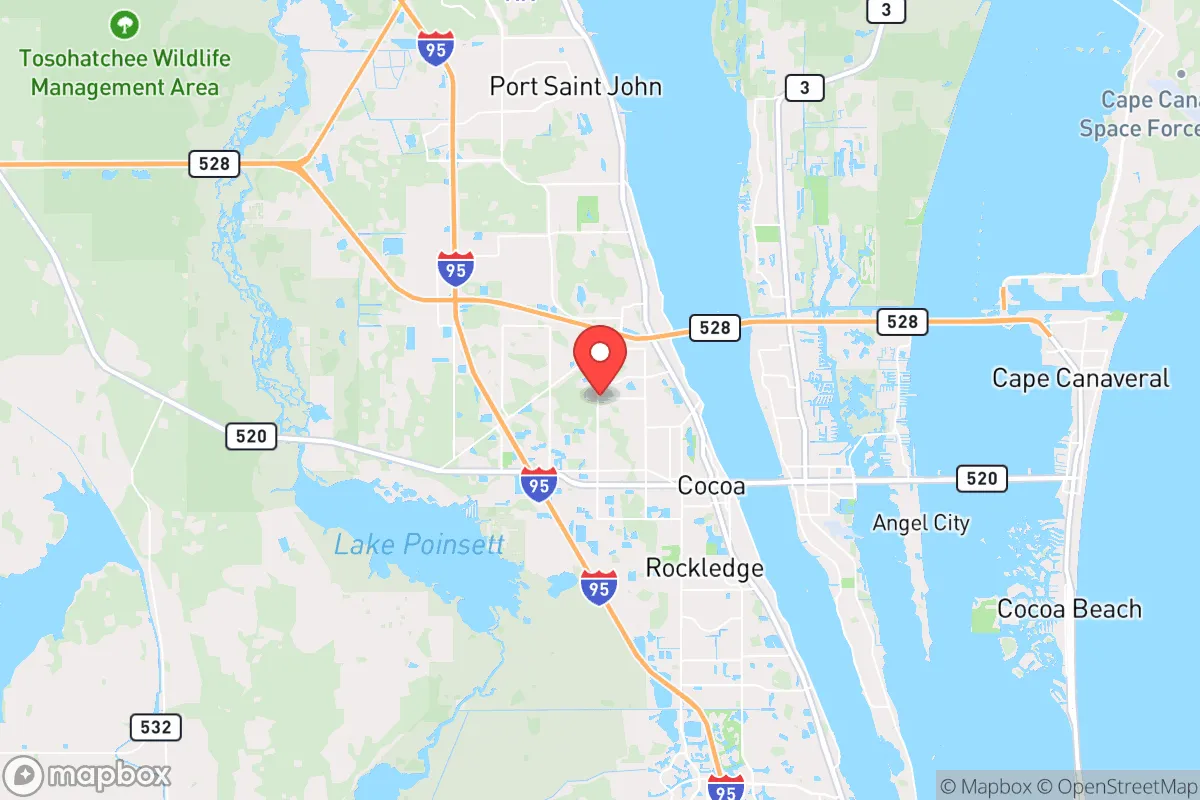
District shown is the primary district for this city’s centroid. Cities may span multiple districts.
Local Political AnalysisPolitical Analysis of Cocoa, FL
Cocoa, Florida, leans solidly Republican, with a Cook Partisan Voting Index (PVI) of R+11, meaning the area votes about 11 points more Republican than the national average. This isn’t a recent shift—it’s been a conservative stronghold for decades, driven by a mix of military retirees from nearby Patrick Space Force Base, aerospace workers, and a strong evangelical presence. The trajectory here is steady: while Brevard County as a whole has trended redder since the 2000s, Cocoa itself has seen a slight uptick in Democratic votes in the 2020 and 2024 cycles, mostly from younger transplants moving into the more affordable parts of the city. Still, the local political DNA remains deeply conservative, and that’s unlikely to change dramatically in the near term.
How it compares
Compared to the rest of Florida—which as a state has a Cook PVI that’s effectively neutral (lean Republican but highly competitive)—Cocoa is noticeably more conservative. The state overall is a purple battleground, with Miami-Dade, Orlando, and Tampa Bay pulling it left, while Cocoa sits in the red belt of Brevard County. Nearby cities like Melbourne and Palm Bay are also Republican-leaning, but Cocoa’s R+11 is a bit more pronounced than Melbourne’s R+9. For contrast, head west to Orlando (Orange County, D+10) or south to West Palm Beach (Palm Beach County, D+6), and you’re in a completely different political world. Even within Brevard, Cocoa stands out as more conservative than the beachside towns like Cocoa Beach, which have a higher proportion of retirees from outside the South and tend to vote more moderately. The real political contrast, though, is with the city of Titusville to the north, which is even redder (R+13) and feels more rural in its politics.
What this means for residents
For conservative residents, Cocoa is a comfortable place where local government, law enforcement, and school board policies generally align with their values. You’ll see “Trump 2024” signs in yards year-round, and the local Republican club is active and well-funded. For liberal residents, it’s not hostile, but it can feel isolating. There’s no real progressive infrastructure—no Democratic Party office in Cocoa itself, and most city council races are decided in Republican primaries. That said, the city’s growing diversity (about 30% Black and 15% Hispanic) has started to shift some local elections, especially in the historic downtown area. The practical effect is that conservative residents enjoy a sense of cultural alignment, while liberal residents often find their voice in county-level politics or through state-level issues like abortion rights and marijuana legalization, which have seen surprising support even in red Brevard.
Culturally, Cocoa’s political lean shows up in everyday life: gun rights are broadly supported, church attendance is high, and the local news is dominated by space industry and military news rather than coastal urban issues. There’s a strong “live and let live” vibe, but it’s within a conservative framework—don’t expect much public funding for bike lanes or arts programs. The biggest policy distinction from the rest of Florida is that Cocoa’s city government is more hands-off on development, favoring low taxes and minimal regulation, which contrasts with the more interventionist approaches in cities like Orlando or Tallahassee. For anyone moving here, the key takeaway is that Cocoa’s politics are stable, predictable, and deeply rooted in the local economy—space, defense, and tourism—rather than the culture wars that dominate state-level headlines.

State Political ClimatePolitical Climate in Florida
State Political AnalysisPolitical Environment in the State
Florida has transformed from a quintessential swing state into a solidly Republican-leaning powerhouse over the past decade, with a registered Republican voter advantage of over 800,000 as of 2026 and a 13-point win for Donald Trump in 2024. The shift is driven by a massive influx of conservative-leaning transplants from the Northeast and Midwest, particularly into fast-growing metros like Naples, Pensacola, and The Villages, while the state’s Democratic base has become increasingly concentrated in a handful of urban counties. This isn’t your grandfather’s Florida—the 2020s have cemented a durable rightward tilt that shows no signs of reversing, even as Miami-Dade and Palm Beach counties flirt with becoming competitive again.
Urban vs. rural divide
The political map of Florida is a study in stark contrasts. The Democratic strongholds are essentially three urban islands: Miami-Dade County (though it shifted 15 points right from 2016 to 2024), Broward County (Fort Lauderdale), and Orange County (Orlando). These three counties alone deliver roughly 40% of the state’s Democratic votes. Meanwhile, the entire Florida Panhandle—from Pensacola to Tallahassee’s suburbs—votes reliably Republican, with counties like Santa Rosa and Okaloosa routinely delivering 70%+ GOP margins. The I-4 corridor, historically the state’s bellwether, has broken hard right: Hillsborough County (Tampa) and Polk County (Lakeland) now lean Republican, while Volusia County (Daytona Beach) has become a GOP stronghold. The biggest story is Miami-Dade, where Cuban-American and Venezuelan-American voters, driven by a visceral opposition to socialism and Democratic rhetoric on immigration, have pushed the county from a 30-point Democratic margin in 2012 to a near-tie in 2024. Rural North Florida, from Gainesville’s outskirts to the Georgia line, votes like Alabama—deep red and culturally conservative.
Policy environment
Florida’s policy environment is a deliberate, legislated expression of its conservative lean. There is no state income tax, a major draw for relocators, and property taxes are capped by the Save Our Homes amendment (3% annual increase for homesteaded properties). The regulatory posture is famously business-friendly: Florida is a “right-to-work” state, and Governor Ron DeSantis has aggressively preempted local ordinances on everything from minimum wage to rental regulations. Education policy centers on school choice: the state has one of the nation’s largest voucher programs (the Family Empowerment Scholarship) and over 700 charter schools. Healthcare is a mixed bag—Florida did not expand Medicaid under the ACA, leaving roughly 800,000 residents in the coverage gap, but it has a robust private insurance market. Election laws have been tightened: the 2023 SB 7050 restricted ballot drop boxes, banned ballot harvesting, and required stricter voter ID. The state also has a “stand your ground” self-defense law and a permitless carry law (HB 543, effective July 2023).
Recent policy direction
The last five years have seen a legislative blitz that touches every liberty a relocator might care about. On gun and self-defense law, Florida passed permitless carry in 2023, allowing any adult legally able to own a firearm to carry it concealed without a permit. On parental and education rights, the Parental Rights in Education Act (HB 1557, 2022) restricted classroom instruction on sexual orientation and gender identity through third grade, later expanded to all grades. The “Stop WOKE Act” (HB 7, 2022) limited workplace and school diversity training. On speech, the state has targeted social media platforms with laws requiring content moderation transparency (SB 7072, 2021), though parts have been blocked in court. On privacy and surveillance, Florida banned TikTok on government devices and passed a biometric privacy law. On medical and bodily autonomy, the state enacted a six-week abortion ban (HB 5, 2023), with exceptions for rape, incest, and the life of the mother. On property rights, the “Live Local Act” (2023) preempted local zoning to allow affordable housing development on commercial land, and the state has strong eminent domain protections. On taxation, the legislature has cut the corporate income tax rate and periodically offers sales tax “holidays” for disaster supplies and back-to-school items. On voting and ballot access, the 2023 law requires voters to request mail ballots for each election cycle (no permanent mail list) and limits drop box hours.
Civil unrest & political movements
Florida has seen its share of political flashpoints, though large-scale civil unrest has been less common than in states like Oregon or Minnesota. The 2020 Black Lives Matter protests in Miami, Orlando, and Tampa were significant but largely peaceful, with curfews imposed in a few cities. The state’s immigration politics are front and center: Governor DeSantis has bused migrants to Martha’s Vineyard and Sacramento, and the 2023 SB 1718 made it a felony to transport undocumented immigrants into the state, required hospitals to ask about immigration status, and invalidated out-of-state driver’s licenses for undocumented residents. There is no sanctuary city policy—the state has banned them outright. Election integrity remains a hot-button issue: the 2020 recount in Florida was smooth compared to other states, but the 2024 election saw Democratic complaints about the new mail ballot restrictions. Organized activist movements are active on both sides: Moms for Liberty (founded in Florida) has a strong presence in school board races, while groups like the Florida Rising coalition push for voting rights and economic justice. A new resident would notice the omnipresence of political messaging—yard signs, billboards, and talk radio are louder here than in most states.
Projection
Over the next 5-10 years, Florida’s rightward trajectory is likely to continue, though the pace may slow. The key demographic driver is in-migration: roughly 1,000 people move to Florida every day, and they are disproportionately conservative-leaning retirees and remote workers from high-tax states like New York, Illinois, and California. The Hispanic electorate, particularly in Miami-Dade and Osceola County (Orlando’s Puerto Rican hub), is trending right, though the Puerto Rican community remains more Democratic-leaning than the Cuban-American bloc. The biggest wild card is climate change: rising sea levels and hurricane risk could eventually slow coastal growth in Miami Beach and the Florida Keys, but inland areas like Ocala and Lakeland are booming. Politically, expect continued preemption of local progressive ordinances, further tax cuts, and a hardening of the state’s immigration and education policies. A Democratic comeback would require winning back moderate suburbanites in the I-4 corridor and making inroads with Hispanic voters—a tall order given current trends. For a relocator, the Florida of 2036 will likely look even more like the Florida of 2026: redder, more culturally conservative, and more business-friendly.
For a new resident, the bottom line is that Florida offers a policy environment that is deliberately aligned with conservative values—low taxes, school choice, gun rights, and parental control—while still providing a vibrant, diverse economy and world-class natural amenities. Liberal residents will find a state where their political voice is increasingly marginalized, especially in the legislature, but where local governments in Miami Beach, Orlando, and Tallahassee still provide some blue sanctuaries. The practical takeaway: if you value low taxes, limited government, and a culture that prizes individual liberty over collective action, Florida will feel like home. If you prioritize robust public services, progressive social policies, or strong labor protections, you’ll find yourself swimming against a strong current.
* Values derived from national, state, county, city and local statistics and may differ in a specific area. Last updated: 2026-08-22T17:11:04.000Z
Narrative content on this page is AI-generated and may contain mistakes. Verify any details that matter before acting on them.
ReloMaps may earn a commission from affiliate links at no extra cost to you.

